Download the PDF. The password is ” cmfeb2015## “
Download the PDF. The password is ” cmfeb2015## “
Download the PDF. The password is “cmmarchee”
Download the PDF. The password is “cmapril##”.
Download the PDF file. The password is “crgimay2016”.
Download the PDF. The password is “cmjune16”.
Hock Hochheim has taught force necessary combat strategies to citizens, the police and military all over the world in places like South Africa, Australia, Germany, Europe, The United Kingdom, China, Southwest Asia for the military and of course, other countries and throughout the United States. Hock has actually done more in real life than most people reputed to be…“ famous and experienced.” Currently Hock teaches hand, stick, knife and gun combatives in some 40 seminars in 11 or 12 allied countries a year.
Why you need to know the law to teach Self-Defence.
What is Self-Defence? Interesting question and I guess there are many answers. If you pick up a self-defence book from the 1980s you are likely to find a number of martial art techniques performed in street clothes.
It is now 2015 and I like to think that we are finally past the above concept. Self-Defence is much more about the non-physical aspects of a confronation and one of the categories included in the non-physical aspect is the law.
Although sometimes coined as the “second enemy”, as it comes after the confrontation, I like to view the law as an entirely neutral entity. For those who know how to use the law, it becomes a useful tool in ones repertoire. Sadly, for those who don’t know how to use it, the law can become a weapon against you.
If you are teaching self-defence but not covering the law, then I would strongly question how you base the effectiveness of your fighting techniques. Surely, if you are teaching fighting techniques that go against the legal principles in your jurisdiction, you cannot be teaching effective self-defence!
For example, if you teach a technique that uses excessive force as a legitimate self-defence technique, then you are potentially setting your student up to be arrested and charged with a criminal offence.
Sadly, there are martial art classes that teach these kind of techniques as legitimate self-defence techniques. Let me provide an example using UK Law.
Under UK Law we have law with regard to the amount of force that can be used. In our fictisious martial art class here in England, the teacher is showing a technique where an aggressors push is deflected and the defender elbows the aggressor in the jaw, followed by a snap kick to the knee, another elbow to the jaw, and neck crank to take the aggressor down to the ground, once on the ground the defender proceeds to stomp on the aggressors head until he is unconscious. At that point the defender then proceeds to stomp on the chest of the aggressor until his ribs are broken. The defender then mounts the aggressor and snaps his neck.
Now, I know I am being over-the-top but I want to make the point that the technique in the above paragraph clearly amounts to excessive force! Therefore the defender is not acting in self-defence for most of the technique.
How can that be taught as a legitimate self-defence technique if the legal defence of self-defence would not be available to the defender?
It is my view that it cannot. Whilst my example was rather obvious, there are many martial art clubs that train there students in techniques that do not comply with the legal system of that jurisdiction.
When I question this, I often hear it said that it is better to be tried by twelve than carried by six. I should note that is usually those who are a capable martial artists but have no knowledge of the legal system that make this claim. The proponents of this view are offering a false choice as well as incorrect choices.
Firstly they are equating your two choices in a self-protection conflict as being: on trial for serious assault or failing to defend yourself therefore you’re dead!
When I have brought this up to the proponents, some of them tell me the phrase is more metaphorical and it represents how it is best to win the fight and worry about the law rather than worry about the law and thus loose the fight and suffer severe injury. Here is where I feel the false choice is given. Proponents of this view do not give the third, and in my view best, option: – it is entirely plausible and possible to defend yourself both physically and legally without worry of being carried by six or tried by twelve.
Also, whilst the physical consequences of a violent confrontation are not to be downplayed, the consequences of loosing the legal battle can sometimes be a whole lot worse.
Think about it for a moment, imagine you defending yourself but your lack of knowledge of the legal concept means you did not act in self-defence or were unable to articulate that you acted in self-defence and this ends up with you being convicted of an assault against a person.
This could result in prison time, loss of your job (including the difficulty of finding a new job once released), not to mention the financial, family and relationship issues that are likely to occur.
In todays information age, I see no excuse for martial art instructors who claim to teach “self-defence” not to actually teach the legal aspect. There is so much information at our fingertips and just as we wish to provide the right physical training to our students; we also need to be provide the right legal knowledge to our students so that they have the ability to avoid the consequences of the law.
Once a clear understanding of the law is combined with effective fighting techniques, we can produce students who have the ability to defend themselves physically and legally.
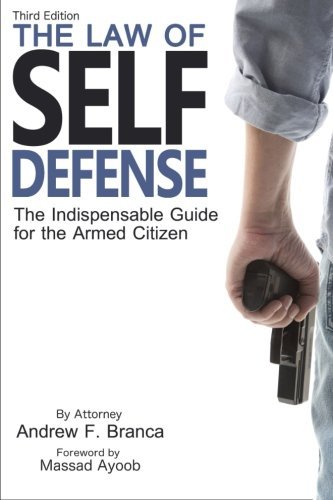
Recognizing that Conflict Manager has an eclectic readership from many countries and with many interests, a book on the legalities of self-defense focused on firearms and specific to United States law may have limited appeal. That said, most of the board members of CRGI know each other through the personal protection community and self defense is a subject that has touched all of our lives. Also, The Law of Self Defense is a good and important book.
That’s the most salient thing. If you have anything to do with self-defense, either as a student or an instructor, the legalities are important. I’d go so far as to say it is negligent to teach self-defense in any form without a solid grounding in force law.
Let’s dispense with something right away. The old saw, “I’d rather be tried by twelve than carried by six.” For those unfamiliar it means, “I’d rather go on trial than be killed.” In logic, this is what’s called a “False sort.” How about surviving AND not going to prison? Embrace the power of and. There are also a few who will argue that thinking of legalities in a deadly force situation will paralyze you. I disagree. Every thinking person knows that there will likely be legal consequences after a violent encounter. It is my experience that, when a problem is known to exist, ignorance creates a deadlier freeze than knowledge.
The Law of Self-Defense takes an intimidating subject, one that has a long history, with sources written in obscure legal language, and nuanced over many jurisdictions and makes it accessible. Practical. It was actually kind of fun to read. And I never got the feeling it was dumbed down.
The chapters take important concepts like, “What is innocence?” and breaks the concept down into common sense language. And gives actual incidents. And quotes relevant case law. At the end of almost every chapter, there are tables that give the exact wording for the specific aspects of law discussed in the chapter for all fifty states. Well written and concise overviews combined with stories and combined with technical details makes a powerful and simultaneously easy to grasp tome that should be on the required reading list for self-defense instructors, students and anyone who carries a weapon.
Branca gives the legal details of a perfect world, but also gives the gritty details of how the cases sometimes go. It’s not always pretty, and that should keep you cautious. Caution is usually a good thing.
Read the book. For an understanding of the legal principles, for an understanding of the legal process (from arrest to booking to trial and the civil side as well) and for the keys to planning a legal strategy well in advance, read the book. If you intend to teach self-defense and want to answer your student’s questions, I don’t know of anything better available.
Editors note. This review pertains to the second edition published in 2013. The third edition is now available.
Jordan Tabor is an American martial artist and security guard. After beginning training in 1999, he would spend the next fifteen years developing his technique and his understanding of violent conflict. He has taught his martial arts at many prestigious schools, including Harvard and Anapolis. He currently teaches grappling and self defense in the Boston area by day, while working security by night.
Born in 1969, Richard Dimitri began his martial arts training in 1975. By the age of 21 he’d acquired instructor certifications and black belts in several forms of martial arts and hand to hand combat disciplines which lead him into various careers that spanned over 2 decades in the fields of private and personal security, bodyguard for high profile clients and doorman. With his training and experience, Richard began researching & formulating a personal methodology of close quarter combat and personal defense predicated on human behavior and the psychology of violence.