ADRENALINE AND FIGHTING! TO SELL A CURE? YOU NEED A POISON.  – Hock Hochheim   

In Vietnam, an average “bungle in the jungle” tour of duty lasted 12 months, and one year is still the common trip length in many overseas situations. There were studies written on this and the Nam subject. The studies broke the 12 month Nam tour down into three effectiveness periods. The first period of approximately 4 months, the classic “FNG” (commonly known as the “fucking new guy”) was considered to be a rookie, new and rather worthless. The next four month period was his best as he slipped into the educated, operating groove, was properly alert and reasonably experienced. And the last few months were said to be his downhill slide! “Worst?” Because he was getting “too use” to the danger, less alert and more complacent.

In general, the average troop was at first – a little too scared and inexperienced. Second, in the groove. Then, third not scared enough. What does this have to do with adrenaline you ask? A lot. Adrenaline and fear factors into each of those periods and the overall assessment.  Stand by.

To sell a cure? You first need a good, scary poison. Adrenaline has become that poison, a boogeyman in martial training the last three decades. The very term itself – adrenaline is a bit of a catch-phrase for several, chemical hormones. It would be hard for me to pinpoint when the craze happened or who did the very first smear campaign. But, some people back then, must have read these and other reports, and saw an opportunity to sell martial training from a different marketing, angle. Who? In general, it was the first wave of these so-called, reality-based, self-defense, (RBSD – a redundant term I still dislike) people with their then, newer and cooler programs.

Amongst this crowd, they preached that every hesitation or false step, every human error, every problem a person had small or big, whether they were ambushed or not, came as a result of the evil adrenaline, robbing your vision, your hearing, your ability to think, act and perform. Adrenaline they claim, made you a big, slow, numb, gross motor dummy, pooping and peeing in your pants, etc. with very “boo,” This concept, this pitch was used to dumb-down training, dumb-down expectations, lower achievements and programs to a barest minimum…and sell them. Quicker is better because all people are reduced to babbling idiots in fights anyway.

So yes, the first wave of the adrenaline wonks appeared on the scene about two, almost three decades ago. They came at you hard, with the “real deal,” “insider’ sales pitch and a “holier-than-thou” smell.

“Step right up ladies and gentleman and see the wonders of human biology destroy your chance to survive any encounter. But Wait!  Wait! Right here in my hand is this elixir. The cure. If you adopt my form of training you will survive. Drink my potion, you will overcome this Frankenstein and fight off your enemies with a new found confidence and skill.”

To sell a universal cure? You need a universal poison. That poison was adrenaline. But is adrenaline really such a poison? Ask any number of doctors, like Dr. Veronique Mead for one. “The adrenaline response has a number of very specific effects aimed at maximizing survival, mediated by circulating epinephrine and cortisol (Braunwald et al., 2001). These effects include a state of heightened alertness, increased energy with which to meet a potentially difficult situation, and augmented muscle strength (Ganong, 2001). In preparation for battle, chemicals are released into the blood to facilitate clotting, and blood vessels in the skin are constricted to prevent heavy blood loss in the event of wounding (Ganong, 2001). Similarly, blood pressure and heart rate increase and the kidneys retain water, all in support of tissue perfusion and the maintenance of fluid volume in the event of sweating or blood loss (Ganong, 2001). In addition, the spleen deposits red blood cells into the blood stream in order to increase oxygen delivery to muscles (Juhan, 1998), and pupils dilate to let more light into the eyes in order to increase visual acuity (Ganong, 2001).”

Okay! Got that? Quite medical. All of this got screwed around to the negative. “Zero-to-sixty” shocks can be negative, sure, but zero-to-sixty somehow became the standard definition. Also, people have misconstrued terms. Audio exclusion, for example, doesn’t mean “losing all hearing,” or “going deaf.” It can mean (and technically does mean ) “focused” hearing, or tuning out distractions. Same thing with vision. When you focus in on the TV set you are not seeing the pine tree plant in the corner of the room. The same thing in a gunfight. When you focus in on the gunman or the gun in his hand, you fail to see the garbage can on the street corner. That does not mean adrenaline is robbing your vision, or stealing your hearing.

Long term, like an overall tour of duty, or short term like a very sudden, surprise blast of activity, if you are over-adrenalized, your performance may not be so good, such as the new, green soldier. If you are reasonably adrenalized, your performance is peaked, and if you are under adrenalized, your performance might be less than hoped for. This below chart comes right out of sports performance textbooks. Performance trainers and coaches have long understood the relationship between what they have called “sports arousal” (adrenaline) and the experience of the athlete.

performance

In this physical performance chart prepared by professional sports trainers Daniel Landers and Stephen Boutcher If someone is barely aroused, he is barely adrenalized and not at all stimulated by much adrenaline, if any? He is not excited enough to benefit from the adrenaline boost. Nor should all the proposed ill-effects that naysayers attribute to adrenaline be present. So, you cannot blame adrenaline for actions of the under-aroused. If he screws up? He’s on his own. All the proposed negative effects of adrenaline really occur at the very far end of the curve, when the person might suffer from a high, “over” stimulus, matched with a host of other factors too, like physical health and situational factors. In fact, in this whole continuum, poor performance and high over-arousal constitute a small, extreme part of this bell-curve chart that not everyone reaches.

This chart above will apply to police work, as well as sports, or any dangerous endeavor. We eventually get complacent. We get lazy. We get careless. By understanding both charts, the short term and the long term, an understanding and a training model develops. It is largely about desensitization. First it’s good. Then it’s bad. In the beginning, you get this best only through experience and then second through repetition training in a realistic setting. But you cannot get too desensitized.

“In the beginning, it is all about desensitization. First it’s good. Then, it’s bad. You get this best through experience and then through realistic repetition training. But you cannot get too desensitized!”

It is scientifically clear that performance is best when a subject is aroused than not aroused, and best when he is moderately adrenalized/aroused, the center of this bell curve. This is true of my own personal experience. I have never felt more alive and more alert, and more clear thinking in many, if not most of my dangerous police times. Being adequately nervous is a good thing. They once asked Frank Sinatra when in his 80s, if he still got nervous when stepping out on a stage after six decades of performing. He answered, “of course I do. I need to be nervous.” Of those dangerous and, or challenging moments in policing? I miss them greatly. I miss them the most.

Poor performance may occur from a host of specific reasons. Pain. Surprise. Confusion. Shock. Ambush. Exhaustion. Anxiety in the long term. Emotional rather than intellectual decision making. Distraction…., a whole host of short-term and long term wear and tear-down of a “tour of duty.” All situational reasons that may interfere with action. NOT JUST ADRENALINE.

NOT ALWAYS ADRENALINE. To lump all performance problems into one cause is to do a disservice to training doctrine. Once you recognize this truth, you can treat the real, individual poisons. A police officer may not think clearly just because she’s worked a double shift. A soldier may freeze just because he was cleverly ambushed. A citizen may not put their key in the door of their home fast enough when being stalked, not because of adrenaline, but because they have simply never practiced putting their key in their door very fast. You may not reload your gun fast enough simply because you haven’t practiced doing it on the ground, sideways and in the mud, as well as fast. It’s different. Doing things differently.

For myself, and I know for others too, it is also a “zero-to-sixty” issue. How dull and unprepared were you, the very few seconds right before to you were confronted with a shock or action? Zero-to-sixty responses are tough.  I have always done best when I have been a stage or level of being “half-adrenalized,” for lack of a better description. This 1/2 stage invokes other topics like awareness and breathing and things so long, we shouldn’t cover them in this essay.

Here’s an example or a “twenty, or thirty-to-sixty” situation. Racer Tom Rockwell said, “When I raced motorcycles the adrenaline would start to flow on Wednesday for a Sunday afternoon race. What that meant on the track was that I had all the time in the world to make split second decisions when things went south. Your whole life doesn’t flash before your eyes; it just seems like there’s time to review it all.”

To best prepare for the race tracks of life? Use the who, what, where, when, how and why of life, use the latest intelligence to construct the problem scenario. Dissect what might happen. Use experience and research, and repetition training to explore the most probable occurrences on down to the least probable. This is the reverse engineering I have talked about for the last three decades. One of our oldest mottoes is “fighting first, systems second.” (And as Einstein said, “keep it simple, but not too simple!” And what was simple to Albert, baffles the rest of us. Simple is a relative term. Need I repeat that? Simple, is a relative term to you and your capabilities, stressed out or not.)

Training will help, but that’s not all –  “Culture, upbringing and environmental conditions will wire the frontal lobe in a unique pattern that determine can individual’s response to extreme stress,” says Dr. Kenneth Kamler, author of Surviving the Extremes.
The Self-Defense Hand, Part II – Marc MacYoung

The difference between theory and practice is in theory, there is no difference —

An anonymous joker

Last time I talked about how a lot of so-called self-defense training is like an airplane with crack in the wings you can’t see. While you’re parked safely on the ground (in the classroom) these potentially fatal flaws won’t reveal themselves. They’ll come to your attention when you’re a few thousand feet in the air.

Something I want to re-stress is: If nobody has ever shown you how complicated self-defense is, how are you supposed to know?

You’re not. That’s why we’re about to cover what’s next. At the same time, this problem has never revealed itself if you’ve never had to use your training. Or if you have used it without negative effects, you lucked out. I say this because these days I work in the damage control field of when your self-defense does work.

What I’m going to give you a check list for self-defense training. These are subjects that you MUST consider (or better yet have looked into) before you try to use your training. They will help you to be able to ‘tell where you are’ in the ocean of variables. That is what will allow you to scale your responses, adjust to different circumstances, and hopefully, help you get out of a situation before it goes violent.

More than that, if your training didn’t cover these, what you were sold is something else mislabeled as self-defense. Or, as is so often the case, it is only one aspect of many, but that has been over-emphasized to the exclusion of the others. These are the issues you need to fill in the gaps in order for you to be safe and stay out of prison.

Hold up your hand.

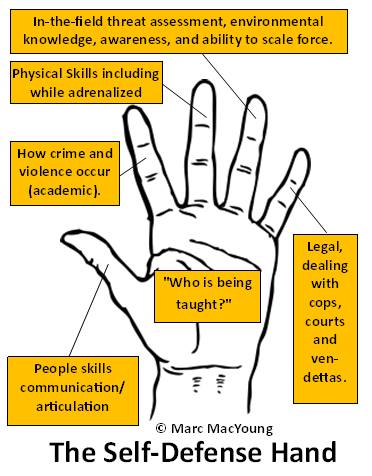
First off your palm is “Who is being taught?”  

There is no one-size-fits-all or one-stop-shopping when it comes to self-defense training. The needs of an older woman are different than that of a young man who is being bullied at school. Now for more depth, reread the last sentence, but replace ‘needs’ with ‘physical abilities.’ It does a small woman no good to be taught techniques that rely on strength and physical conditioning.  Another consideration is people from different backgrounds and environments. A person from the inner city is going to be facing different challenges than someone from suburbia. A police officer has different rules of engagement than a civilian, the ability to walk away (no duty to act) is a big factor in what that person needs to learn. So the question is, is what being taught appropriate (or useful) for that person? Personalizing this, the question is, “Who are you and what are your needs?” Not what you are afraid of, but what you need. This is especially means, ‘what kind of circumstances are you most likely to end up in?’

Like in real life, the palm serves as the basis for everything the hand can do. Also to further the analogy, the fingers work together with each other and the palm. Without this cooperation, much less the presence of these  multiple components, a finger is, by itself, useless.

The palm sets the needs, abilities and capabilities of the person. The information must be scaled to and appropriate for the person. For example, don’t try to teach a 110 pound woman to box and call it ‘self-defense.’ A larger, stronger man will pick her up and throw her like a dart. Does she need to know how to effectively hit? Yes. But only as small part of a larger, more effective strategy.

The thumb: People skills, communication/articulation

Simple truth, most violence can be avoided by good people skills. While there are folks out there who will rob you, there are a lot more people who will physically attack you for pissing them off.  The people who get into the most violence and conflicts tend to fall short in this skill set. Often in the form of giving their emotions priority. Seriously I’ve seen people flip others off and then squeal they were attacked for ‘no reason.’ And they sincerely believed it too.

Knowing not how to provoke people is a skill. A skill based on understanding how people work and not doing certain things — no matter how justified you feel, how much you want something, how emotional you are or how much of a hurry you are in.

Here’s an example, most violence comes with instructions on how to avoid it. It’s a pretty simple contract, do or stop doing ‘this’ and violence will not occur. In a super majority of the time these instructions are legitimate. “Shut up or I’ll kick your ass” is pretty straight forward contract. However, many people personalize it with “How dare you try to tell me what to do” and instead of shutting up, proceed to comment about the guy’s testicles on his mother’s chin. Then they blame the other person for being unpredictable and not living up to the contract. No, a serious lack of understanding human nature — including your own — is what got your nose broken in those circumstances.

A big advantage of — and why it’s the thumb — people skills is how useful they are. Not only will they help you keep from having to use your self-defense training, they’ll help you get through life, relationships, and job much easier. This wide application takes it outside the realm of just self-defense and makes it a life skill.

Another life skill is communication. Communication is really important for people skills, but it’s also important to let someone know they’re crossing lines. Articulation is a subset of communication, but it’s what is going to keep you out of prison when it comes to explaining to the authorities why what you did was self-defense and not illegal violence. (We’ll come back to this.)

The index finger: How crime and violence occur (academic)

Let me ask you some questions, where did you get your ‘knowledge’ about how crime happens? How about how situations escalate to physical violence? What is your baseline to identify the danger you’re supposedly training to protect yourself from? (Hint, odds are it’s more Hollywood based than you realize.) With those questions comes another. “How can you effectively defend against, much less avoid, a danger that you have no idea how it manifests?”

Violence and crime comes in many forms. Yet, entirely too many people think of violence in terms of what they’ve seen in the movies and going back to a high school fight. In fact, a lot of training prepares you to win that high school fight.  Still others are training to ‘win’ in the situation they perceive they ‘lost’ before. That skews one’s perspective. Knowing how both violence works and what developing crime looks like is a key element to assessing danger. Also being able to articulate why you ‘reasonably believed’ what you were doing was self-defense. (Remember I said the fingers work together?)

I’m also going to put something in the ‘academic’ category you need to not only understand, but be able to apply out in the field. That is to ask: What threat assessment model do you know? I really don’t care if it’s Ability, Opportunity, Jeopardy (AOJ), Intent, Means, Opportunity, Preclusion (IMOP), Jeopardy, Ability Means, (JAM), The Five Stages (Intent/Interview/Position/Attack/Reaction) or Ability, Opportunity, Intent (AOI). This is the kind of academic knowledge that can save you. It’s not just in the field, it’s during the aftermath (a.k.a. not being arrested and put into prison).

The middle finger is your physical skills.

This is both the finger that most people focus on giving to their attacker and –at the same time — it’s usually broken.

One of the ways it can be broken is you have to ask: Do the mechanics of what you’re doing actually work? For example, there’s a whole lot more to a punch than just sticking your arm out with a fist at the end. Unfortunately, the way most people are taught, they’re doing the latter and calling it punching. This isn’t the search for the mythical ‘right way to punch.’ I’m talking their punches do not have the mechanics to deliver power — this especially under the stress and whirling chaos of a conflict.  What should be a hard punch, loses enough power that it becomes basically a slap.

Another example, is do your blocks actually work? Or would a dedicated attack crash through them? Kind of an important question that. While we’re on the subject, can you hit the target that you’re shooting at — especially when you’re scared, moving and adrenalized? Remember kiddies, every bullet comes with a little lawyer attached and you’re still responsible for the damage any bullet you sent out that misses the intended target.

A second common ‘fracture’ is do you know when to use a move and when not to? For example, do you know when it’s safe to kick at a charging opponent and when it isn’t? (Hint, it depends on the kind of kick and where you’re standing.) Do you know when it’s time for empty hands and when you need to be going for a weapon instead? (This is the failing woefully I mentioned.) When it comes to physical application, every move you know has a time, place, strengths and weaknesses. Did they specifically teach you that? Just knowing a move doesn’t automatically mean you were taught these elements of application.

A third way you can have a broken finger is if you don’t know how to scale your force.  As I often tell people, when your mother tells you to “Go handle Drunken Uncle Albert” at a family reunion bone breaking techniques or fatal damage moves are a bit much. (Besides, Aunt Bessy would be pissed.) At the same time, submission techniques aren’t something you want to try when five guys are jumping you.

End Part II

Dimorphism Matters – Garry Smith and Jayne Wharf

Jayne Wharf and Garry Smith are editors of Conflict Manager magazine and directors of the Conflict Research Group International. We are both senior instructors in Ju Jitsu, Jayne is currently training in preparation for the 3rd dan grading and Garry his 4th Dan. We both teach realistic self defence but from very different positions, literally.

Jayne stands 5’2½” tall and Garry is 5’9”, she weighs 8st, he just under 15st. We regularly grapple, spar, brawl and ground-fight together and with others, it is what we like to do, but mostly we train and teach together. Difference in size due to dimorphism matters, we need to take it into account when we train. Sexual dimorphism is the condition where the two sexes of the same species exhibit different characteristics beyond the differences in their sexual organs. Size, muscle mass etc. Both of which will influence the outcome of a violent conflict.

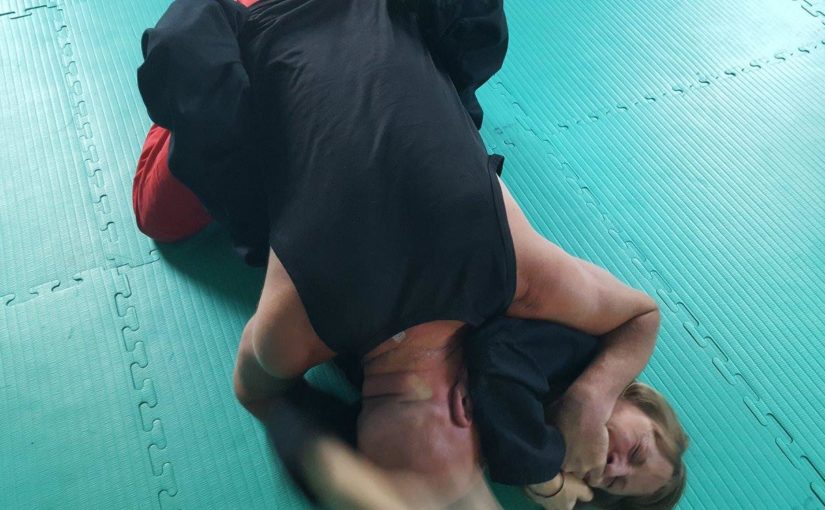
Recently we have see certain ground-fighting techniques, pretty technical ones, being promoted as good self defence for women. They are not, they are unrealistic, easy to counter and will not work against a committed attacker who knows what they are doing. We know, we train this all the time. When we were doing a demo for our juniors last week, I thought we were just showing a few moves nice and steady, so it was a big surprise when Jayne came at me like a hell-cat. It took me a good minute but I eventually got on top of her and pinned her. We were both red faced and puffing and panting. We did it again a few days later for a different group of juniors, similar outcome but this time she got her guard in so tight on my ribs I involuntary farted, I quickly tried to blame Jayne but the kids knew it was me. Red faced again.

So in light of seeing BS techniques peddled as good SD, and what we do when we train, we decided to have the following conversation.

In our training session last Monday we had a short, but intense, ground-fight on the mat. The purpose was, if I remember rightly, for you to show the juniors that you need to fight aggressively against a bigger stronger opponent, not that you warned me. We have trained together for some time now, given the imbalance in size and weight why do you keep doing this?

JW: You’d like me to say it’s because I like it … haha. The purpose on Monday was as you say to show the juniors that no matter if you’re the underdog (in particular the girls) you still have a chance if you have heart. Your brain may well be telling you you can’t win, but you have to push that aside and at least try, don’t give in before it all kicks off.

Why do I keep doing it? For me personally it’s extremely rewarding. I get an opportunity to test what does & doesn’t work on someone who is bigger, stronger (dare I say it without offending you?) heavier than I am. I’m taking about the ‘cheats’ here because there is no way I would win if I played ‘fair’, so I don’t. I have to use my whole body to create the tiniest amount of movement, but with every small adjustment I may be gaining a long term advantage. I can promise you by the end I am absolutely exhausted, but this is the second reward, with each bout I not only gain information I also improve in fitness and strength.  

GS: As I said earlier I am almost twice your weight, No offence at all, it is as it is. OK so each fight allows you to ‘probe’ more is that fair?


JW: Yes, no two bouts are the same. I always have to push aside the ‘I’m going to lose mentality at the start. I pretty much take it a stage at a time pulling on what worked last time where I can. I don’t forget the stuff that didn’t work, I will have thought about ‘why’ these didn’t work probably on a dog walk. If I have a possible ‘solution’ I may try that. I can’t plan ahead as such but I can prepare. Sometimes I have ‘something’ in mind that I want to try & I will attempt to manoeuvrer my way into it. I do listen to my mentors & will always try out their suggestions even if initially I think it’s not appropriate for me; I’ve been proven wrong many times…so again another lesson – don’t assume you know better…that’s good coming from someone who as you know knows everything … hahaha.

GS: OK so what is it like fighting as a small woman against a nasty violent bigger man?

JW: I don’t know what that’s like now. Fighting against you is extremely awkward, but I know

you, you’re not the ‘nasty violent bigger man’. I met the nasty violent bigger man years gone by & I promise you I would annihilate the chap I have in mind if I were to meet him today. So for me all the training over the past few years is working for me. Fighting against you & the other fellas in the club is rewarding….smelly, sweaty, exhausting, but rewarding.

GS:that is good to know. The thing is we know we train within safe parameters. We cannot bite, gouge etc. We do dirty fighting drills but I struggle as a man who would just go brute punching, to use such tactics, how can we do these things, should we?

JW: I personally have no desire to inflict injury on others or myself in the name of self defence, so I would say ‘no, we shouldn’t’. As a club we already go way further many other as you know & I am happy with that level. If you want to encourage women to learn (as I think we should) then that’s not the way to go, we don’t want to frighten them away before they even try. I have also seen that for those who want to go that extra mile likewise we will make it happen; I’m thinking of you & Johnny here.

GS: Well you surprise me a little here, You are quite aggressive in your application of technique in Ju Jitsu and very aggressive in our Self Defence training to the extent that I am incredibly proud of you if that is not patronising.  For the reader Johnny and I have both had more than a few street/pub fights (with others) and we like to go for it a bit when we glove up.

JW: What can I say is I like to show heart. I’m in training for my 3rd Dan and know that I need to exhibit the techniques above the expected standard…that and perhaps I just like to occasionally inflict some pain on yourself & Lee, John…well all of your really.

GS: I think you do that and achieve a gold standard, to be honest there are times your face looks like you want to kill. Now do not play that down. Most women cannot do that. Sometimes I look up after you throw me and you are raining in punches and knees etc., all pulled of course, and it is scary. What are you thinking when you do this?

JW: Honestly? Not much other than … it’s hard to put into words. There’s a mixture of as a trained Ju Jitsuka wanting to show a fantastic ‘finish’, as a coach wanting the students to see how ‘we’ want them to exhibit a technique and then …this is where I go dark…. What I want to do to past & any potential attackers.  

GS: That is interesting, as instructors we demonstrate technique after technique, Recently we have been showing people full mount, side mount etc. as part of our ground work.  When we demo fights it is fun and you come at me full on. As you said I think that is excellent for the kids, especially the girls to see. WE want them to cheat, how do you feel about videos that show complicated technical chokes?

JW: First things first, I ain’t full on (haha) I go the extra mile but I have more in the tank trust me. Videos showing complicated technical chokes…it depends on who’s showing them, also the accessibility and target audience. These should not be out in the general public domain. They need governance.

GS: LOL so that is typical of you, not full on, well that will be sorted where you can go full on, I love fighting Johnny, I love fighting anyone in sporting fashion or for real, I love fighting you because you really go for it, so full on next time then. Thing is when we talked the other night you mentioned lack of feedback which I think was a fair criticism. Please explain to the reader what would help. For example whilst ground fighting the other night you used your knuckles in my left ribs, just digging them in on the blind-side. I can tolerate that but if you did it harder maybe it would shift me.  

JW: Yes, so I guess the point is just that. If I ‘try’ something I am always (I know you don’t believe this) conscious of not going over the top. Look I grew up with two hairy arsed brothers who took great delight on one hand being my protectors (and still do) then on the other tormenting me & hanging my upside down by one leg over the bannisters. So I’m heavy handed. What is helpful to me is to work out when & how I do need to push a bit further, make my response / counter stronger to have an effect on someone who is heavier, stronger, more stubborn etc etc. That said I still appreciate someone who is adrenalised who will not necessarily respond in the same way.

GS: OK you know how much I respect you as one of my senior instructors, my favourite training partner and dog walking companion. One last question, do you think you can take me?

JW: My brain says ‘no’. This is not just based on a feel, this is based on the fact you are in my opinion a fighting machine, trained & condition over many years. I may well be a tom–boy, but I’m not to that ‘gold’ standard. What I can say is it would be messy. I may not win, but I’d go down fighting.

GS: I think that is why I hold you in the deepest respect. I think you would  extract a great deal out of me so it would be a poor victory if we fought for real. We need to now explore how we can push the boundaries. You may be little but you always punch well above your weight. I think with the right circumstances and conditions you could wipe the floor with anyone, me included.

So, for once, I think you are wrong, you have the attitude, the aggression and the ability. I know, I have the ability to drop bigger, better guys, been there and done it many times. That is why I know you, given the window of opportunity, can cream me if you get that sweet shot in. You may be little but you are determined.

We need to work on some drills that take us further. You need to help me shape them.

By the way we have a no holds barred fight owing 😉 Let’s see what you have. Soon.

JW: Hummm now you mention it I did drop Lee (technical knockout apparently), doubled Pete over & made Bill see stars! I have made some great friends and learnt many things, not all self defence related, during the years spent training. I think a lot of women would benefit from just experiencing a tiny piece of what I/we as a club have experienced. There’s a lot they can learn and fun to be had alongside the calorie burning they desire.   

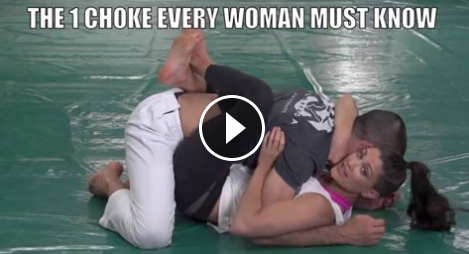
“Every woman should learn this choke.”- Well, should they really? – Erik Kondo

“Every woman should learn this choke.”– Well, should they really? The above statement is an opinion about the widely viewed “Gracie Choke” technique video to be used against sexual assault. It seems that a number of people agree with it. On the surface, it sounds reasonable. After all, why not? What harm does knowing something create? (Full video here)

But let’s deconstruct it and see what that statement really means.

“Every woman” really means “most physically fit women”. For example, women with only one functioning hand, or have limited grip strength, or are very young or are old are not the ones being considered here. A “choke” is a technique. “to learn” really means “to be able to learn and execute” “should” really means “because it will work” AND there is a reasonable possibility of needing to use it.

Therefore, we now have the opinion statement expand to say:

“So and So thinks that most physically fit women are able to learn and execute this technique AND there is a reasonable likelihood that they will be in a situation where they need to make it “work” AND it will “work” against most types of male attackers.”

When it comes to a physical self-defense technique, what does it mean to “work”?

In my opinion, the most useful criteria come from Rory Miller’s Golden Move, where the Move has the effect of:

  • Damaging your attacker
  • Weakening his or her position.
  • Strengthening your position.
  • Protects you from damage.

A technique is a sequential set of one or more moves. Therefore, a technique that “works”, has a high probability of meeting ALL of the above criteria.

  1. If it causes your attacker to be unconscious or dead, you have damaged him or her.
  2. If your attacker is unconscious or dead, you have weakened his or her position.
  3. If your attacker is unconscious or dead, you have strengthened your position.
  4. If your attacker is unconscious or dead, you are now protected from damage from him.

At first glance, it seems like the choke, meets all the criteria for “working”. But, not so fast, there is one more element to consider. That element is time.

According to the extended video it takes “6 seconds” for the technique to be effective. Is that an average of 6 seconds, where some people execute it in two or three seconds and others in 10 or 15 seconds against the “average” attacker? Or is that the minimum time it takes for a skilled practitioner to make it “work”?

Given that it is highly unlikely a scientific choke study was done to determine an “average” of 6 seconds. Most likely, it takes a skilled practitioner 6 seconds, and a less skilled practitioner longer. Is that 8, 10, 15 seconds or more? I don’t know, and my guess is that nobody else knows either.

The reason the time lag is important is because of what could be happening while the woman’s hands and legs are occupied with the technique and she is waiting for it to take effect. Assuming that the close body position doesn’t allow the attacker to engage in power full punching, it still does allow for the possibility that the attacker might be able to use his free body parts to:

  • Gouge and claw the woman’s eyes.
  • Crush her wind pipe.
  • Squeeze and choke her along neck with this hand(s).
  • Drive this thumb or fingers into pressure points in her neck.
  • Rip off her ear.
  • Drive his finger into her ear canal.
  • Drive his fingers into her nose.
  • Bite her, rip, and tear her flesh.
  • Dig his knuckles deep into her ribs.
  • Drive his head into her face.
  • Drive his forearm into and across her face and or throat.
  • Utilize short whip-like facial strikes.
  • Reach and deploy a concealed weapon such as a knife or other sharp object.
  • And other types of related of close quarter infighting attacks.

All of this could be done in the time it takes for the technique to take effect. In reality, during this time period, it is probable that

  • The attacker is not damaged.
  • The attacker’s position is not worsened.
  • The woman’s position is not improved.
  • he woman is taking damage.

In this case, the technique meets all the requirements for being the exact opposite of a Golden Technique.

When someone is being choked in a real life confrontation, they have no idea of whether the choker is only trying to knock them unconscious, or is actually trying to kill them. Therefore, someone who is being choked is likely to be “fighting back” for his life and will use any and all means available.

Choking requires taking away excess space which means getting very tight to the person and limiting his movements. The woman must cease her escape response and focus all her efforts on attacking. That requires a mental switch from fear based “get away” actions to anger based “attack the attacker” actions. In the situation envisioned, the attacker now no longer has the option to willingly stop his attack and disengage. He is literally being forced to stay and engage in what could be a life or death struggle.

If the attacker’s actions cause the woman’s choke to fail, she is now positioned very close to him. And she has likely expended a great deal of energy in trying to make it “work”. What is her next option? Instruction of a technique is incomplete without addressing what to do if it fails.

The next question is “How exactly is this technique learned?” This is a physical technique that requires repeated physical practice to learn. The student has to learn proper hand position and wrist extension. She needs to understand the proper angles of to apply force. Some people will take much longer than others. But everyone will need lots of practice time.

Regardless, to become reliably proficient, she would have to practice it against a wide variety of men of different weight, neck sizes, and musculature. Fat necks, thin necks, skinny necks, muscular necks, sweaty necks, heavy shirts, light shirts, tight shirts, loose shirts, sweat shirts, dress shirts are some of the types of men and clothes she needs to practice against and with (and what about a person with no shirt?).

She also needs to be able to execute the technique in the scenario intended for its use. Since the choke is promoted as a defense against a stranger rape attack, for realism, she needs to practice with men who she is not psychologically comfortable training with. Men who can create the real fear and feeling sexually assaulting her. These men would have to violently force themselves on top of her and between her legs in order to create both the physical position and the mental stress required to realistically “practice” execution and condition her emotionally.

They would also have to resist in manner consistent with someone who thinks he is being choked to death. And as with many types of learned physical techniques, she would need to periodically refresh her skills for her entire life in order to not forget how to do it.

The final issue is whether this type of practice will cause her to fixate on a type of attack that is both statistically unlikely to happen and also doesn’t represent the type of sexual assault that usually does happen to women. The vast majority of women are assaulted by men they know or are in some type of a relationship with. They don’t actively resist, and they don’t report the crime. And in many cases alcohol is involved which impairs their ability to execute physical defense.

How will the choke be used in these circumstances? Remember, any choke comes with the possibly of causing death. In order to choke someone, you must be willing to take the chance you will inadvertently kill him or her. That reality requires a certain mindset and emotional state to use it in a conflict.

On the flip side there ARE a number of benefits from learning this choke that do apply to physical self-defense. But that doesn’t mean “every woman should learn this choke”. It means that some women who choose to engaging in this type of training may benefit in the following manner if they train realistically.

  1. They would realize that just like women, men vary greatly in not only in body type, but in willingness to endure pain and willingness to continue to attack when faced with determined resistance. This fact may seem obvious, but how would a woman who never engaged in head to head competition with a variety of men know that? Particularly, a woman who believes (has been repeatedly told) that all men are stronger than all women?
  2. They would realize that the manner in which this choke can be broken provides the key to counter-attacking in a real life sexual assault. All the nasty infighting tactics mentioned previously are effective ones for women to use if they find themselves in this type of situation. By understanding what would cause themselves to disengage their own chokes, they may understand what may cause their attackers to disengage their attacks.
  3. They would realize that what they have been told about learning specific self-defense techniques to deal with specific types of attacks is unlikely to help them. For most people, skilled based physical techniques are likely to fail under stress. But instinctive actions that have been conditioned under stress based scenarios have a higher likelihood of success.
  4. They would benefit from learning physical skills that require a combination of flexibility, strength, coordination, timing, and confidence. Skill building is generally very beneficial even if you never apply the skill in real life.
  5. As long as they know the practical limitations of their techniques, they will benefit from the learning process itself. Specifically, learning when NOT to attempt to use certain techniques is a valuable part of this learning process.
  6. Assuming realistic practice, they will develop the mindset and mental conditioning needed to have a greater chance of successfully resist an assault.
  7. They will be in a supportive environment with other women and men who all have the same goal of improving their ability to successfully defend themselves from a physical attack.

When it comes to whether or not “every woman (or man) should do something”. It is important to recognize who else benefits from what they all “should be doing”. Is it all women as implied, or is it really someone or something else?

There is a big difference between something being beneficial for SOME women and ALL women, because something that may help some women in some situations may also hurt other women in other situations.


The Self-Defense Hand – Marc MacYoung

The Self-Defense Hand:
Assessing if what-you-are-learning works for self-defense — and why you need to do it.

“Everyone knows what something means until there’s a problem”  

Paul Spiegal
Contract Attorney

There’s a dangerous problem about both learning and teaching ‘self-defense.’ Mostly it’s about what you don’t know you don’t know.

It’s not hyperbole to say this lack will result with you in prison, the hospital, the morgue or financially destitute. (If not you, then your students.) Here’s the catch, it’s a problem that doesn’t reveal itself until you actually try to defend yourself. Think in terms of a plane with a crack in the wing you don’t see. While on the ground, nothing looks wrong and the problem doesn’t manifest. What’s going to happen if you try to fly that plane?

That’s why we’re going to have to spend some time identifying these hidden cracks before you’ll understand the fix.  Starting with how many people don’t know what self-defense means.

“But, but I’m trained in self-defense I know what it means!”

Oh yeah? Is it a subject  or an action? If it’s a subject, what’s involved? If it’s an action, what specific action and in what context? Let’s get something straight right now. You know what you’ve been taught as self-defense — usually in class. Another factor is what you have ‘researched’ and decided on your own. (I used the ‘ ‘ because much of the available material come from marketing spun sources.) Those are an understanding of the subject. That’s not the same as engaging in a violent situation with the appropriate level of force. Levels and actions to remain within the parameters of self-defense. Outside of the classroom, the range or the dojo self-defense is a little more … complicated

How do you use the term ‘self-defense?’ Is it a noun or verb?  Many people think of it as a verb. It’s a type of action they think they’ll do. (Wait, self-defensing?) Yet, self-defense is in the dictionary as a noun. The subject of self-defense becomes an identifiable ‘thing’ — as in person, place or thing  You learn self-defense. You acted in self-defense.  But subjects tend to be complex. They involve lots of different things. However, your perspective changes if you think of it as a verb. Action is a whole lot simpler. All those pesky complexities disappear. In fact, you can start calling almost any action self-defense — and give yourself permission to do so. This regardless of whether they fit inside the parameters of the subject or not. When you don’t blur self-defense to allow become both a subject and  an action, you clearly see a distinction between learning about and doing. There’s also a difference between knowing and doing. These are some of distinctions many people have lost.

That’s why we have to track it back to your root definition. Oh sure there’s the general verb/adjective definition. It runs along the lines of “defending myself from an attack.”  But when you think about it, that’s actually kind of vague.  Starting with, what do you mean by ‘attack?’ I ask because you’ll find folks sticking in caveats and spins. For example, “Self-defense is using my training to protect myself from physical and emotional attacks.”

Hang on there. Is someone using harsh language at you the same as slapping you? Is punching you the same as someone beating you? Is someone trying to punching the same as trying to shoot you?  If the answer is ‘no,’ then using the same training as a blanket response is obviously a bad idea. If the answer is ‘well they’re all attacks’ (a qualified ‘yes’)  you’re dangerously close to shooting someone for slapping you. (Or saying something that provokes someone to punch you.) Stated this way, it seems ridiculous. Obviously everyone knows that’s not what self-defense is.  Okay, so what is self-defense then? And, more importantly, how do you apply it in the real world? What are some hard and fast standards you assess self-defense by?

Not so easy is it?

This goes beyond just ‘how much force do you use?’ It goes into what makes it self-defense (legal) vs. fighting, assault, manslaughter etc. (illegal). Just so you know, this is an area where subjective interpretation can really screw you up. It goes into when you stop using force (or cross into being the aggressor).  Most people have no clear metrics or understanding about what legally constitutes self-defense, threat assessment, the sort of situation that requires it, how they can put themselves into or get out of such situations or be able to avoid excessive force.  All of which have lots to do if what you do

  1. a) even works or
  2. b) if you’re going to be arrested later.

You’re in danger if you’ve never asked yourself, “Is what I’ve been taught really about self-defense?” This especially if what you’ve been taught has been mixed with sports, self-help or a social/political agenda. I recently had the unpleasant experience of talking to a women’s self-defense instructor who freely admitted she was relying on the man being arrested in any situation. That was why they didn’t include use of force limits or legal issues in what they taught women. Instead they encouraged women to go-all-out and told them it was all ‘self-defense.’ (Hint, you can knock him down, but you can’t jump up and down on his chest in your heels. The last isn’t self-defense.) Their instruction was predicated on the idea the police would always assume the woman to be the victim and arrest the man. (Rather disturbing version of ‘equality’ eh?)

With this in mind you need to ask is, “How do I assess if my response is self-defense?”  Well, that brings us to the quality, expanse and — most of all — focus of your training. Because the answer to that question depends on if your training is teaching how to do it. Unfortunately, most of the time the answer is “No it isn’t.”

Let me explain that. You can spend a majority of your training time learning (in depth) a particular aspect, but that doesn’t mean you’re getting other — relevant — information about self-defense.  (For example, all your tactical shooting training doesn’t teach you when to shoot.) Once you begin to search for some kind of standards about what is and what isn’t self-defense is all sorts of  previously invisible information comes onto your radar.  When that happens you realize ‘acting in self-defense’ is not as simple as you thought it was.

Let me give you an example of relevant information you’re not being taught about self-defense. Tell me: Where all these attackers you are training to handle are coming from?  Well obviously, the simple answer is ‘They’re bad guys intent on hurting me.’

From an internal perspective that seems self-evident and obvious; except from an external standpoint it’s not that simple.  Starting with how do you know you’re not aggressing on him?  It’s not as black and white as you might think. Remember I used the word ‘subjective’ a little earlier? Here’s something that seriously influences it. A fellow by the name of Les Carter talks about the three core sources of anger

1) Preservation of essential needs.

2) Preservation of self-esteem and

3) Preservation of core beliefs.

While the manifestations are many, that mechanism is simple and pretty universal. You feel these are threatened, anger occurs and you act to < dramatic drum roll > defend yourself.

In case you missed it, that mechanism is the same for someone you call the ‘aggressor’ as it is for you ‘defending yourself.’  When you’re emotional, you think you’re defending yourself — even as you’re attacking. Spelling that out: When it comes to MOST violence, he thinks he’s doing exactly the same thing you think you’re doing; namely defending himself, except from you. And maybe he is because you’re so scared, hurt or angry, you are actually attacking.

That’s why it’s important to look at your actions from other than an internal perspective. You need to know if you are, in fact, aggressing against him while telling yourself it’s ‘self-defense.’  Believe me when I tell you crossing that line is a lot easier to do than you might think. Well, isn’t that awkward? Here’s the real unpleasant part, unless you know the ‘fingers’ I’m going to talk about in the next installment — and apply them — there’s a damned good chance, he’s partially correct.

Here’s the bad news, from an outside perspective you have him, any other witnesses testifying and possibly video of your participation in the creation and escalation of the conflict. That’s not self-defense. It’s a crime. In fact, this makes YOU the bad guy. Which if your so-called ‘self-defense’ training works, you’re going to get arrested. If it doesn’t work, you have other problems …

So what is self-defense? Where does the rubber hit the road with nuts-and-bolts standards, considerations, metrics and limits? This especially becomes important in doing it out in the real world. That’s where you can be put into prison or killed if you get it wrong.  Now the really bad news. Odds are you were taught sets-you-up for those results. Largely, not because of what you were taught, but what you weren’t taught.

Remember when the answer to ‘what is self-defense’  had answers like “defending myself from an attack”? And why that’s not such a viable answer?  (A more viable answer is “The appropriate level of force needed to keep you safe from an unprovoked attack,”)

Until now, that definition wouldn’t have made as much sense.   So why is this so hard to understand? Two reasons.

One of the reasons is all the instructors out there who are peddling whatever it is they teach AS self-defense! Martial arts, mixed martial arts, knife fighting, shooting, empowerment, self-help, cardio and fitness … it’s all self-defense, doncha know?

No. No it’s not. But you won’t find that out until you’re getting arrested, or a fist crashes through your block and breaks your nose, or the back of your head is being jack-hammered off the concrete or you get jumped by six guys because you were ‘ready’ to fight only one.  Wait, what? Is it really that bad? Yeah. In fact, it’s worse than you know. That’s why I’m writing these articles. Remember that fuzzy definition of self-defense?

Because it’s so vague, in the classroom/dojo/gym almost anything can be peddled as self-defense training. You wouldn’t believe some of the things I’ve heard instructors calling ‘self-defense.’ And they do.

When you come out and ask “Is what you’re teaching self-defense,” you will have people who insist it is — regardless of what they are teaching. You’ll usually find they’ve changed the definition of ‘self-defense’ to specifically mean what they are teaching.  (This especially in self-help, empowerment training.) That’s why you need to have a better definition, other wise you’ll be sold a bill of goods. Or, going back to an earlier analogy you won’t know until you take off your wing is cracked.

If you press by asking ‘how is it self-defense,’ most often what you’ll get is “Well it’s not exactly self-defense, but it can be used for it!” Sure, and a cattle truck can be used to haul kids to soccer practice too. It’s just not as good as a mini-van for the job.  Are they lying? Well no. It can be modified, but then the question is are they also teaching you how to modify it? To make it work, you’re going to have to tweak it differently  for out in the street… or in the living room… or at a bar… or in a parking lot at  two a.m. against multiple attackers. That’s allowing that it can be modified that much. That’s one hell of a big allowance.

Here’s where things can get a little … tricky. Often what is being taught by a particular source is exclusively a single aspect of self-defense, such as physical. This can be likened to a single finger on a hand, important, but not all there is to the subject of self-defense. Nor is the one aspect the key element of self-defense (e.g., all you need is the physical).

Nobody knows the whole of the subject of self-defense. And while we’re collecting ‘nopes,’ even allowing for specialization in one aspect, nobody knows all of that either. Pick a topic out of the  aspect of physical. Any topic, shooting, empty hand or knife. You can learn a lot at a particular school. There will come a time when you’ve learned all that you can in that school, but that doesn’t mean you know all there is about the topic. That’s how big even these smaller topics are. I recently watched a SWAT team commander learn a new pistol grip from a female firearms instructor. The grip compensated for long fingernails. The man can shoot like nobody’s business, but acrylic nails wasn’t something he’d considered, much less had a solution to.

Another issue goes back to why I came up with the idea of the self-defense hand. That is often what is taught is small tidbits of different ‘fingers.’  There’s a lot of important information being left out. This is where things get really muddled. There are subjects that have relevance to self-defense, but that doesn’t make them self-defense. For example, there are certain people who have be convinced they are ‘worth’ defending themselves (a common issue among abuse survivors). But that does not automatically make ’empowerment training’  effective self-defense training — even if it does involve yelling, kicking and punching. But you can be damned sure it’s being sold as everything you need.

I really want to stress this point. It’s not that the information is wrong or doesn’t work. The problem isn’t that clear cut. It’s more that while what’s being taught will work in certain situations, what those situations are isn’t being taught. Or how to spot when it’s time to just turn and run fiercely. That’s because nothing you are trained in is going to work in those circumstances.

These are just a few of the issues involved with changing self-defense from a noun to a verb. The former is a subject to be taught. The latter  is being able to do self-defense in the real world. Which brings us back to…

The second reason why ‘what is self-defense’ is complicated question is because of the real world answer. Not in the dojo answer. Not in the classroom answer. But one that has to do with your actions. Actions you will be held accountable for.

In application  the most exact answer is “It depends.”  

‘It depends’ comes closest to being the right answer because the question needs to be reframed as “Under different circumstances, what is both the appropriate level of force and stays within the boundaries of self-defense?”

That turns from a search for a simplistic answer to a subject of width, depth and understanding.  (Which it just happens to be.) Realize violence comes in many different types, levels, variations and changing circumstances.  Remember the “The appropriate level of force needed to keep you safe from an unprovoked attack” answer?  Well what the appropriate level of force is depends on the circumstances of the situation. Circumstances you won’t be able to predict. Circumstances you can only asses on the spot. In other words, it depends.

Odds are, what you were taught as self-defense would work under certain conditions. But were you taught how to recognize when you’re in them? More importantly, recognize when you’re not? For example I knew a young black belt in a McDojo who down blocked into a knife. Great answer for an empty handed attack. In this case, the knife won. I tell you this because there is no one ‘answer,’ response or training system that covers every situation. Yet, odds are that’s what you’ve been sold or have bought into.

All of this has been aimed at understanding there’s an invisible crack in the wing of your airplane of self-defense. The last thing you want to have happen is discover the problem in the middle of a self-defense situation

End of Part I

I Train Therefore I Am – Garry Smith

Since I crashed my motorcycle a month ago I have had a very sore right foot, just the foot below the ankle, it was very swollen and is still a little larger than normal. In the past week I have sprained my left thumb ground fighting and had a nosebleed whilst sparring last Thursday. Luckily the nose held out whilst sparring on Saturday but I did ache a bit afterwards.

It is all minor stuff luckily and we all know pain is only weakness leaving the body……

I guess I still have quite a bit of weakness to get rid of. The thing is I still get a nice feeling when I pop in the gumshield and put on the gloves, It still feels good to stand toe to toe, tap gloves and get the signal to fight, it still feels right to move in and trade, to brawl it out, I am no show-boater. I may puff and pant afterwards but the desire to keep going in is strong.

Nobody is trying to kill one another and it is training with all its safeguards, but you still have to step up to the mark, people are trying to hit you in the face and anywhere else they can. There is no compulsion, we all do this for fun and what we call light is anything but, it is just not full on. If it goes to the ground so be it, the punching continues, no tap outs here. The open mat is good but confined spaces work too, this coming Saturday we will be fighting in the toilet cubicle and in a narrow corridor, there will be a broad range of different experiences, sizes, ages and gender differences.  

It all goes into the mixer, the job of the experienced is to help those with less experience. Training is training, it is not real. Real combat is nasty stuff if you do not end it quickly. It can be costly in so many ways, firstly in damage to your body and mind, as I know to my cost, then comes the aftermath. So bits get hurt now and then and a 57 year old body takes longer to heal than a 27 year old one, sad but true, so why keep doing it? The answer is oh so simple, because I can and it keeps me happy.

Training is part of my life, staying healthy and fit, trust me that is not in an obsessive way, are important to me. Remaining strong as the defender of my family is my main purpose in life, I think. I have a duty as a husband, father and grandfather to protect my clan. Criticise that all you like, and yes I have become the patriarch of the family, it is how it is. It works for us.

We will all have our own individual motivations to train in whatever it is we train in. We will all have our own sense of why we do it, what it means to us. I do not really know what my family, the people I love most, think of what I do bearing in mind teaching Ju Jitsu and Self Defence are both my hobby and my business, I never ask them. I know they think I am slightly mad by riding a motorcycle, (the brand new one should be underneath me as this issue of CM goes out). It is just how I am I suppose, slightly unorthodox.

Recently my youngest daughter stepped back onto the mat to help me teach the Ju Jitsu class my almost 6 year old grandson, her son, now attends. We have 3 generations on the mat now and it is a wonderful feeling that they share my passion. My wife watches as she looks after my daughters 8 month old son it is a bit of a family affair on a Wednesday night.

I will freely admit that when I was 27 I saw people of 57 as old, and they were, because they were socially conditioned to be so. Nowadays 57 is the new 27, in fact it is even better because of the experience we have gained along he way. Yes the body is not the same, wear and tear is an obvious factor, but the mind is less constrained.  I do not measure myself or my performance against a fit 27 year old, that would be unrealistic, but I look to my peers, the people I grew up with and that is where the reference is relevant. Sadly a few are so affected by alcohol and drugs  I wonder how they keep going when their only purpose in life appears to be to consume greater amounts of alcohol and drugs and as my wife periodically reminds me, that could so easily be me had I not met her. Others look and behave like prematurely old men, there is no energy, no vitality in them, their life is a dull routine. Are they happy, maybe they are, who am I to judge, but I can observe.

What I see no longer worries me, it used to, I decided sometime ago to get on and live my life and let others fend for themselves. Somewhere along the way I made an deal with myself to just be me. It worked. I think.

I am no philosopher, I try to educate myself constantly, always craving to add to the body of knowledge that is in my possession already. If I were a philosopher  I would have to think of some great quote that encapsulated my philosophy in a nutshell. But, as I said, I am not.  Maybe I train therefore I am would do it?

Today is not a training day, I have no classes to teach, I am at a bit of a loose end. Yesterday my daughter came round and I played with my 8 month old grandson, he is a strong boy,  even my daughter now admits he looks like me and he does. So as I hold him in my arms I look forward to the day when he gloves up with me and play on the mat like his big brother will soon. I hope I am able to teach them more of the things I have learned and hope they do not have to use it like I did.  

Whatever age you are you need to live life to the full, consolidate existing skills and acquire new ones. Learn from everything you do, everything. I tell my students that every time they train if they improve just 1 thing, however small, then that is a win. Life is not a rehearsal, this is it folks. You have one body, one mind, make good use of them. If you are an instructor then you need to set an example for your students in your training, your behaviour and lifestyle. This does not mean you will get everything right, you will make mistakes, some things will fail. Learn from them and share these experiences too. People need to learn that failure is OK, it is giving up that is not.

Resilience is a vital quality in life, so onwards through the minor injuries, through the mishaps and the odd failure. Do I have any training tips to give? I certainly do, train hard, train because it means something and read quality books and articles to underpin and inform that training. Alternatively simply sit back, switch on the daytime TV and vegetate.


Your Self-Defense Training a Stalled “A Lie-To-Children”? – Erik Kondo

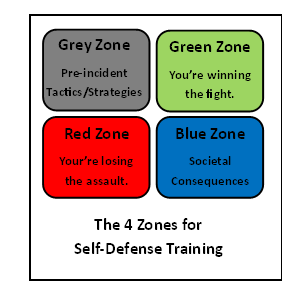
Note: This article is a continuation of last month’s article on the Red, Green, Grey, and Blue Zones model for self-defense training.

A Lie-To-Children is defined as “a phrase that describes a simplified explanation of technical or complex subjects as a teaching method for children and laypeople.”

There are four main categories of self-defense training. Almost all self-defense training can be described by one or a combination of them.

Three of them can be thought of as Lies-To-Children, only one of them is not.

The first two of these have the positive effect of helping students deal with low level violence that is unlikely to escalate into high level violence. But this type of training doesn’t provide its students with the means to differentiate between potential low and high level violence. And the means to avoid and deal with high level violence.

The third focuses on high level violence, but it also doesn’t provide the means to differentiate between low and high level violence. It also doesn’t provide knowledge on how to avoid and deal with the aftermath of violence.

Only the fourth deals with the multiple aspects of avoiding a variety of levels of violence, differentiating between the levels, dealing with the levels, and the resulting aftermath.

Fortunately, Lies-To-Children can be used as starting points. The provide a basic, but flawed understanding that can be reworked and expanded into deeper understanding.

The Four Categories

  1. Empowerment Based Self-Defense is really about giving people permission to physically fight back (reversing their passive social conditioning). It uses the person’s natural capabilities which is encouraged through Green Zone training.

It can be identified by its use of positive feedback for all self-defense actions regardless of how ineffective the actions actually would be against a determined attacker. The goal is to make the student feel “empowered”.

What it doesn’t do is:

  • Give students the knowledge to recognize, avoid, and assess danger. (Grey Zone).
  • Give them the actual physical skills to deal with a serious assault. (Red Zone)
  • Give them an understanding of the aftermath of violence (Blue Zone).

2. Martial Arts Based Self-Defense is about developing physical skills and spiritual qualities to deal with violence through Green Zone training.

It can be identified by its use of repetitive physical training of “fighting” techniques to build mastery. This is commonly (incorrectly) thought of as “muscle memory”.

What it doesn’t do is.

  • Give students the knowledge to recognize, avoid, and assess danger. (Grey Zone).
  • Give them the actual physical skills to deal with high level violence. (Red Zone).
  • Give them an understanding of the aftermath of violence (Blue Zone)


3. Combat Based Self-Defense is about focusing on relatively rare situations of high level violence and the use of lethal force usually done through Green Zone training.

This type of training can typically be identified by its kill or be killed attitude for all levels of violence for civilians.

In the best case, this type of training provides the student the means to deal with limited types of high level violence. In the worst case, it provides only the illusion of having the means to deal with high level violence.

In both cases, what it doesn’t do is.

  • Give students the knowledge to recognize, avoid, and assess danger. (Grey Zone).
  • Give them the means to deal with low level violence. (Usually Green Zone)
  • Give them an understanding of the aftermath of violence (Blue Zone)

These first three categories have much in common and a few differences. Their approaches are different. But in many respects they all end up in the same place.

What “stalled” means

What the above types of training do is to provide a starting point for future comprehensive self-defense training. But only if the student is willing to recognize the stalled nature of his or her current training. Stalled training is incomplete training that no longer advances. There are flaws and gaps in it. For students to move forward, they must acknowledge they are stalled and be open to expanding upon their current knowledge and training system.

This training can be thought of as a foundation that can be built upon. But only after certain aspects of it are removed and rebuilt.

  1. Comprehensive Self-Defense training that is not a stalled Lie-To-Children is made up of the understanding of:
  •  Recognizing, Avoiding, and Assessing all levels of violence. (Grey Zone)
  • Dealing with the legal, ethical, and other societal aftermath of violence. (Blue Zone)
  • Dealing with high level violence, the Fear Response, and other associated behavioral issues. (Red Zone)
  • Dealing with low level violence, not escalating it into high level violence, the associated behavioral issues, and more. (Green Zone)

The above areas can also be described by Rory Miller’s 7 Aspects of Self-Defense, the Hand of Self-defense training as described by Marc MacYoung, and the prevention, intervention, and mitigation of aspects of my 5D’s of Self-defense. It really doesn’t matter what model you use, also long as all the elements are included.


The Green Zone, Red Zone, Grey Zone, and Blue Zone – Do You Train only for the Green Zone? – Erik Kondo

Four Zones

When most people think of martial arts based self-defense, they think of an athletic and skilled martial artist beating up an attacker. And most effective martial arts training does in fact, teach you how to win a fight. When you are in the process of winning, you are aggressive, confident, and performing well. You are damaging your opponent and he or she is not damaging you. You are in a strong position and your opponent is in a weak position. Whether you dispatch your opponent with karate, jujitsu, MMA or some other style, it doesn’t really matter. Assuming you have reasonable skill, whatever techniques you apply, they will most likely do the job. You are in the Green Zone.

When you are in the Green Zone, you are performing at your optimum.  As long as you can stay in the Green Zone, you are likely to defeat or successfully disengage from your opponent. The problem is that in a true self-defense situation, your attacker doesn’t want to let you fight back in the Green Zone. He or she wants you to be the Red Zone. The Red Zone is where you are in the process of losing. You are being overwhelmed. You are fearful or frozen. You are unsure of how to respond. You are a psychological and physiological mess. You are taking damage and not damaging your assailant. You are in a weak position and he or she is in a strong position. You are NOT performing at an optimum level.

Most traditional martial arts training doesn’t teach you how to deal with the Red Zone. It teaches you how to fight when you are in the Green Zone. Realistic physical self-defense requires that you know how to get out of the Red Zone and into the Green Zone before it’s too late.

Prior to a physical conflict, you are in the Gray Zone. From the Gray Zone it is a quick transition to either losing in the Red Zone or winning in the Green Zone. Your assailant’s goal is to get you into the Red Zone as quickly and as easily as possible. He doesn’t want to risk having to deal with you in the Green Zone. Therefore, he uses tactics such as an ambush, deception, a weapon(s), superior numbers, etc. to overwhelm you. He uses the Golden Attack (See Rory Miller’s Golden Move). The goal of the Golden Attack is use overwhelming violence to:

  1. Damage you.
  2. Prevent damage to him.
  3. Worsen your position.
  4. Improve his position.

Once you are put into the Red Zone, you may never get out and apply your Green Zone skills. And that is exactly what your attacker intends to happen.

Conversely, if you find yourself starting off in the Green Zone, most likely it is because you are illegally fighting and not in a self-defense situation. In this case, dispatching your opponent with your martial arts skills may land you in jail or in civil court.

Some martial arts instructors have circumvented the reality of the Red Zone by advocating the use of a Pre-emptive Strike against the Bad Guy. In this case, it is you that launches the first attack. You initiate the transition from the Grey Zone into the Green Zone. For simplicity and ease of teaching, the instructor ignored/justifies the legal aspects of the Pre-emptive Strike with the use of Bad Guy labeling (opponent is a known murderer/rapist/etc.) But as a practical matter, you now are the one that has used the Golden Attack. And more than likely, you will need to articulate why you did what you did, to the police and possibly a judge and jury.

What happens after a violent incident is the Blue Zone. It is here that you will have to explain your actions to society as to why your response was legal self-defense. In order to do so, you need to know how the law applies to your situation. You need to articulate the reasoning for your actions beyond only stating that “you were afraid for your life”.

Golden Feed vs. Golden Attack

It is typical for martial arts techniques to be demonstrated and taught in response to a simulated “attack”. This attack is really a Golden Feed disguised as a Golden Attack. It is a Golden Feed when:

  • You are mentally and physically prepared to respond.
  • You are literally waiting for the “attack” to happen, which then acts as the trigger for your prepared response.
  • The “attack” doesn’t damage you, prevent damage to your opponent, weaken your position, strengthen your opponent’s position
  • You are not concerned with the negative consequences of your response, which means you have full conviction that your response is the “right” thing to do.
  • Your opponent’s attack was singular in nature. For example, he only tries to punch or grab you but then does nothing else. As a result, you are able to respond with multiple movements to his one movement.

To summarize, your opponent’s “attack” is actually a setup for you to launch your own Golden Attack. To the uninformed, it may look as if you are training from the Red Zone, but you are actually in the Green Zone.

Situational Awareness is only part of the Grey Zone

Most traditional self-defense instruction talks frequently about the importance of situational awareness. The basic premise is that by being aware of your surroundings you can avoid being assaulted and ending up in the Red Zone. The other aspect is that by demonstrating that you are an aware person, you can deter potential attackers. These are two important aspects of the Grey Zone, but there are more. Situational awareness is only a subset of the Grey Zone.

The Grey Zone is the series of events that occur before a potential or actual assault. Maybe you are assaulted, or maybe you are not. The Grey Zone is a place of uncertainty.

You might be aware of an impending threat, but that doesn’t mean you know how to deal with that particular threat. Or possibly, you are mentally aware of your surroundings, yet you don’t “see” the threat developing because you don’t recognize it as such. Realizing that you have problem doesn’t mean you know exactly what the problem is, or that you have the knowledge and means to fix it.

In the Grey Zone, your emotional Monkey Brain may influence you to act in a manner that you intellectually know is contrary to your best interests, but you do it anyway. Dealing with the Grey Zone requires not only situational awareness, but knowledge of criminal behavior, violence dynamics, environmental knowledge, understanding your own abilities and limitations, and above all good judgement and critical thinking.

No matter how proficient you are at fighting in the Green Zone, unless you have learned to avoid or survive the Red Zone, navigate the Grey Zone, and mitigate the Blue Zone, your self-defense training is deficient.

Clint Overland on the Red Zone

“I like being other people’s Red Zone. I start where most people have to build up to.

Say that you have made promises to either do something. Pay a debt or deliver a product at a certain price for a certain amount and you decided to welch on your word. And maybe you have the balls to back it up, and the ones you lied to don’t have the strength to discipline you for your indiscretions. But they have the money. That’s where a hard crew comes in. We enforce their will by starting at the Red Zone.

Now you as the Welcher may be a total bad ass. A walking Martial arts legend. Death on Two legs.

I am going to know this because I have researched you. This helps me formulate my plan of action. My crew and I will do it on you when you are least expecting it. First we, pepper spray you in the face, and then taze you while you’re screaming. Next, while you’re down, two of us take hammers to your legs and arms. Removing the threat to us. This is why pros work in Red Zones. Your best option is too stay out of them.”

Terry Trahan on the Red Zone

“The Red Zone is a paradox. You don’t want to be there by accident. But, it is the place you want to push your opponent to be as soon as physical conflict becomes your tool to end the situation.

Once that switch has been flipped, everything you do should have two purposes;

1) make sure you go home, and 2) overwhelm your opponent in order to end it quickly.

If you are being pre-emptive, you don’t initiate violence until everything is lined up in your favor: position, weapons, allies, whatever you have to tip the odds your way, and throw your opponent into his Red Zone.

If all of your situational and environmental awareness has failed, and you are in a reactive mode, you must force your attacker into his Red Zone as quickly as you can. Aggression, forward drive, environmental control and savageness until you can make your exit.

By overwhelming him, you put yourself in control, and keep him spiraling and falling into his Red Zone.”


How Bad is your Bullshitsu Infection? – Jamie Clubb

“The essence of the independent mind lies not in what it thinks, but in how it thinks.” – Christopher Hitchens

I am currently in the process of editing, researching, writing and re-writing a multi-volume book entitled “Bullshitsu and the Fight to Make Martial Arts Work”. It is a project that I started around 2005 as an examination of the legacy of the R.B.S.D. (Reality-Based Self-Defence) movement, but has since evolved into a critical overview of martial arts subculture in general. My initial belief was that self-defence teachers were the modernist antidote to what had gone wrong in the combat arts. This left me with a huge scope of study, but I underestimated my task.

I expected to find charlatan instructors who had either been corrupted by commercialism or were hopelessly deluded by their own mythology. However, what I discovered was that critical thinking is a cold and hard tool of reasoning that has no loyalty to style, teacher, tradition, testimony or anecdote. It isn’t impressed by an individual’s level of experience or where they have taught. What I found was something that did not filter out a bunch of villains and nutcases, but a condition that permeated every part of martial arts subculture including the R.B.S.D. movement. Even when I deconstructed the most notorious controversial figures in the martial arts world, I often found uncomfortable reflections.

A lack of overall regulation, the persistence of tribalism and a general under-appreciation of the scientific method has allowed something comparable to a social virus to mutate and break down walls of logical reasoning in many a hardened fighter or reasoned teacher. I called it Bullshitsu, primarily because it made a mildly offensive title for my book, but also because it was a good martial art portmanteau equivalent for what many sceptics have used to loosely bracket all sorts of nonsense and magical thinking in society.

My sales blurb to one side, below are a selection of some reoccurring questions that I have found that help to identify the existence of Bullshitsu in one’s training, learning and teaching.

What do you know about your system’s history?

Even a modern system has its roots in something and will be modelled on the experience of an individual that has then been taught by someone else. As techniques and concepts are passed from teacher to teacher, changes are invariably made. Many martial artists rightfully argue that they are continuing a living tradition that they can prove has an unbroken lineage stretching back for generations. Others are trying to reproduce a system that died long ago, sometimes as an immersive historical investigation. In both instances a type of irrational thought that psychologist Bruce Hood calls “essentialism” often takes place. Nothing, not even physical objects, can age without some form of change taking place. This isn’t to discredit individuals who try to preserve a tradition or resurrect one, but to acknowledge the inevitability of constant change influenced by a wide variety of forces.

A third group, which operate alone or as part of the other two, are those who believe in and/or propagate martial arts mythology. These are individuals who put their faith in the word of teachers who have no evidence to back up the roots of their art. Many martial arts have attached their origins to unprovable lineages, sometimes stretching back to pseudohistories about the Japanese Ninja, the Korean Hwarang, the Chinese Shaolin Monks, the European Knights Templar, the Russian Kossaks and many more besides. Ethnocentric ideas of hyperdiffusionism have put forward many creation myths where one country is seen as the root for all martial arts learning. Russia, Greece, India and China all have persistent martial arts creation myths. Despite the fact that any culture with access to wood has independently developed a hunting bow seems to escape this mind-set.

Understanding what the evidence tells us about a system’s roots and its evolution helps prevent us from operating off a false premise.  

Have you ever properly questioned your teacher?

Many martial arts operate in a tribal hierarcical subculture. The person at the top is the seat of all knowledge and so it goes through his most senior instructors the various instructors under them. It is a top down system of control. If the chief instructor changes his mind on something, which virtually all of them do to some degree, the entire martial art he heads changes with him or splits off in protest. If he dies then his named successor takes on the mantle and so on. Other instructors do have a say on matters, especially if they suddenly prove themselves to be successful, but the changes are often subtle. There isn’t usually an established or respected line of feedback coming up through the ranks that will have a regular impact on the head instructor. Meanwhile, in an even more tightly controlled environment, within the classroom the student works to please the instructor (or a grading panel) more than improving their actual education in the martial art.  

Pretty much every system of martial art in the world is somehow the result of direct or indirect cross-training. Tribal protectiveness led to many associations and clubs to ban their students and instructors from training elsewhere. We live in supposedly more open times, where cross-training programmes have become more common. However, what has happened now is that it is often the club that controls the cross-training, providing experiences in other arts to retain their students’ interest. Even systems that pride themselves on progressive and open-minded cross-training tend to stick to the same predictable martial arts systems.

Having a teacher who is above being questioned can lead to all sorts of problems. I have seen combat sports teachers and even world champions buying into pseudoscientific remedies and endorsing self-help ideals that have no basis in actual proven application.  Likewise, I have seen both traditional and modern martial arts teachers use their authority to endorse both sides of the political spectrum. What’s worse is the way such politics get integrated into the actual teaching.

Encouraging critical thinking as part of a teaching process is not about being ridiculously liberal in a class and allowing argumentative timewasters to nit-pick at an instructor. Argument for the sake of argument is just pseudoscepticism, which can be as damaging as unthinking credulity. However, encouraging an environment where students can investigate, question and feedback is progressive and makes martial arts more in line with science than a belief system.

Do you have any sacred cows?

Martial arts are full of concepts that have come to distinguish individual styles. It’s easy to see it in the traditional martial arts. Some stick rigidly to linear principles of movement, others throw their lot in exclusively with circular movements, there are those who focus everything off the centre-line principle and some have compulsory set forms; then there those who place their belief in the existence of esoteric energy. Finally we have the various philosophies – religious and otherwise – that have become welded on and intertwined with the teaching of martial arts.

Modernist martial artists might scoff at such adherence to certain structures or belief systems, but they would be wrong in thinking this was something restricted to traditionalists. The R.B.S.D. world has accumulated its own stockpile of concepts that are often referenced as if they were holy sacraments of knowledge and wisdom. They are often linked to the mid-20th century luminaries of the USA. From the military we have Colonel John Boyd’s O.O.D.A. Loop, Sergeant Dennis Tueller’s Drill and Lt. Colonel Jeff Cooper’s Colour Code. From psychology we have Hick’s Law created by William Edmund Hick and Ray Hyman and Guthrie’s Law theorised by Edwin R. Guthrie.

How often are these theories held up to scrutiny? How often are they questioned or properly tested within martial arts/self-defence lessons? Yet all have been readily questioned outside of the R.B.S.D. subculture with mixed conclusions. Times move on, a society moves on and so does science. Critical thinking martial arts are not dismissive of established principles, but they don’t accept panaceas and are wary of certainty in the context of teaching.

Perhaps your sacred cows lie in people. All the great martial arts pioneers had their faults and often questionable belief systems. Accepting them as fallible human beings and understanding what influenced their decisions allows you to take more responsibility for your training. We can honour a person’s work without having to slavishly defend all their idiosyncrasies, quirks and ideals. We can even separate art from artist in some instances. However, believing in total inerrancy of a leader – even if that inerrancy is focused on the area of their expertise – promotes cult-like thinking and prohibits rational progression.     

Do you practise pious fraud?

I have an entire article/chapter dedicated to something I have come to call “Jessop Thinking” in the martial arts world. It is named after the main antagonist, Colonel Jessop, in Aaron Sorkin’s famous military courtroom drama, “A Few Good Men”. The part was memorably played in the movie adaptation by Jack Nicholson. Jessop’s notorious “You can’t handle the truth” rant in court, which ultimately leads to his undoing, is based on his self-righteous belief in practising pious fraud. He thinks that his huge responsibilities heading the Marine Corps at Guantanamo Bay permit him to lie as he sees fit. Martial arts teachers often have the same arrogant assertion. They will tell stories about things they don’t necessarily believe to be true, as if they were true, in order to help keep a student’s dedication. Whichever way you look at it, the matter is a violation of trust. This problem combines the false premise issue that occurs when a martial art gets mythologised with having information controlled by teachers who are seen to be above criticism.

Do you rely on appeal arguments?

The martial arts subculture is riddled by appeal arguments. Appeals to authority ensure the cult-like subservience to the top down process, including total veneration of a style’s founder, living or dead. Appeals to tradition or antiquity enforce the “time-tested” myth. The survival of a system can be down to the influence of its practitioners or their ability to adapt it to the changing mood of the time, rather than the value of what is being taught. Appeals to novelty enforce the idea that just because something is modern it is also somehow better. New doesn’t automatically mean progressive. This brings us onto appeals to popularity, which is very common in the martial arts world. Like any other human being, martial artists are susceptible to trends and get caught up in them without engaging critical thinking. The popularity of a martial art, regardless of whether it is being picked up by law enforcement or the military, is usually down to its marketing rather than any a measurement of its effectiveness or efficiency.   

How tribal is your martial arts club and community?

This brings us onto something I call “Stylism”. Humans are naturally tribal. We operate in groups and as those groups grow they often fracture. Groups are bound by codes and practices. These same principles apply to martial arts subculture. Whether one group is trying to protect their business or their emotional investment, they often view other similar groups as being inferior. Martial arts “Stylism” is a complex subject and happens in many ways, but the following provides a rough view.

At the most microcosmic level there are those that see their club or particular branch of a style to be above anything else. We have seen this type of tribalism occur within many famous martial arts institutions and even within actual families. Then we move onto those who view their particular art to be superior to all others, the previous group often hold this view as well. Next we get an ethnocentric or nationalistic view, where everything outside of their chosen art’s birthplace is viewed as inferior or derivative. Finally there is the big three-way divide in martial arts between Traditional Martial Arts, R.B.S.D and Traditional Martial Arts. The distinctions are fair even if all three overlap. It can be respectively seen as a battle between traditionalism/classicism, modernism and postmodernism.

“Stylism”, when it is properly examined, hinders progression. It smacks of essentialism in that martial artists are forced to view their arts, systems and methods as tangible properties. There is a lot we all can learn if we become aware of our prejudices and the prejudices put upon us by our training culture. This self-awareness allows us to remove intangible obstructions and better research our training.      

When did you last make a mistake (and admitted making it)?

Humility is a common theme in martial arts. The western martial arts world endorsed it through their distorted romanticisms about chivalric knights. The eastern martial arts world pushed it through their melding of religion and philosophy at the turn of the 20th century. However, if you listen to the autobiography of most martial arts teachers you won’t hear much personal humbleness, unless it is the story about how they had nothing and made their way to the top. What you will hear is the incredible life story of someone who has always been right. He will have had his hardships and problems – perhaps a target of bullying and suffered from a disability of some description – but you will rarely hear about when he was wrong. Instead you will get a smug figure of authority who casts himself as an icon of wisdom in various anecdotal stories.

Such self-belief fits in with the Tony Robbins empowerment guru model observed by investigative reporter Steve Salerno. Empowerment gurus automatically believe they can advise on anything in life and they are self-appointed experts regardless of whether they have the specific knowledge, experience and education on any given subject. With the advent of social media, we have seen martial artists regularly using their position of authority in martial arts to preach on a wide variety of subjects – including politics – as if these subjects were mere extensions of their job role. Without apparently doing much impartial research they propagate to their martial arts flock conspiracy theories, urban legends, pseudoscience, pseudohistory, sensationalist journalism, quack remedies and their own personal politics. In so doing they are continuing a martial arts tradition that goes back to the turn of the 20th century, where we find the roots of Bullshitsu in nationalism, pre-scientific beliefs and the proliferation of pulp fiction.  

The average martial arts teacher obeys his tribal instincts and asserts an alpha position, exerting little discipline over his ego in this process. He will certainly tell you about humility, but don’t expect to hear about how he totally messed up a technique today or his second thoughts about a certain martial arts concept he has been teaching for the past 20 years. And so this model is copied by his students when they become instructors.

Cognitive dissonance is not something the average martial artist takes into account. Yet it is something we often see in the subculture of martial arts. When uncomfortable realities about a martial art – be it history, theory, science or practice – hit home, the typical response is for the devoted martial artist to go into denial, make excuses or fall back on what psychologist Carol Tavris calls “the engine of cognitive dissonance”, self-justification. What they don’t often do is learn, especially if this information has come from outside of their respective tribe. However, a teacher who acknowledges their mistakes is more likely to be able to relate and connect to their students. They have the best chance of being able to move forward with training and to gain more productive results.


My critical thinking journey into martial arts subculture is covered in my upcoming multi-volume book, “Bullshitsu and the Fight to Make Martial Arts Work”.

Simple Skills versus Complex skills. Is there a winner? – Kevin O’Hagan

In this article I am going to play devil’s advocate on a particular topic in the world of Martial arts that is regularly mentioned. I hope it will be thought provoking and spark interest and thoughts on the matter.

In the myriad of ‘reality based’ systems these days we hear many instructors preaching that in a real situation we should only use gross motor skills to defend ourselves as anything more complex will fail under pressure. Rising heart rate is blamed for this happening and when it reaches anywhere between 120 to 145 beats per minute fine motor skills begin to deteriorate and anything above that complex skills start to go. So the word is keep it simple and you will have more chance of success. Sound advice?Maybe?

But who is that advice for? Is this gospel? Does all the evidence available point to this fact?

Many studies have been done on this topic, particularly in military circles. In 1950 S.L.A Marshall’s, ‘the soldier load and mobility of a nation’, were the first to document performance deterioration under stress. Later Bruce.K.Siddle’s landmark research at PPCT took this further.

But now there is much evidence out there to argue the research. So is it true or not?

I want to give my humble opinion on this subject from my own findings. It is not set in stone but I can only speak from my own experiences and many of my colleagues and Martial arts brothers and sisters.

Well I have certainly preached the gross motor skills theory on more than one occasion and there is a lot of truth in this statement. I will tell you later to whom and why I preached it. But if this statement is totally true where that does put the Martial artist that trains day in day, month in month out, year in year?

This person has been working relentlessly on collecting and training a vast repertoire of techniques. They have worked their way up the belt ranks. They are instructor certified. Each day they train religiously working on a particular topic or technique. But if we took the previous statement about gross motor skills as read then what are they training so hard for?

If their ‘reality based’ cousins tell them that only simple, basis, gross motor skills will work in combat why are they bothering doing all the other stuff ? Maybe we should knock it on the head and just practise hammer fist and knee strikes. Job done!

Surely what we train in we believe we can make work in a real situation? All those years of learning kicks, strikes, locks, throws, groundwork and most of it won’t stand up in a ‘fight’.

Shit what a waste of time and effort. All that money invested. All that blood, sweat and tears.  You should have been practicing half a dozen basic moves, because that is about all that is going to work in reality. Fuck I have been cheated and all these so called Masters have played me like a fiddle! I am gutted….But wait….

I know firsthand of individuals who have knocked people out in ‘real fights’ with a spinning back kick or smashed them into the dirt with a shoulder throw. I know dozens of people who have taken others out with triangle headlocks, arm bars, wristlocks and chokes. But how could they? These are not gross motor skills. Surely these are fine motor skills, maybe even complex motor skills. So what is going on? Who is right?

Well let’s examine what I believe to be a Martial Artist. Anything that has art in its title must suggest that it is reaching for the highest levels of excellence. It is striving to be an art form.

Let’s take another view of this. An individual informs you they paint for a living do you presume they paint houses or portraits? Yes they are both forms of painting but one carries a greater degree of skill than the other. Could Rembrandt paint a door? Probably. But he also had the fine skills to paint a masterpiece on canvas. He didn’t limit himself to just painting a bowl of fruit. His belief system told him he could achieve much more. Surely as Martial Artist we should be working on the same thought process.

If fighting skills didn’t progress beyond just gross motor all our martial arts systems would be still  based on hitting somebody else over the head with a big ‘fuck off’ rock. Surely we have come forward more than that?

If I believed that the only things that will work in a ‘live’ unarmed combat situation was a kick in the balls or a punch on the jaw, how often would I have to train those skills. Every day? Five years? Ten years? More?  I don’t think so.

But if I wanted to apply wristlocks and arm locks to a real live resisting opponent or take them down with a hip throw, sweep or double leg, then that would require more time and more practise but it can be done. This is what makes champions. This is what they do.

To state only gross motor skills work under extreme pressure and the adrenal rush is doing all the Martial artists a big injustice as many can prove otherwise.

But you can counter argue many Martial artists have been beaten in the ‘street’ by an average street fighter. This is true and really warrants another article of its own. But suffice to say, it was probably more to do with playing in somebody’s backyard and not realising or understanding their rules than just the techniques not working.

But if the gross motor skill statement was solely true then how can a musician come out on stage in front of 1000’s of people and play a faultless piano or violin concerto. There is a shit load of pressure and adrenalin there.

What about the chef creating a masterpiece meal in front of the television cameras or a master tennis player coming out on centre court 2 sets down in the final and being able to come back and win the next 3.Isn’t this all pressure? What about the formula one racing driver zooming around the track at 200 mph? Or the skydiver?

If only gross motor skills worked under pressure how would our fire fighters or our military operate effectively?

Maybe the answer lies in time?

I think a more accurate summary would be if an individual had limited time to learn how to defend themselves, then simple gross motor skills are the way to go, no doubt.

If you were teaching a 6, 8 or 12 week self defence course then gross motor skills would be on the top of the agenda. This is when I have used this principle the most.

Systems such as for example Krav Maga were originally designed for soldiers with limited time to learn C,Q.B skills before going into war. They didn’t have the luxury of years of training so they had to learn something relatively simple that could be picked up in a short space of time. Gross motor skills will always be the easiest to learn.

The same can be said for our Police force. They get limited time to practise complex unarmed combat skills, so under pressure they are more likely to go for their baton or C.S gas than a wristlock or armbar.

But if you were going to open a club to teach week in week out based only on this theory how long would it be before people got bored with just practicing that knee to the balls or poke in the eye? Pretty soon you will start adding the intricacies of combination strikes, grappling or weapon work.

Do all these instructors that promote gross motor skills not train in any other aspects of the combat arts?

If you didn’t most people would eventually give up training or want to learn some more advanced skills.

So maybe we are padding out the skills and syllabus for money not fighting techniques? Oh dear what a thought.

If you are a Martial artist and prepared to devote a massive part of your life to training then you will be able to apply more advanced techniques and fine motor skills. As long as you have pressure tested them correctly and you have the right mental attitude then you can make anything work. Also you will require the patience and passion to stick around long enough to get to train them.

Back in the early days of the UFC you wouldn’t have thought you would have seen jumping spinning back kicks and backfists or flying armbars used with any success but these days we do. Why? Because somebody has decided to practise them and pressure test them to death to make them work. They have the vision and belief. They did not set limitations on themselves.

What does it take to achieve these things?  Time,effort,skill and belief. It depends on what sort of person you are. Do you want to read the book or wait for the film?

If we want to accelerate our martial arts training for example but can’t devote day in day out training how can we make the most of it and feel we are progressing towards our goals?

Experts reckon it takes 10,000 hours to master a skill or subject.

There are 8,760 hours available to us in a year. Take all the things we need to do outside of our training and we roughly have 3,500 hours left.

So how can we achieve?

Firstly 10,000hours is working to perfection. Don’t mistake this with excellent, very good; good, decent, not bad or OK…They are not the same thing by any means.

View 10,000 hours as a goal to work towards, an incentive. A journey begins with the first step or 10,000hours begins with the first minute. Time to start now.

If you don’t want to devote the time to be a Martial artist but would like to learn the rudiments of effective physical self defence techniques, gross motor skills are the way to go. If you want to stick around for the bigger picture you can certainly add more to your fighting skills.

Whatever skills you wish to learn the keys are to drill,drill,drill. Then pressure test in the type of environment you want them to work in (street, cage, contest mat, on the doors, etc etc).Understand and feel adrenalin and learn to work with it. Time is the key.

Proper training, time and effort can achieve great things. History proves that. Yes maybe not everybody will achieve these high levels of skill but I believe that’s what every Martial artist is trying to do when they step out on the mats every day, year after year. That is the goal and that’s what keeps them coming back for more, learning new stuff and pushing for higher levels of skill just like the musician, the painter, the sculpture, the poet, the writer etc.

To achieve a high level of competence in anything you have got to be prepared to work your ass off and sacrifice all. Most won’t. It is a big ask to be truly a champion, a winner and a success.

There are different levels of skill and depending on how much work you want to put in to your chosen field will determine what you will get out of it.

When I have a beginner come to my class I will teach to them simple, gross motor skills to start with but as time progresses and they improve I will gradually give them more technique to work on the same as you would do in any hobby, job or past time. Isn’t this were a syllabus comes into play?

Learning to knockout somebody doesn’t take a lot of physical training. Most people would be able to develop the power and technique to do so within an hour. Having the mental capacity and knowing when and how to deliver with proper timing will take much longer. That having said it wouldn’t take years. If this was your sole aim then there are martial arts systems certainly out there better equipped than others to do this and in a shorter space of time.

It will depend really on whether you just want fighting techniques to blast somebody off the planet if they get in your face or whether you wish to become a student and eventually master of a martial art.

Yes there are some Martial artists out there living in ‘cloud cuckoo land’ and practising the biggest load of bollocks on the planet but there are also many out there that are truly great and can make the most complex of techniques work for them under pressure. I have been fortunate to train with a great many.

This is why I am proud to call myself a Martial artist and continue after 40 years to keep honing my skills. I can also call myself a fighter because I have been there and done a bit.

I have immense respect for all the arts and for the people that have spent a life time in them. I may not agree with everything they say or do but I still respect them.

Much over the last 20 years has been written about how to train Martial arts technique more effectively and the explosion of MMA and its like has dispelled many myths that were carried around in those circles.

Simplistic skills are always going to be the easiest to learn and use but I believe with dedicated practise more complex skills can work and can start beginning that person’s simple skills. This is the foundation of all the Martial arts and their syllabus. For example a judoka’s Osoto gari to a layman is a complex skill but to the judoka it is a ‘bread and butter’ move. Can they make it work? Sure they can. They have done it dozens of time in contest. Could they make it work on the street? You bet. I have seen it.

In conclusion I sum up once again by saying that yes there are other important elements to add to the mix but essentially the length of time training a technique is one of the major keys to making it work under pressure regardless what that technique is.