Monthly Article Index

What is “Weapon Retention? – Dan Donzella and Tim Boehlert

Weapon retention is described as protecting, while carrying, any weapon such as a firearm or knife from someone that willfully attempts to take it by force from you. For law enforcement it’s a course taught for keeping in your possession your firearm in or out of your holster.

Over the years firearms and holsters have changed dramatically. Up until recently holsters merely secured a firearm only via a button, a piece of leather or with nothing at all. So with this understanding early weapon retention training had to be purely preventative and defensive only, for example, by placing both of your hands on your firearm and holster to keep it in your possession when grabbed by an attacker. Even with today’s high-tech secure holsters this method is still being taught.

In 2007 a new larger regional Police Academy was being created in my hometown. The Captain in charge of this project realized that an upgrade of the Defensive Tactics course was needed. Since the Department was changing their choice of firearm and holster, a new weapon retention course would be needed. I was given the task for the new course. At the time I was teaching a patrol and a traffic unit, so I teamed up with the head of the patrol unit. He’d acquired the new firearm and holster, as both were not issued yet.

The new retention course would be taught when the new equipment was issued at the academy and during ‘in-service’ classes. I looked over the existing course and knew that we’d have to start over from scratch. Since the new holster was very secure, we’d all agreed to create a more offensive-minded course.

I worked on a simple, but very effective technique to defend against having the weapon being grabbed, from every angle and while in the holster or out of the new holster. It was very well received; the officers responded well and liked the new concept. I am very proud to say that an officer who’d just completed the in-service retention class had had a firearm drawn on him, and he was able to use one of the techniques to disarm his assailant.

As a result of this one incident, other doors were opened for me at the department. I began retooling the Defensive Tactics curriculum as well. Working with patrol, traffic, and S.W.A.T. units and even helping officers with testifying in court cases, but I’ll save that for another article.

Let’s change gears and talk about civilian carry issues.

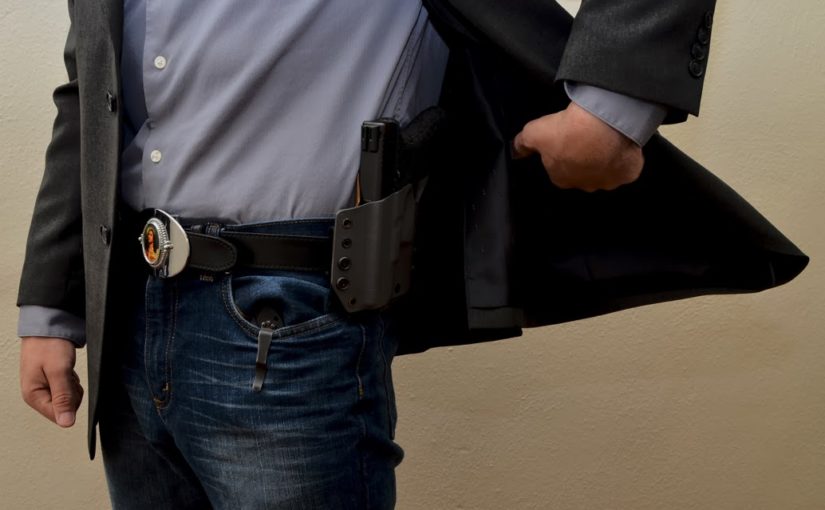
Unless you’re in a state that allows open-carry, most likely you won’t be using a retention holster. Carrying your weapon concealed is to your advantage. No one should know you are carrying. Using, drawing or showing your firearm is the last thing you want to do. Always be on your best behavior, follow all the laws of your state, do your homework, research your state laws. Be aware too that even county laws in your state can be different.

Having the right and ability to carry concealed firearms comes with immense responsibilities. You will be expected to know the law, to understand the circumstances where you may be breaking the law – i.e. by carrying your weapon into certain buildings: government agencies, institutions of higher education, or onto school grounds as a few examples. You have the responsibility of knowing your weapon intimately. You should train on and off the range. You should learn empty-hand skills as well, especially since you don’t have a secure retention holster.

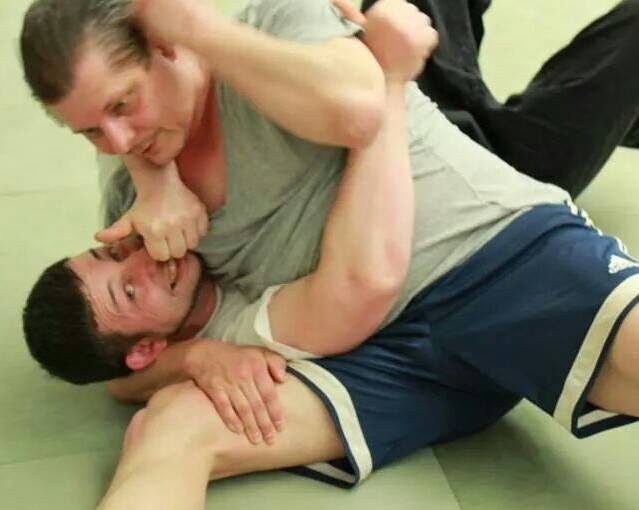
Your offensive response has to be more aggressive, quicker and more precise. I also teach how to use your firearm as a punching, pushing, cutting and locking weapon. You may need to make space, or where you weapon is jammed or even empty. “Cover all your bases” as we say in the United States. Think out of the box and above all be creative. There’s nothing wrong with carrying a knife as back up, especially in a grappling situation. And again: research the laws, and get proper training.

Most officers during their careers never draw their weapon. So, most likely you never will as well. But that doesn’t mean you shouldn’t be prepared in every aspect.

If you do draw your weapon, you’d better have a very good reason to do so. We had an incident in Florida where a civilian shot a man that was attacking a police officer. He was told by the officer to do so. After the fact the civilian dropped his weapon and backed away. Exactly what you are supposed to do with other officers arriving on the scene.

In an active shooter situation, you may be the only one that can stop the mass shooting. Remember the proper procedure afterward: Police will come in fast; don’t be mistaken as the killer. Obey their commands to the letter. Today, most likely, everything will be caught on video, so your actions will be studied and analyzed.

In my hometown we have a very large mall. As we all should know by now they are magnets for crime, gangs etc.… I knew most of the officers working overtime at the mall, and I was told to never come there unarmed, because they just can’t be everywhere, and that the mall’s security would be useless.

It’s sad but that’s the world we live in today. As a civilian or as a police officer, carrying a firearm imposes an immense responsibility on you. Remember your basic rules: always treat a firearm as if it is loaded, never point it in an unsafe direction unless you plan on firing, always keep your finger off the trigger until and unless you plan of firing your weapon, know your target and what’s behind it.

Dan Donzella has been teaching numerous Martial Arts systems and creating curriculums designed for law enforcement for over 40 years.

Tim Boehlert worked in Security for a large regional health-care facility in conjunction with numerous Federal, State and Regional agencies. He’s authored numerous internationally published articles on Martial Arts and Security issues.
Fatal Attraction Part II – Mirav Tarkka

The love story begins

Back to our “love story”, since the person who feels more guilty and more submissive then the non-victim has been selected (as a victim), he/she has to deal now with a face-to-face aggression. Sometimes, in order to create an emotional defensive mechanism, the victim develops positive feeling towards the aggressor, in order to minimize the damage (in his/her mind) and danger.

Remember also that an attack, an aggression (even if it is not domestic or with someone you know) is a relationship. One doesn’t exist without another. The aggressor isn’t one without a victim, a victim isn’t one without an aggressor. There is a subconscious agreement between these two, a Symbiosis; just like in nature. Changing that balance will change that relationship.

Stockholm’s syndrome

To demonstrate an extreme kind of relationship between the aggressor and the victim I am going to explain a little about the Stockholm’s syndrome – the “capture bonding”.

The Stockholm’s syndrome consists of “strong emotional ties that develop between two persons where one person intermittently harasses, beats, threatens, abuses, or intimidates the other.”

The victims, in this case hostages, end up defending their captors, would not agree to testify in court against them, and even fall in love with them. “We” (who are not “living” the situation) see it as a paradox, as captives’ feelings for their captors are the opposite of the fear and disdain we expect to see as a result of their trauma.

Psychologically speaking, the Stockholm’s syndrome is considered a product of SURVIVAL INSTINCT. “The victim’s need to survive is stronger than his impulse to hate the person who has created the dilemma” (Strentz). A positive emotional bond between captor and captive is a “defense mechanism of the ego under stress”.

The more the victim believes (or led to believe) the likelihood of their survival is poor, the more the victim is likely to develop “love” towards the aggressor in a “face to face” scenario, especially when the captors perform acts of kindness, fail to abuse the victim and so on.

The Stockholm syndrome spreads beyond a hostage situation. “Child abuse, domestic violence, human trafficking, incest, prisoners of war, political terrorism, cult members, concentration camp prisoners, slaves, and prostitutes” can also fall prey to Stockholm syndrome.

Dee Graham (1994) brought the Stockholm syndrome to the “world” of domestic violence. She claimed that the threat of male violence around women, and women’s fear of the men, defies women psychologically and socially. Meaning, women act in a way they know will please men in order to avoid emotional, physical or sexual assault (caused by male anger). Women bond to men to survive, same like hostages bond to their captor to survive, and therefore women are more likely to develop this condition.

Your call!

You can now understand how every victim is responsible for “being chosen”, and how we all make choices that can change our life courses forever. You can adapt a non-victim mindset (and behavour pattern) and empower yourself mentally, spiritually and physically, creating a harmonic self – immune to the external circumstances as much as possible, or you can develop a victim’s mindset, let your guilt and submissiveness take control over your life instead of you taking control over them.

The question remaining is, HOW? How can you avoid being chosen as a victim or being attacked?

In many of my videos, I speak about situational awareness (SA), pre preparation and avoidance as physical “concrete” ways to not be attacked.  Remember, the more prepared you are the less likely you will have to deal with what you are preparing for. Having a preventive and protective (but not paranoid) mindset and awareness, having always an improvised weapon, keeping your “guards up” and so on is very important, and you can read and watch more about this on my blog (https://miravselfdefense.com/mirav-blog/)

But here is something new, fascinating and extremely important. I have been discussing in this article the fact that feeling guilt and the need to be punished contributes to your “atmosphere”, to the energy field you carry around you that tells your aggressor if you are an easy target or a difficult one. So the true prevention of these potential “punishments”, and this is related also to your relationships with people and yourself, your habits, your personal life, events that “happen” to you (nothing is by accident!) comes from… the inside – YOU!

Stop punishing yourself! Love yourself more!  Surround yourself with positivity and happiness! Replace the feelings of guilt, self-sabotage, and anger with compassion, love, and gratitude. Once your energy field, your frequencies, no longer match your aggressor’s ones, he will look for someone else to perfect his match. So, self-work always produces a better you, even here.

Free yourself of the idea you should be punishing yourself. Think of it this way; even if you did do something worth suffering for, punishing yourself won’t fix it. It will make it worse not just for you, but for your environment too. You might become an aggressor yourself! Self-sabotage and suffering don’t lead to self-forgiveness.

Into action

I know it sounds simple, maybe too simple. To be truthful, self-work never ends, and there are always ways to do more and do better.  Meditation, self-reflection, and writing (to yourself) help, but there are some really good “quick fixes” that help quite fast, almost immediately (I used them myself).

One is the “Ho’oponopono” an ancient Hawaiian practice that works on your guilt-forgiveness process. You can download it from YouTube and play it to yourself or just say the four phrases to yourself several times a day. It really works like magic.

The second quick way is just to do good deeds, at least one – even little- good deed every day. Make someone smile, give a compliment, help someone struggling with the groceries, and so on. The good energy that your deed will produce inside you, will “fight” the negativity of the guilt and anger.

Surprising, eh? Speaking about self-defense, violence, love, temptation, meditation, forgiveness, anger, guilt, good and bad… all connected together, creating a deadly chaos, or a harmonized and safe being. It is all about your self-awareness, and choices.

I hope you enjoyed this article.

Please feel welcome to contact me for questions or comments via email: coaching@miravselfdefense.com

Stay safe and loved.

http://www.miravselfdefense.com

Marcus Linde

I am Marcus Linde and since 2001 deepened a form from the Cheng Man Ching line of Yang style Tai Chi Chuan under Master Detlef Klossow from Düsseldorf. In addition, I continue to form the sword, walking stick and longstock in the pushing hands of the Taiji (Tui Shou) and the weapon forms.

Since 2012, I have been working on aspects of self-protection and violence prevention. Here I regularly attend courses for pioneers of reality-based self-defense such as the American author Rory Miller , or the Canadian “enfant terrible” of the scene, Richard Dimitri . My knowledge and skills in this area are being looked at in the training of health care and nursing, social services and educational institutions.

Website.

Matt Beecroft

Matt Beecroft is the Director and Head Coach of Reality Self Defence and Conditioning with over 12 years experience working within both the self defence and fitness industries.

I have a list of current and previous clients including the world aerobics champion, government departments, members of Adelaide STAR group, Adelaide Remand Centre Correctional Services Officers and various personnel of SAPOL, the Army, Navy, Air Force and security, professional athletes, personal trainers, amateur fighters and everyday people wanting to reach their full potential in the areas of health, fitness and personal safety.


Mirav Tarkka

Israeli-born Mirav is a world-renowned self-defense expert, specializing in Krav Maga (Israeli Contact Combat).  With over seventeen years of  experience as a trainer, Mirav founded Defense Tactics™ (International Combat Training) and Recharge™ (Alternative Functional Fitness) and has now set a goal to inspire, train and help empower individuals and groups at all levels, focusing on the mindset and mental training (as well as the physical aspect) and creating  online courses especially for women all around the world, regardless of their physical abilities, age or culture.  

Mirav studied, trained and served with the IDF (Israeli Defense Forces) at the Wingate Institute (Israel), then completed and instructed many international training courses.  She holds university degrees in Psychology and Criminology and a diploma in Physical Education.  With appearances on television, features in magazines and newspapers throughout Europe, Mirav is often invited to demonstrate her work at many international workshops and seminars covering self-defense related topics.

Recently Mirav became a mother of two and says:

“Having my daughters has emphasized even more, for me, how important my role in life is. I need to be able to protect them, at all times, I can’t trust anyone to do that ‘for me’. I need to be strong, extra-assertive, powerful, to be capable of defending them and myself, and to set an example of the independent women I want them both to be. The love of a mother for her children is the greatest force  that exists – that is my underlying drive and that will be what protects them, combined with my knowledge and experience. I would truly wish for all women in the world (and men) to realize their true power, whether they are mothers or not, their true responsibility to themselves and their loved ones, and to take full control of their lives. No one should have power over you.”

https://miravselfdefense.com/

Youtube Video of the Week – The Fairbairn Sykes Fighting Knife

Warning: This video contains graphic descriptions of Commando combat.

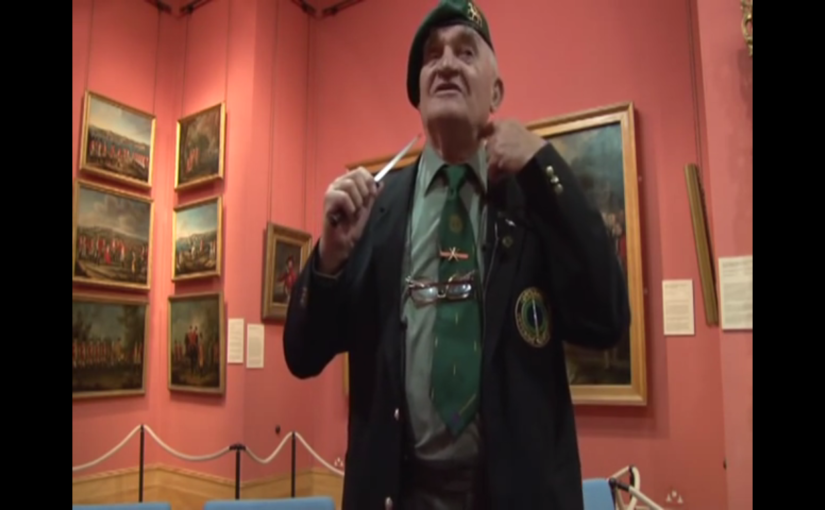
Trooper Stan W Scott, No. 3 Army Commando, demonstrates the use of the Fairbairn-Sykes fighting knife.

Part of the ‘Draw Your Weapons: The Art of Commando Comics’ exhibition at the National Army Museum in London from 1 September 2011 until 30 April 2012.

These knives are hand Made in Sheffield, where your CM editors live, and yes Garry does have one.

Follow the National Army Museum on:
– Facebook: http://www.facebook.com/NationalArmyM…
– Twitter: http://twitter.com/#!/NAM_London

Self-Defense and the Helping Professions – Alan Jensen

In the ten plus years I’ve been in the social services field, I have had multiple confrontations and aggressors.  However, I have also had the good grace to train in traditional martial arts and self-defense for almost twenty years.  On the other hand, most clinicians in the field or in out-patient settings have not.  Most agencies, such as my own, understand the risks that we take on a daily basis and have some form of self-defense programs.  Some have been implemented for years, others were created after the deaths of other clinicians.  I can emphatically state that these programs do not work and many times, instill a false sense of security for the clinician.  But what system does and how can it be implemented?

I cannot remember how many seminars or talks I have attended where I was told by a man with a microphone and long credentials how to act in the moment, lacking an understanding of real world interactions or verbal de-escalation training under stress.  This is followed by a supposed “expert” explaining in multiple steps how to protect oneself, e.g. hair pulling, allowing staff to practice only a few times, before moving on.  This does not teach anything.  There is no practicing verbal de-escalation and no movements are done to become ingrained or could be done under pressure.

My current agency has a program called S.O.L.V.E.: Solutions of Limiting Violent Episodes.  It was developed by a former Law Enforcement Officer (LEO).  There are two trainings for the SOLVE, twelve and twenty four hours, depending on if you work in a group home.  A yearly recertification is required.  This training includes verbal de-escalation and self-defense techniques, cumulating in a written test and mock real world scenario.  It sounds like a good program on paper.  In reality, you cannot fail, all answers are given before the test, and you need to demonstrate the skills with an agreeable aggressor.  The verbal de-escalation advice is sound, but not stressed.  Once you pass the course, the recertification is around skills only.  Again, you cannot fail.  I’ve seen them pass people who don’t know their lefts and rights.  How does this help clinicians in the field?  It hinders them.  “I passed SOLVE, I must be okay.”  This is akin to the person who just got their black belt.  “Because I’m a black belt I can defend myself.”  No, you, most likely, cannot.  When that client becomes verbally aggressive, can you remember what someone said months ago?  Can you remember a skill you practiced five times?  In almost all circumstances I can say “No!”  It is a false sense of security.  The big question I have, is what can?

Many years ago, I was trained in the “spear” technique: observe and act.  It worked.  However, I quickly realized, that I would hit many of my clients when they got close in a session with no malicious intention.  The goal is psychiatric rehabilitation, not to hit someone who is already traumatized.  Recently in a master class with Sensei George Mattson, he was taking about aggressors and how much distance one should have between yourself and the aggressor.  I have some knowledge about keeping space, I have an idea of what to do if someone makes me aware that they are an aggressor, I can work with that.  It’s when people are close that I don’t know what to do; I have had physical contact multiple times before I could respond accordingly.  So I asked Sensei Mattson about this.  He told me that there was a lot of “infighting” that one could do, and continued on with the class.  What does one do when in close contact but is trying to help?  Identifying the threat and being attune to situations helps.

Gavin de Becker is right, fear is a gift.  However, those in the helping professions tend to ignore this gift.  How many times does a clinician from a psych triage program go alone into an unknown home to do an assessment?  How often does a clinician go to a new client’s home without reading anything about the person, regardless of the safety issues?  We, many times, talk ourselves out of these feelings, stating that we are in the helping profession.  I teach listening to oneself and removing oneself before the situation escalates, but only filed a Harassment Prevention Order (HPO) after twenty-four logged voicemails, multiple threats, and a death threat.  He broke part of my car and I continued working with him.  What, do we in the helping professions have to rely on to keep ourselves safe in our work?  This is the big question for me.  We are out in the home, in the community, in the school every day and there is no adequate way to address the safety issues that we encounter.  What there is to rely on is not sufficient.  Spend some time, talk with a social worker, talk with a psychologist, or a clinical nurse.  They all will have stories and their own take on this issue.


Abduction Training – John Titchen

The sobering reality of a fake abduction

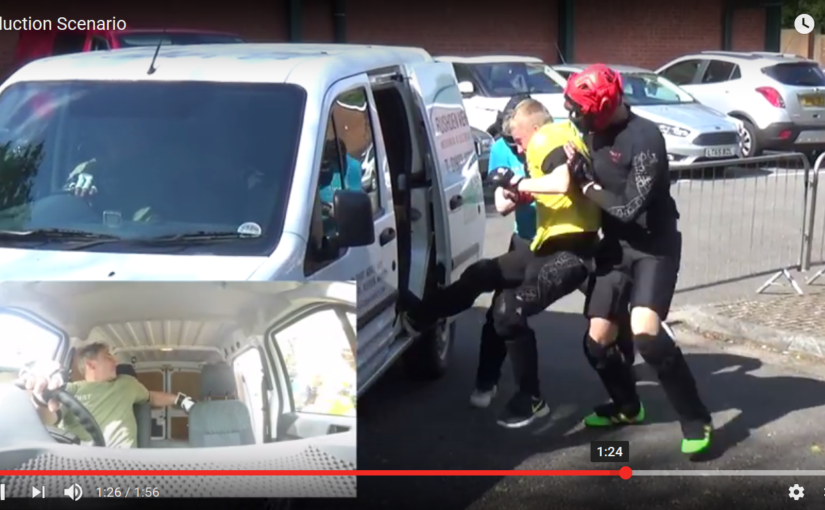
On Saturday, under my supervision, four teenage boys (aged 13-14) experienced a fake abduction. This was a single scenario in a multi faceted training day for both adults and teenagers. While this is a very rare event, it is perhaps one feared the most by parents, and so we wanted to see what we could learn from replicating an example.

Like all training, we had to make compromises for safety. The most glaringly obvious compromise was that the boys knew they were going to experience an abduction attempt. They also knew which vehicle the attacker(s) would use. What they didn’t know was how many people would be involved or how we would set them up.

That wasn’t the only compromise:

– due to a scheduling clash we had to stage our scenario outside a venue filled with young children with open doors for ventilation, so the teenagers couldn’t shout for help or bang on the vehicle,

– the vehicle wasn’t scrapped so we couldn’t kick it or hit people into its bodywork.

– for safety all shots to the head were pulled; the attackers wore headgear in case of backward uncontrolled strikes,

– the teenagers were bare-headed and we decided to proceed on the basis that the attackers would use body shots to subdue them so as to preserve their looks.

Each teenager entered the scenario ‘blind’, not having seen the ones that went before or having had opportunity to get any information from the previous participants. They were asked to walk down a particular passageway as if on their way home from school or visiting a friend. An aggressor would run up behind like a jogger, and then grab the boy to lift him into the van where a second person could assist in controlling them. A third man was behind the wheel.

This obviously represented a possible attack. More people could have been involved. We could have used a fake weapon for intimidation. The aim of the exercise was for all of us to see how difficult it was to escape once the attack had begun, and how quickly it could be done.

The results were chilling as you can see.

Of the four participants, three were taken with the van ready to drive away within 12 seconds from first contact. The longest resistance lasted 35 seconds, and had he not been pulling his shots (for safety) that young man might have escaped or caused his attackers to abandon their attempt for fear of being caught. As it was we did attract some outside attention.

One of the most obvious things to take away from the exercise is that awareness of your environment is everything. Anyone listening to music on headphones would be easy prey. Hoodies would reduce peripheral vision and reaction time. Choice of routes, walking in company, wide corners and how you react to people around you in terms of innocuous hand positions (scratching the back of your neck for example) would make a difference in reducing the odds of being a victim and in being in a better position to resist.

These abductions featured bear hugs in what is their most likely use. These particular scenarios reinforced that unless you act before it is fully on, you are not going to get out very easily, and you probably won’t have a stable ground platform to work on. I teach bear hug defences to illustrate principles of movement, and to try and ingrain the reaction to move before it is on, but I recognise that the attack is both rare (because there are very few scenarios in which someone would do it) and that once it is on then most defences I’ve seen demonstrated (including my own) are ineffective until the person starts to release you.

If you want to theorise about bracing against a van, or pushing off from a van, or a car boot… try it. Come up with ideas, but then try them until you have some high percentage solutions.

This was nothing more than a training exercise, but it has given all those participating something to think about.


Fatal Attraction Part I – Mirav Tarkka

Guilt and Punishment 

All of us are prone to feel guilty about something or other. It’s quite normal, no need to feel guilty about it.

We all feel guilty about something, eating too much, eating too little, praying too little, loving too much or too little,  being too honest or not telling the whole truth, wanting someone we shouldn’t or not wanting the one we “should”, believing in God, not believing in anyone, workaholics, shopaholics, drug addicts,  alcoholics, pheromones, nymphomaniacs…and what else?! We all have our little “sins”.

But what does this actually mean? Well, if we all feel guilty, we all have a need (subconscious or not) to be punished. “Horrible” as it sounds, in one way or another, this is how you attract violence into your life. Whether you are violent in some ways towards yourself, you let someone treat you badly or you attract an aggressive incident.

Sigmund Freud (1916) explained that most of us aren’t strong enough (character-wise speaking) to “supress” our guilt without feeling self-deceived and therefore diverse forms of self-punishment are formed. He divided these into “the criminal from a sense of guilt”, “those wrecked by success” and “other self-sabotaging and self-tormenting character types”.

Friedrich Nietzsche believed (1887) that we want to experience guilt as we have a rooted desire to cause suffering, in order to dominate others and express power. It is our integration into society and culture that prevents us from doing so, but the instinct is always there.

From a religious point of view we grow up believing we “should be” or “could be” better people, but consider ourselves unable to (due to our nature/instinct), therefore we feel guilt (and confess, donate, fast, cry, suffer, pray for forgiveness etc’).

In all these explanations the common factor is that the feeling of guilt leads to the “agreement”, or even the will, to suffer. Once we pay that price our guilt feeling diminishes and we are able to feel good again until the next time.

How This Impacts Our Vulnerability 

So, if you subconsciously (or consciously) feel guilty about something, you are more likely to look for trouble, or let trouble look for you. Now, I am not saying that you wake up in the morning, leave your home and try to find someone out there to beat you up. But I believe that you create, knowingly or not, an energy field around you (“I feel guilty, I should be punished, I feel unworthy, I feel vulnerable”) which will attract an aggressor more readily. Aggressors look for this type of “easy victim”, people who are submissive and not likely to fight back. If you believe you should be punished, your inner strength and will to survive will be weaker than if you believe your life is worth living that you are worth living.

On the other hand, if you are a person who is generally more connected and aware of your feelings, and self-being, you have been working on your guilt and anger, and the energy around you “feels” to the aggressor as if you are “not the right one”. In this sense it would be challenging to fight you and it won’t be that pleasurable. The aggressor is looking for a submissive person in order to feel more powerful (himself); if you are not that, then the “power trip” is …. pointless.

It has been scientifically proven that aggressors, like wild animals, choose their victims by picking up on subconscious signals. The “predator” knows in a matter of a few seconds who is a suitable target and who isn’t.

Hardening the target

“If I had the slightest inkling that a woman wasn’t someone I could easily handle, then I would pass right on by. Or if I thought I couldn’t control the situation, then I wouldn’t even mess with the house, much less attempt a rape there.” (Brad Morrison, a convicted sex offender who raped 75 women, quoted in Predators: Who They Are and How to Stop Them by Gregory M. Cooper, Michael R. King, and Thomas McHoes) “Like, if they had a dog, then forget it. Even a small one makes too much noise. If I saw a pair of construction boots, for example, out on the porch or on the landing, I walked right on by. In fact, I think if women who live alone would put a pair of old construction boots—or something that makes it look like a physically fit manly type of guy lives with them—out in front of their door, most rapists or even burglars wouldn’t even think about trying to get into their home.”

Betty Grayson and Morris I. Stein (1984) tried to find out what attracts aggressors to certain victims and what doesn’t. After videotaping pedestrians (without their knowledge) on a busy street in New York, they asked convicts to make their selection of who they would choose to attack, within seven seconds. The results were surprising. The selection was not depending on age, race, size or gender (for example, some small women were passed over and some large men were selected). Even the convicts themselves didn’t know how to explain their choice. But what was common to all the “potential victims” selection, was a few things in their body language, that sends messages to the subconscious mind that that person is weak, is distracted, can’t defend themselves, and feels as if they deserve to suffer (lack of self-love, again the guilt feeling).

To give a few examples, the potential victims that were selected dragged or shuffled their feet when walking, while “non-victims” had a smooth stride stepping heel to toe; potential victims walked slower than non-victims, or had an unnaturally rapid pace when nervous or scared, while non-victims had again a steady “normal” pace of walk; potential victims had a slumped posture that indicates weakness or submissiveness and a downward gaze (the guilt again!) whereas non-victims had a confident, “correct” posture and looked straight and around (situational awareness).

So, Can you “fake it till you make it”? Can you fake the body language to seem more confident and not be potentially selected by aggressors? The answer is YES, you can walk more confidently, you can seem to be more centered, you can be more aware of your environment, you can change the pace and stride of your walk… but can you really fake confidence? can you fake inner strength? Can you fake self-love…? The non-verbal signals your body will give up in a stressful situation is not something you can easily camouflage.

http://www.miravselfdefense.com

Rory Miller @ KPCombat – May 20th and 21st 2017

Hey Everyone! Rory is back in Edmonton in May!

Make sure you get your chance to train with this highly sought after expert, before he retires.

If you don’t know who Rory is
He is the author of Meditations on Violence and Facing violence.
He is a world renowned expert in self defense and has taught in far too many places to list here.

Make sure you reserve your spot early as this will sell out! www.kpcombat.ca/