Monthly Article Index

Understand the Difference Between Safety and Security. It Might Save Your Life – Erik Kondo

It is common for people to want to increase security for themselves, their family, their neighborhood, their country, etc. In most cases, people think in terms of adding security measures in an existing security system. The basic thinking is that the current security system has a weakness that needs to be reinforced or a hole than needs to be filled.

For the sake of this writing, I am going to talk about security in terms of a security system and/or security measures while safety is the inverse of absolute risk from a harmful event. The lower the risk of a dangerous event occurring, the greater the safety. This relationship applies to both personal and public safety.

Security is some action or measure than is done to protect against a known risk. The simplest example is a home security system which is designed to help prevent home invasions and burglaries. Another example is carrying bear spray while walking in the woods. These are two means of raising the level of your security system.

Safety on the other hand is really a function of the overall ecosystem. Safety is determined by the result of the interconnected factors that make up the entire ecosystem. One of these factors is the security system.  The level of a person’s safety is a function of his or her risk to danger. Public safety is determined by the public’s level of risk to danger.

For many, security is thought of as being like a fence. The fewer weaknesses/holes in the fence, the more effective the fence will be at keeping people out. The same thinking goes for personal safety. In this case, the person is the security system. By shoring up his or her weaknesses, his or her personal security system becomes more effective.

The preceding methodology seems to be common sense. But as compelling and as reasonable as it seems, it has a logical flaw. Measures that strengthen a security system don’t necessarily lead to greater actual safety in the real world.  The reason for this is that actual safety is a function of the safety ecosystem in which the security system is just one of many interconnected elements. The strength of the security system is NOT the only factor that determines the overall safety of the ecosystem.

An ecosystem is a complex network of interacting elements. A security system is one element of this ecosystem. Since all the elements are interconnected, changing one element has the potential of changing the other elements too. In other words, strengthening the security system may have the unintended effect of upsetting the balance of the overall safety ecosystem. In this case, the result may be an ecosystem that is less safe despite the presence of a stronger security system.

How can this be? For example, assume that you wear a padded vest as protection against being punched in the chest. It is an undeniable fact that if someone punches you in the chest, you will be more protected than without the vest. Therefore, you must be safer, correct? And if everything stayed the same, you would be safer. But everything doesn’t stay the same in an ecosystem. Its very nature is to be interconnected. Therefore, changing one element has the effect of changing some or all the other elements.

In this example, it is very possible that wearing a padded chest protector in public will influence some people to want to punch you since you now are a juicy target. Therefore, your risk of being punched in the chest has just gone up. And while you may be more protected from the chest punch, you may end up falling and hitting your head. You may end up getting into more fights then before you had the chest protector. The overall result is that your safety decreased even though your security system has increased.

Getting back to the fence example. Let’s assume that the fence surrounds an apple tree grove. The fence has the effect of keeping all but the most determined people out. These few people climb the fence and steal a few apples every day. Therefore, you decide to make the fence higher and top it with barbed wire. Now even the most determined thieves will not risk climbing the fence. Your security system is stronger.

But the safety of the apples depends upon the ecosystem in which they exist, not just the strength of the security system. Since the determined thieves can no longer climb the fence to get the apples, they change tactics and join with many others to ram a huge hole in the fence. The net result is a hoard of people who attack the fence, create a hole, and pillage the apple grove. The overall safety of the apple grove decreased despite the increase in the security system.

What this means is that the level of safety can go down as a result of the level of security going up. For some people, this is a mind-blowing concept. That is because they erroneously think that safety and security are the same concepts. And if there was no safety ecosystem, then the level of safety would be the same as the level of security.

In real life, there is always an ecosystem. Therefore,

Safety = Security System +/- (The effect of everything else in the ecosystem which changes as the Security System changes).

Therefore, it is impossible to determine whether increasing the strength of the security system will increase or decrease overall safety unless all the elements of the ecosystem are taken into consideration. Every person and every entity exists in a unique ecosystem with different factors to consider.

Let’s consider a few more examples.

  1. Carrying a knife is a security measure. Doing so increases the magnitude of the person’s security system. But whether it increases their safety depends upon the person’s unique ecosystem. If carrying a knife increases the possibility that it will be taken and used against them, then it lowers their safety. If it increases the possibility that they will be shot, then it lowers their safety. If it increases the chance that they will go to jail, then it lowers their safety. On the other hand, if it doesn’t do the above and increases the chance that they will be able to use it for self-protection, then it does increase their safety.
  2. Increased police firepower and body amour represent an increase in security. If this increase creates a deterrence from people committing crimes, then it increases public safety. If on the other hand, many members of the public see this increase police security methods as menacing and decide to retaliate by rioting and committing crimes, then public safety is reduced.

Don’t be fooled by those who think that safety is that is always the same as security. Or those who consider that increasing security measures is simply a matter of “common sense”. They don’t know any better.

You live in an ecosystem. Your family lives in an ecosystem. Your neighborhood and your country, both exist in ecosystems. Increasing your safety requires more than just adding or strengthening security measures. It requires understanding all the factors involved and taking into consideration how they interact.

 

Predatory Niceness in Everyday Life – Teja VanWicklen

  Listen to Teja’s story.

This year at my son’s school has been problematic to say the least. Both his teacher and the administration have shown themselves to be old dogs, mired in bureaucracy. Things had been going well, but at the end of last year a new super intendant of schools was installed and his first move was to change everything, including many things that seemed to be working. One semester of inconsistency and lack of focus on the kids and my son’s longstanding A/B average has dropped fully to a C. He is acting out, disregarding authority and rushing through work – all behaviors that had vastly improved and which we thought were behind us. The details here are not important. I do not think I know better than others and prefer to let people do their jobs. But I know my son, and I know his work ethic. And I know it has changed drastically in tandem with the new administration.

At the beginning of the year, I met with the new teacher. She smiled. She loved children. She assured me she had my son’s number and all would be well. I know myself. I am quick to judge. I have to remind myself to be forgiving. I wish it weren’t this way, but it is. My first reaction is often to go in for the kill. To stop the bleeding before it starts. So my Neocortex steps in and convinces me to take a step back. I do, I try to have a little faith in people, to give them a chance.

It really doesn’t help when after I’ve calmed my inner monster to make way for the nicer, fluffier me, people disappoint me anyway.

At one point, we called a meeting with the teacher and the administration and went over the specific issues we were having. The teacher admitted to being unfair to my son and did so in front of her peers and the principal. My husband and I were so impressed by this we wrote her a letter thanking her for taking responsibility and showing such character. We left the meeting feeling we had reached the core problem and solved it. Instead, this teacher went straight from being unfair to my son and calling him out on every little childish indiscretion, to allowing him to get away with everything. New problem. So we asked ourselves: is she clueless, or is she actively playing the system? Is she simply doing whatever it takes to keep us off her back rather than helping children succeed?

And so it went, numerous correspondences with the administration. The word document I created from the emails is twenty pages long. Each email reply is the same, “We have met with teacher, we have addressed the issues and feel everything is back on track. Have a nice day.” The word ‘nice’ has so many meanings.

Whether someone is deceptive, untrustworthy or otherwise damaging on purpose or due to laziness or ignorance is for the most part irrelevant. The damage is still done. Some people use charm or niceness on purpose, most don’t. It is simply a habit that has persisted due to its efficiency. We are conditioned to expect bad behavior to be obvious. But, low level predators, victimizers and troublemakers (and bureaucrats!) live under the radar. They keep you off-balance but never push so hard that you push back. This kind of behavior is so much more complex and certainly more prevalent than most of the behaviors you will learn to guard against in a self defense class. As a general rule you are probably unlikely to be mugged several times a week.

I could of course have listened to my instincts early on as Gavin to Becker tells us to do and demanded a change of class without giving the teacher a chance at all. I could have, in other words, listened to the overwhelming voices in my head that said this teacher is steeped in old habits and just telling you what you want to hear – that, in effect, all my concerns were justified. For that, there likely would have been ramifications. For instance, in demanding a class change once classes were solidified on the books and teachers and children matched (more effectively than in our case one would hope) it would have raised hackles. It likely would have been more difficult to request help the next time since the alarm had already been raised. I would have given away my element of surprise – the fact that I am willing to fight if it comes to that.

So I held back in favor of diplomacy.

I could have, at any point, called an advocate or the State Department of Education and had someone intervene. An advocate would force the school to change my son’s class or address the issues in some other way. This too would have raised hackles and caused a closing of ranks against my family. In short it would have been a declaration of war. And my son still has a few more years at this school unless I want to home-school him.

Again diplomacy.

At any point I could have confronted the teacher, told her “I had HER number,” and I wasn’t going to let my son fail socially and academically without a fight. But what would that have accomplished. If I scared her it would make it difficult for her to do her job. More likely it would challenge her, piss her off and cause more problems.

Life is so much more complex than a good old-fashioned brawl.

Or I could wait and see – and put in the time. A lot of time. I could do the best job possible of working regularly and diligently with the school and with my son to make things work. This is the path I chose since this will likely be my son’s school system in the coming years. It is not ideal, we are in a holding pattern. I’m spending hours a day negotiating, writing letters, having meetings and tutoring my son (this, in addition to the usual daily grind). Now we wait for the next report card to tell us if any of it is working.

Ultimately none of this is about anything so fanciful as making a right or wrong choice. It’s about spotting problematic behavior as early as possible, making strategic choices and changing course, even multiple times, if the situation calls for it. It’s also about living with the fact that there is no perfect choice – no building theme music to herald the culmination of a long journey. And hindsight and second-guessing are futile and distracting. There’s often in reality, no way to know if you did the “right thing” or even “the best thing”.

In this case, I’m feeling a bit stupid. Even with years of training, I was blindsided by niceness. We often are. It’s such an excellent tool. It takes us by surprise. Who wants to punch the nice guy. Who wants to look like a bully and turn others against their cause. So often the preemptive strike can backfire.

So I continue to recalibrate. I have my eye on next year and hope to be well ahead of the game. The teaching staff next year is not stellar, I am told, and that is a formidable obstacle. But, there is still time and I am on it. We are creating allies and setting up the groundwork for a more successful year. It takes time and patience. Two words I’m not always fond of.

Strategizing – mental self defense – is underrated and underexplored. The issue at hand is how to spot low-level predators, victimizers and trouble makers as early as possible; to give name to the benchmarks of predatory niceness and create some sort of vetting system. Many date rapes happen this way – creeping niceness that builds trust.

It’s all well and good to talk about heeding your instincts and criminal ploys to watch for. But, what happens when someone says all the right things, always apologizes, smiles and never does anything obvious enough to point to. What happens when it’s not a matter of life and death, just quality of life and sanity. Or your child’s educational future.


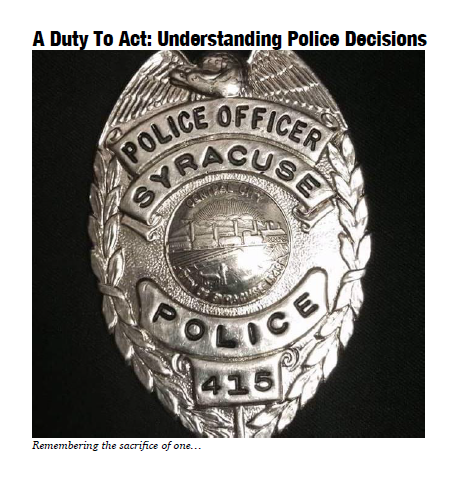
A Duty to Act: Understanding Police Decisions – Tim Boehlert

This forty page digital digest by Tim Boehlert is a comprehensive examination, summary, and reference guide that is the result of Tim’s attending a multiday seminar on police use of force.

The seminar centered around the legal and practical aspects of police use of force along with both citizen and police rights and responsibilities.

The digital digest is also filled with links and references for further study and investigation.

Click here to download.

Tools to Combat the Issues of Complacency vs. Reality Part III -Tim Boehlert & Matt Swartz, NYSP, Ret.

Day Two – Witnessing Reality

On day two of the academy we were shown showed a video of a roadside shootout. The aggressor shot until his gun was empty. He was also the target of the officer simultaneously. The aggressor was able to continue to fire on the officer, reload and fire more shots, get back into his vehicle and drive away. He made it about a mile or so down the road. The officer pursued, and when he approached the vehicle, only then did he discover that he had fatally shot the man. The aggressor was dead behind the wheel. That’s a long ‘Dead Man’s Ten!’

Read the FBI research on actual homicides. Read the Street Survival Series of books put out again by Calibre Press and Jim Glennon. Read the Artwohl/Christensen book on Police shootings. These are men and women that have prepared to take a life, but read about their ‘experience.’ Read the personal stories and insights. Ask yourself the hard questions now, because when ‘   it’ happens will you have time to ask yourself, your lawyer, your family, and your sensei? It’s not easy. Don’t delude yourself with macho attitude. These are humanized accounts of what happened and the outcomes. The effects it had on the police officers, their families, and their friends. How it totally changed their world. This is reality. Cold, hard, honest.

The Knife Solution

If you fancy that you’re a knife guy. Think about this. It takes very little skill to kill someone with a knife. A whole lot less skill than it does to do the same thing with a gun, I believe, in many instances. A gun allows you distance, which psychologically gives you an edge – distance is a form of de-humanizing the act. It de-personalizes your actions to an extent not possible with a knife.

Using a knife on another human is a very personal act. You will get their blood on you. You’re not going to walk away untouched by this act like you may after having shot someone. You will likely get cut or worse if it’s against another person wielding a knife. Learning whatever art you choose to use for this weapon is no guarantee. It doesn’t matter much if it’s FMA or any derivative. Because, even if you do prevail, is it going to be what you’ve fantasized it was going to be like, or did it even go down the way you ‘saw it ‘ in your own mind? No, it didn’t. That I can guarantee. It never does.

(Matt disagrees with me on this point and adds these insights for consideration: “repeatedly and effectively stabbing/slashing enough to kill? Not that easy. vs. pulling a trigger over and over [consult wound data comparisons]. I disagree and think the opposite is true.” I based my thoughts on the psychological investment inherent in an act of violence where death is the outcome, perhaps as a one-sided goal (his, not yours): intent, commitment and no ‘personal barriers issues’. Matt closes with: “Will power vs. Skill power = Kill power!”)

Check this out. Look up some prison knifings on YouTube. Watch a few, and see what reality really looks like. These guys have skills that you don’t and you won’t be prepared for their skills. To your mind, they may not be skills, but in the end, it works – with a knife, a shiv, or any manner of ‘weapon at hand.’ Skill is the least of it.

Now go find the brutal footage of terrorists using any imaginable means to kill people that they have effectively ‘othered’ –whether doing so for strong religious ‘beliefs’, or for strong political ideology as their driving force.

If you can actually sit through a few short glimpses, or watch an entire clip of one beheading, then at least you’ve witnessed the reality of reality. You’ve started down the road to enlightenment. From here, you need to stop and reassess your journey, but you will only if you are smarter and more responsible after having done so, for the benefit of others that you are training. There is very little skill involved in this act. Intent is the driving force, and you likely don’t possess that ‘skill.’

Reality as a Valuable Learning Tool – It’s Missing in our Curriculum

Reality is not a common learning tool, and it really should be. It needs to be. If we are to be Honest, and display Integrity, then we owe it to ourselves as well as to our students. We need to be better and more completely educated – even if and when it’s disturbing, and knowing that what we are teaching is not the whole story. It’s fantasy in too many cases. I don’t mean to say it’s intentional, as it isn’t always. But, it is intentional if we disregard the facts and the realities and don’t speak to it or teach it to our students.

Be responsible and accountable. Don’t propagate your ‘reality’ into impressionable minds. Do the research and then make those resources available. I have listed just a few herein.

Don’t be fooled by your own complacency – you’ve been training with willing partners, and following standard Dojo (read: sport) ‘use of engagement’ principles. They are falsehoods if you’re training to use a weapon against another human.

There are glitches and safeties built into your training methods and programs (thank you Rory Miller!) I’m telling you that you are fooling yourself and misleading your students. Can you really afford to continue this practice in good conscience?

There are many ways to speak to this subject matter, but the reality is that you probably haven’t yet faced reality. This is your wake-up call. Please accept the invitation. It’s my gift to you.

Who said you can’t learn any Martial Art from a book or by watching a video? I whole-heartedly and respectfully disagree.

In a future article I will expound more upon the Civilian Academy Experience – an overview that will include more in depth information about all three days.

Acknowledgement:

Matt Swartz, NYSP, Ret. is a very modest man possessing extraordinary talent and drive. He offered to read this article in draft form and provide me with some feedback, and I am so grateful that he did so. I met Matt briefly and by chance while attending an LEO-only training session a few years ago given by FLETC DT Senior Instructor Charlie Moore, USMS, Ret. Matt is the subject of a chapter of Charles Remsberg’s fourth installment of the original Street Survival series published by Calibre Press, titled ‘Blood Lessons’, which was used in Police Academies to train new recruits. I am proud to know Matt, and now even more so for his contributions to this piece.

https://www.policeone.com/health-fitness/articles/1811517-Trooper-interviewed-in-Blood-Lessons-named-Athlete-of-the-Month/

https://www.policeone.com/police-products/training/books-training-materials/articles/1811526-Book-Excerpt-Bionic-Trooper-from-Blood-Lessons/

https://www.amazon.com/Blood-Lessons-Life-Death-Encounters/dp/0981900801/ref=sr_1_1?ie=UTF8&qid=1486337120&sr=8-1&keywords=blood+lessons

Resources:

https://www.amazon.com/Killing-Psychological-Cost-Learning-Society/dp/0316040932/ref=sr_1_1?ie=UTF8&qid=1486306471&sr=8-1&keywords=on+killing

https://www.amazon.com/Deadly-Force-Encounters-Mentally-Physically-ebook/dp/B002ZRQ5BY/ref=sr_1_1?ie=UTF8&qid=1486306490&sr=8-1&keywords=artwohl

https://www.amazon.com/Name-Self-Defense-What-costs-worth/dp/0692250212/ref=sr_1_1?ie=UTF8&qid=1486306511&sr=8-1&keywords=in+the+name+of+self

https://secure.calibrepress.com/shop/books/street-survival-tactics-for-armed-encounters/


Stranger in a Strange Land Part II – Darren Friesen

As a Canadian having now lived in Costa Rica for 7+ years, I often get asked by expats on smooth(er) integration and immersion into a new culture. With some cultures having an innate dislike for foreigners relating to “stealing” jobs from nationals, losing unique elements of culture, cultural disconnects and the like, it can at times make one a target that stands out like the proverbial sore thumb. This article is the result, though not limited to the list itself as this is just the tip of the iceberg. Some conceptual ideas on survival and safety when living abroad as an expat:

  1. ….Visualize situations in advance and come up with a plan as to how you would act if…

(eg. Burglar comes in through the back, catches you off-guard in the night, alarm goes off, you hear someone fiddling with the window) Have that reaction hardwired by the time it happens. It takes no time at all and puts you in a state of constant vigilance. Preparation, not paranoia.

  1. With what’s happening in the U.S. right now with law enforcement “profiling” certain races, there’s been a negative stereotype, whether justifiably so or not in certain cases. But profiling can be an extremely effective tool for a civilian/citizen. What have the invaders done in previous home invasions? Were there more than one? What’re the common qualities of the burglar? (lower-class, multiples, from in-town/from out-of-town, poor upbringing, expose to violence at a young age, are they violent, could they be, do they have a history of violence) This is infinite but always better to know what you’re looking at than being caught off-guard by it. What places are populated by this type of person, where are they in accordance to your residence. Criminals are different in every place. A home invader in the U.S. may have different strategies and tactics than in Canada. Canada different than in Costa Rica. It’s not a universal phenomenon. It’s location-specific.
  2. Change routine. Take different routes to work, go to different restaurants, change your activity patterns at home. The more you act in patterns the easier it is for criminals to predict your behavior and take advantage of it. (“Bill goes out for supper with his wife every Tuesday to ChiChi’s at 5:00pm” – they watch and pick-up on these things.)
  3. Learn to think like a criminal. I call it the “Predator-Prey Reversal”. If you were a home-invader/mugger/kidnapper/car-jacker..hell, sociopath, killer, mass-murderer, active shooter, violence-driven individual…what would YOU look for in a victim? Don’t be that. Be specific and be extreme, it doesn’t make you a bad person to get in touch with your inner animal, you’ll find you can relate that much more to how others operate and make yourself less of a victim.
  4. Learn to “people-watch.” I have at times taken students to the mall for class. Just to watch people. Who hypothetically looks like a potential problem, interaction between people, notice suspicious behavior, who’s watching you, why.
  5. The modern criminal. There are two types of violence: social and asocial. Social is at the bar over a spilt beer, two men cockfighting over a woman of vice versa, demonstrations of physicality and an agreement to “settle things.” These rarely turn really ugly as they’re over pride. Asocial violence has a completely different dynamic: it’s to benefit one of the two people/groups involved. It’s not a fight they’re looking for but a victim and they have a profile too. Body language: fearful, slumped, short steps, looking down/only straight ahead, meek, submissive. Don’t be these things. Even if you can’t authentically, ACT persuasively like this in public, when there may be eyes on you. (And, yes, these actions can follow you home so it pertains more than a little to a home invasion, without a doubt)
  6. OC sprays, homemade/improvised sprays, tasers, stun guns. It’s not a guaranteed problem-solver. Know your weapon always if you’re planning on using it and NEVER bluff. If you’re called on it, the ensuing damage could be greater and more personal to the criminal as you’ve aggravated him/her. Practice how to use your tools: accessibility (where do you carry it, can it be deployed rapidly, do you know how to use it, what obstacles need to be overcome to utilize it-locks, switches, Velcro openings, etc.) What are the advantages and disadvantages of using it. (A spray is far more effective in the house than outside with a 30km/hour wind blowing against you) If you think you’re armed simply because you’re carrying a weapon, let me assure you that without this pre-emptive planning, it is a decoration, nothing more.  I haven’t seen many tasers here in CR with the two extendable prongs. The majority being sold are of the stun-gun variety which means what? You have to be up-close and personal with your aggressor to use it. Close-range. If you have no training and have inner doubts that it may get taken away from you, it will. And some sprays don’t work on everyone. They do testing where some people (not many but this goes to pain tolerance, skin resistance, drug/alcohol usage, your accuracy, the volume of spray that actually hits intended targets and other intangibles that you will not know at that moment)
  7. Internet safety. DO NOT post your activities on Facebook or other social media. After the fact is one thing but to do so before invites the criminal to find out when’s the best time to invade your home. “My wife and I are going to the Juanes concert tonight! Can’t wait, it starts at 7!” Not a wise idea, in fact, pure stupidity. And for those of you that say Facebook is safe and you’ve put all the necessary precautions up, you haven’t. It’s free so that means ANYBODY and EVERYBODY is on it, including the criminals. Be cautious of accepting people on your friend’s list that you don’t know, don’t completely trust, just met or are simply friends of people you know somewhat.
  8. Police take in the U.S. an average of 11 minutes response time for home invasions, from what they’re announcing recently in the U.S. and Canada. (ADT advertises in Canada for 33 minutes before police arrive through their monitoring) How much more do you think it’d be here?? Significance? You can’t rely solely on this element to protect you and keep you safe. Most home invasions will be solved, one way or other (if you get what I’m saying) long before the 11-minute mark, if you even have time to put this train in motion. And, remember, police here aren’t always your friend as this is a small country and they may have grown up in the community along with many of the people who have intent to rob you.
  9. Get in habit of “proofing” your house to the extent you’re able…daily. This is one pattern that is a good one for both yourselves and onlookers. Lock windows and doors before leaving. Skylights. Check for other openings that you may not have thought of where they can get in. Are there weak points in your property that open themselves to unlawful entry? Points where the CCTV cameras don’t hit? Areas with poor visual acuity? Blind spots? Be prudent.
  10. Post-incident. Here’s one that doesn’t get enough respect: learn basic 1st You simply never know regarding the aftermath of violence. Loved ones may survive who’ve been left for dead or are dramatically injured, including yourself. A little damage control goes a long way.
  11. Post-incident. Never chase after your aggressor if you’ve managed to survive the initial robbery in-tact. A) Its no longer self-defense. B) You are re-initializing potential violence and C) could end up 6-feet under.


Personal Security Theatre – Mark Hatmaker

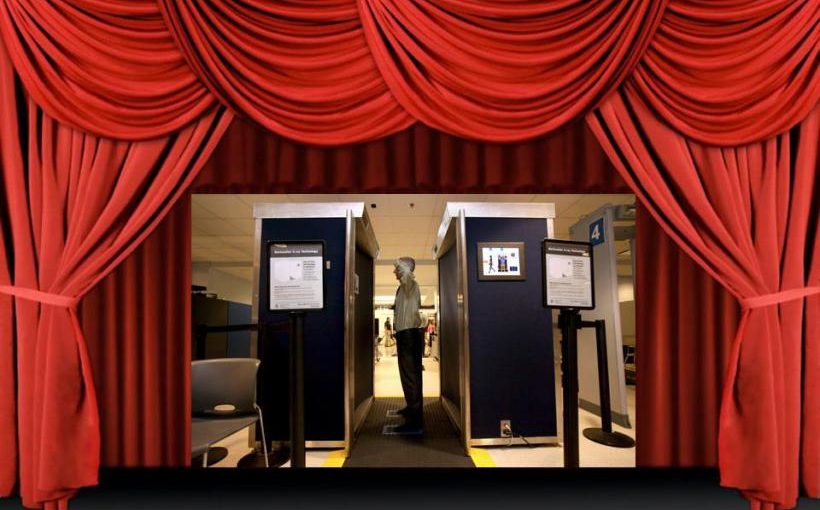
The Transportation Security Administration [TSA], designated cops in schools [aka School Resource Officers or SROs], gun-free zones, random bag checks on subways, and other like-minded safety initiatives have been called security theater by more than a few wise minds.

Computer security maven Bruce Schneier is credited with coining the term security theatre. Mr. Schneier is author of the prescient and illuminating book Beyond Fear: Thinking Sensibly About Security in an Uncertain World.

He offers that the TSA does little to nothing to “keep us safe” and this large outlay of expenditure and labor is there to act as nothing more than a pacifier or Linus’ security blanket for a cowed populace.

Mr. Schneir is not alone in this assessment, Ross Anderson, is a Professor of security engineering, University of Cambridge Computer Laboratory. His research bailiwick is that of the economics and psychology of information security.

Professor Anderson is equally as scathing in the review and record of any of the mentioned displays of security theatre and their purported benefits. [His book Security Engineering is a must-read in the industry.]

Security Theatre is designed [well-intentioned or not] to convey safety/security benefits that dissolve upon close examination.

By this point we are all well aware of the cost-to-benefit absurdity of the TSA’s abysmal record; the TSA’s own internal assessments are less than admirable.

School Resource Officers also come up short, an excellent piece on the perversity of this policy can be found in the Reason magazine article “Why Are Cops Putting Our Kids in Cuffs?” by Robby Soave & Tyler Koteskey [Reason March, 2017.]

Studies of Random Bag Check Policies on Metro Subways in several cities reveal yields of zero arrests despite what many rightly see as infringement of rights. And gun-free zones, well, as we painfully know those who abide by that bit of theatrical law are the very ones we’d prefer to be armed. [At least that’s my preference.]

The purpose for discussing security theatre today is not to provide yet another reason for we the outraged populace to shake our collective fists at our “betters” in bureaucracies but rather to turn the accusatory lens around.

Yes, the aforementioned theatrical productions are unwise, immensely costly [in dollars, time, and in some cases lives] but our outrage seldom does little against our leviathan bureaucratic systems of governance.

Since we can do little to affect security theatre on the macro scale I ask what might we be able to do in the micro, that is at the personal level?

What habits, behaviours, bits of theatrical security showmanship might we be indulging in in our own lives that when we put the cold hard light of pragmatics on it dissolve into TSA uselessness?

Here’s a brief battery of questions to allow you to self-assess.

Do you own a personal protection device?

If so, do you regularly carry it?

Be that device a firearm, a tactical folder, a Taser, hell, it could be a phaser from the future, if it is not carried, that device is no more than a prop in your amateur personal security theatre production.

If you do carry a security tool, have you been trained in its use?

Do you regularly “groove” your training with weekly sessions? [We must always keep the mantra regarding skills in mind “Use it or lose it.”]

Is your device one of actual practical value? This must be asked, as over the years, I have seen many variations of doo-dads that can attach to your keyring or gravitate to the bottom of purses that may be nothing more than teensy theatrical props.

Case in point, the pocket kubatan. I have seen these for years and I ask you honestly how many reports have you encountered echoing these lines?

“I was approached in a parking lot by three shady characters, but fortunately I had my kubaton and lived to tell the tale?”

I’m not picking on the kubaton exclusively, with a little common sense and a little candour evaluate your own tool and ask if it is a benefit or a security prop?

Allow me to ease potentially ruffled feathers by reversing our lens again.

Assuming you think the TSA is an efficient and effective body protecting you from terrorist threat would you approve of a mandate that stripped them of their firearms and instead provided them with kubatons vs. terrorists?

Would you feel safe in a “bad” part of town if you knew that all the cops kept their guns not on their person but somewhere in their glove compartments or at the bottom of their cop purses?

How about if you knew they had never been range qualified for the weapons they carry? Or, if they had been qualified have never bothered to train with the weapon again?

You see what I’m saying, what’s good for the goose is good for the gander. If it is unwise policy and security theatre for those uphill in the hierarchy, I argue that is all the more unwise and dangerous when we look at ourselves as we are inevitably always the first responders in every incident in our own lives.

Let’s turn that lens around upon ourselves once again.

Have you trained in self-defense?

Notice I did not say tae kwon do, Brazilian jiu-jitsu, boxing, or any other combat sport. As formidable, fun, and worthy of merit they all may be in their own arenas, a mere 15 minutes out of your life viewing actual assaults on YouTube will reveal that violent reality seldom resembles a sportive construct.

So, again, have you trained in self-defense?

If so, do you regularly touch-up your skills?

If not, that krav maga class from a few years back or that half-hearted touch-up of skills occasionally is akin to the weapon seldom if ever fired.

Self-defense that does not reflect real-world realties is akin to mime in our security theatre presentation, that is, an art form best performed by oneself for oneself as no one really needs it. [Apologies to mimes everywhere, in truth, I find Chaplin a genius.]

To carry on our theatrical criticism, much lip service is paid to awareness, alertness, mind-setting, and like “eyes of a warrior” mentalities. And yet, I know many [many, too many] folks who preach that message who conduct their lives with heads-down and phones out—this is particularly conspicuous at airports and all large public gatherings where one would assume that this touted “warrior alertness” is most in need.

To give voice to awareness and mind-setting talk is, again, security theatre, the mere uttering of lines in a play. We say the words we think that a high-speed/low-drag seasoned Navy SEAL would utter, but if we aren’t stepping up to the words we are simply playing a role and we may be fooling no one but ourselves.

So, again, I ask you what’s your own bit of security theatre and what can you do to take it from the playhouse to the streets.


Road Talk: Season 2 – Varg Freeborn

 Listen to the audio now online or download for later when you are offline.

Episode 1 – Mission Parameters
Mission parameters are the internal boundaries we set for our mission that define how far we are willing to go and what we are willing to go there for. Many mistakes in violence that end in death or prison are rooted in poorly defined parameters.

Episode 2 – Self-defense May Not Be What You Think
The importance of understanding what self defense is, and isn’t.

Episode 3 – Instructors and Students
A rant about the role of instructors and students. More cooperation and less competition among instructors. Students, branch out and get a variety of training. Lower level instructors get your head out of your ass and get out and learn something so you can quit teaching garbage to unsuspecting students.

Episode 4 – Confidence vs. Fantasy
Hypothesis, Theory or Fact. How realistic are your beliefs about your fighting skills?

Episode 5 – Situational Awareness
A different view on situational awareness and learning how to relax by having a good threat assessment system.

Episode 6 – Knife As a Self-defense Weapon
My thoughts on why using a knife as a “self-defense” weapon is a setup for failure on many levels.

Episode 7 – Fallacies of Judged By Tweleve – Part I
Thoughts on the fallacies of saying “I’d rather be judged by 12 than carried by 6”.

Episode 8 – Judged by 12 – How Not to Think About it – Part II
Ways to NOT say “I’d Rather be Judged by 12…” and other ways to stay out of jail (and the ground).

Season 2 – All Episodes 1 – 8

Listen to all the episodes at one time (70 minutes total)

Road Talk: Season 1 – Varg Freeborn

 Listen to the audio now online or download for later when you are offline.

Episode 1 – Your Mission
A quick talk about the importance and meaning of conditioning for the fighter (and self defense civilian, leo, etc.)

Episode 2 – Orientation
Your “orientation” is the foundation for how you will react to a violent encounter. It encompasses everything that makes up your decision making process and parameters. Orientation is one of the two major components of a fighter, (the other being conditioning.)

Episode 3 – Criminal Combat Culture
Some talk about criminal combat culture and prison combat culture, and how it affects the orientation of the violent criminal in such a way that puts the good guy at a deficit.

Episode 4- Conditioning
A quick talk about the importance and meaning of conditioning for the fighter (and self defense civilian, leo, etc.)

Episode 5 – Kata Based Training vs. Reality Based Training
A few thoughts on the differences between kata based training and fight application.

Episode 6 – Concealment
Concealment means more than just hiding a weapon. This applies to understanding your threat and enemy as well.

Episode 7 – Aftermath of Lethal Force
A quick talk covering the psychological and social aspects of the aftermath of a lethal force event.

Season 1 – All  Episodes 1 – 7
Listen to all the Episodes without interuption.