Principles-Based Teaching, Part V – Rory Miller

Recap: the first four articles in this series covered the concepts behind principles-based teaching. Understanding the goals of training in general and your training in particular. Understanding what principles are. Auxiliary skills that every good teacher needs. Basic methods of instruction.

Teaching and learning are not just technical, physical processes but mental and emotional as well.  On a psychological and emotional level, you have to prep people for learning. One of the most toxic things we have done in martial arts and in some of the reality-based systems is to make conflict special. People come to us convinced violence is alien to them, it is complicated, it is hard to learn. With new students, part of the teaching (cognitive) process is to explain that violence is natural. The physics are the same as any other physical activity and the mentality is part of our evolutionary heritage. It’s been hammered and brainwashed out of your students, but they are all natural fighters, all survivors.

For the physical aspects of self-defense, the teaching pattern is simply:

Game

Skill build

Return to game

Accelerated game(s)

Scenario training

I like having an over-all game that skills tie back to. The game has to be well designed:

  • Known safety flaws, minimal bad habits
  • Contact
  • A competitive element but not a competitive focus
  • No winners or losers

Every live training must have safety flaws. In the end, martial arts is about damaging a human being, yet we must not damage our training partners. So there is always an element of artificiality introduced for safety. You and the students must be conscious of the safety flaw.

Life is a contact sport, and fighting and self-defense are even more so. You cannot develop skill without contact any more than you can learn to swim without water. You must design games that work at different levels of contact, but each level of contact will have different safety concessions.

I like the game to have a competitive element to it, but no winner or loser– you are going to strive to be more efficient than me, but if you excel at that, you haven’t beaten me, just given me a more challenging problem to solve. The problem with full active resistance or any form of direct sparring is that only the winner learns that “it works against a resisting opponent.” The loser, who probably needs the skill more, learns that it fails against resisting opponents. Failure is not a lesson you want to teach at the beginning stage. Dealing with failure is an important lesson, but the student must be ready for it and you must have the judgment to teach that lesson.

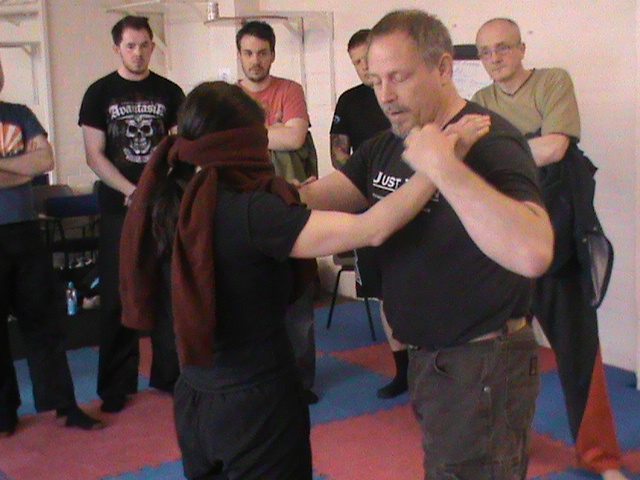
I use three levels of play. Each level involves more speed but less contact. I start with the one-step. That’s the slow motion, taking turns, efficiency exercise described in Drills: Training for Sudden Violence, (That’s Smashwords. Link to Amazon Kindle.) Next level up is to blend that into a faster flow drill. The third level of play is infighting randori–fast, all techniques allowed, but very controlled contact.

The one-step helps the students see opportunity and experiment with multiple types of force simultaneously. It is safe, requires very little training and has many variations. It is particularly useful at pointing out the bad habits that come from fast training.

The primary flaw in the one-step is the slowness. You must face speed to be prepared for speed. A flurry attack is often mentally and emotionally overwhelming. The slowness can also be exploited to cheat, if the students can’t get over the winners/losers concept.

Drills are what they are and no more. I never call the one-step a fight simulation. It is a geometry problem made out of meat, and your job is to solve the moving meat problem as efficiently as possible.

The one-step allows thinking time. The flow level speeds up the action and decreases cognitive time, which is a good thing. But any increase in speed has drawbacks:

  • As the students go faster, they see less and thus they learn less
  • As the speed increases, the safety flaws become more necessary
  • As the speed increases the safety flaws have to become more automatic. Speed ingrains habits harder, including the bad ones.

Students need supreme control and confidence to play infighting randori well and safely, and frequently, this one has a winner. It integrates skills better than anything I know, because it is too close and too fast to process cognitively. The range allows all categories of attacks simultaneously: strikes, kicks, strangles, locks, takedowns, biting, gouging, etc. and because of the complexity and speed, it rewards and reinforces adaptability under stress like no other drill I know

Scenario training is an attempt to simulate real encounters. It requires the right equipment and a superbly skilled team to run scenarios well. Done well, scenarios force students to use judgment in tandem with their skills and integrates self-defense skills beyond the simply physical stuff.

Those are the games I use. A student will play the one-step first, before any instruction whatsoever (other than a safety briefing and a demo of how to play the game). This is important, because if they give themselves permission to play, it doesn’t require special training to be effective. This reinforces the earlier message that none of this is special, surviving is what you evolved to do.

The process, from here is simple. Play the game, do a breakout session for skill building. Put the students back in the drill.

Skill building sessions require you, as the instructor, to know your building blocks and principles inside out. You must come up with ways to demonstrate them and, more importantly, ways for the students to experiment, discover and experience the concepts.

One example: Joint locks breakout session.

First talk (Teaching): There are a few principles that are critical for making locks work, so leverage, two-way action, exploiting gravity, basing, and “gifts” (you don’t make locks, you find them) are explained. All principles are demonstrated and the students get to ask questions.

Second talk (Teaching) There are only three kinds of joints you can lock in the human body: Hinge, ball-and-socket, and gliding. Hinge joints are locked by applying force just above the joint and as far down the lever arm as possible.

First game: Challenge the students to come up with eight different elbow locks each. (Elbow locks are safer than knees or fingers at this stage).

First discovery— the students will see that there are both an infinite number of locks and only one.

Second talk and first game are repeated for each type of lock.

Special session on fingers because they are a doubled hinge joint in the same grip space as a ball-and-socket joint and close enough they can be spiral fractured against each other. Fingers are an especially target-rich environment.

Second game: After all the joints are covered, the next game is a lock-flow drill where students practice seeing the gifts.

Then the students return to the 0ne-step. Not to do only locks, but because locks are fresh in their brains, they will see a lot of them.

Repeat the cycle. Break them out of the game to work on something else, like targeting. Then put them back in the game. 

Theoretically, you could, after each skill, increase the speed through the flow and randori levels. 

I don’t do it that way. They can work on the principles in one-step forever. I move them to flow and randori based on their abilities and confidence level. Animals learn through play and the first exposure to randori should be fun and slightly overwhelming but shouldn’t make them feel terrified and helpless.

The last, critical piece to self-defense is to occasionally run good scenario training. That allows them to use their skills in tandem with their judgment. And use more force, because of the armor. That said, scenario training is very hard to do well and safely and easy to do poorly. And poor scenario training can mess up students, physically, tactically and emotionally. It is better to stay away from them completely than to do them poorly. You need not only proper instruction, but practice.

In the end, the goal of real force training is to be ruthlessly efficient. To achieve one’s goal with the absolute minimum of wasted effort and time. PBT is my attempt to apply that sensibility to teaching as well. To use everything we know about how people learn and how they react under stress to create a superior survivor in the minimum time. Principles-based training is a step in the direction of ruthlessly efficient instruction.

There are some caveats, though:

1) Done properly, it allows and encourages creativity. Which means your students will innovate some sneaky shit and beat you far sooner than if they train in techniques. PBT is not a good method for egotistical instructors.

2) It can be hard to measure and test. Using this platform for jointlocks, we’ve gotten untrained officers improvising locks under pressure in an hour. And some of those locks would seem to be advanced. But they wouldn’t have been able to name a lock or to demo a specific lock. Which makes organizations and concrete thinkers uncomfortable.

3) It’s incompatible with most martial arts business models. The student/teacher relationship will shift to colleague/colleague very quickly. I like that, personally.

To quote Melody Lauer, a handgun instructor in the US, critiquing a (completely unrelated to me or PBT) class she had recently attended: “The way the class is structured and the instruction method demands an excellent instructor to pull it off.”

Principles based training elicits excellence from the students, but it demands excellence from the instructor.

 

From the streets to the Ivory Towers and back – the other side of conflict research, Part 2 – James Hall

Last month, the first part of this article offered an introduction to the research into conflict and violence undertaken by Universities and other institutions. This month, we will look at how this extensive body of institutional research can be accessed.

The main channel by which academic and other institutional research is exposed to the rest of the world is academic journals. Tens of thousands of different journal titles are published worldwide, containing articles written by researchers and reviewed by peers, i.e. other researchers in the same field as the author. Journals may be published in print, electronic or both forms. Unfortunately for the lay reader, academic journals are nowhere near as accessible, and often nowhere near as readable, as the books and blogs and websites which many of us are more used to. Most academic journals provide access on a subscription basis only, which for individuals can be expensive – over £100 / US$150 per journal per year in some cases. Some ‘open access’ journals can be accessed free of charge, usually online, but the journals with the strongest reputations for high quality research often charge the highest subscription fees, and vice-versa. Identifying relevant journals from the vast number of published titles can also be challenging, particularly in an inter-disciplinary field such as conflict and violence. Some journals exist which are specific to the field, and relevant research is also published in journals specific to each of the many disciplines which conduct research into the various dimensions of conflict and violence.

Lastly, research in academic journals is presented in a format and style which is intended for an academic audience, not the lay reader. Academic readers will be interested in not only the outcome of the research and its implications, but also in its design, the quality of its statistical analysis, and so on. Sections of some academic articles will be meaningless to any reader who doesn’t have at least some education in statistics beyond High School level. All of these challenges can, however, be overcome, with a little effort.

The most accessible starting point when exploring academic research is Google Scholar (http://scholar.google.com). Entering search terms (e.g. ‘teen dating violence’) into Google Scholar will return a list of academic resources matching the search terms. Often, only a summary of each article will be available, but in some cases the full article may be accessible as a PDF or via a web link. However, this is a comparatively unstructured approach which may not be the best if you are looking for high-quality research on a specific topic, in which case your nearest University is probably the best resource.

Most Universities have institutional subscriptions to numerous journals, which are made available for students, faculty and staff via their Library service. Some Universities also offer access to members of the public, although practice varies widely. For example, in the UK: Bristol University offers no public access at all; Oxford University’s Bodleian Library provides public access to its printed and electronic resources for £38 (c. US$60) per year; Birmingham University offers access free of charge to its printed resources for up to ten visits per year, or unlimited access to printed resources and limited access to electronic resources at a cost of £50 (c. US$80) per year; and Nottingham University provides unlimited public access to printed resources and its pubic e-resource suite completely free of charge. In all cases though, resources can only be accessed at the physical location of each University’s library – printed resources cannot be borrowed, and electronic resources cannot be accessed remotely. A good starting point would be to contact the Library service at your nearest University and ask about their public access policy.

Identifying relevant and credible journals is just as much of a challenge for students as for members of the public. Consequently all University libraries have expert staff who will be happy to offer help in this regard. Demand for this service from students tends to be greatest as deadlines approach, which tend to be towards the end of terms / semesters, so the Librarian service (or equivalent) may be more available in the middle of term / semester when student demand is lower.

Examples of relevant journals include:

Subscription-based:

  • Psychology of Violence (http://www.apa.org/pubs/journals/vio/)
  • Journal of Interpersonal Violence (http://jiv.sagepub.com/)
  • Violence and Victims (http://www.springerpub.com/violence-and-victims.html)

Open access:

  • Journal of Aggression and Violent Behaviour (http://www.journals.elsevier.com/aggression-and-violent-behavior/open-access-articles/)
  • Journal of Injury and Violence Research (http://jivresearch.org/jivr/index.php/jivr/index)

Some subscription-based journals offer open access to selected articles, e.g. the International Journal of Conflict and Violence (http://www.ijcv.org/)

The credibility of journals and individual articles can often be gauged by the number of times a specific article, or articles published in a specific journal, are referenced by other researchers. The databases to which University libraries often provide this information, and again the Librarian service should be able to show you how to access this information. This is only one indicator, however – newer research will obviously have been referenced by other researchers less frequently than older research.

Gathering the important information from journal articles is largely a matter of understanding how they are written. Articles presenting different types of research will be presented in different formats, but most will follow a structure resembling the following:

Abstract: All articles will begin with an abstract, which is a short summary (usually no more than 200 words) of the article. A well-written abstract will state why the research was done, how it was done, the main outcome of the research and the main implications, in a style which is easy to read. The purpose of the abstract is to enable the reader to decide whether to invest time in reading the full article, which is important for the academic audience, but for the lay reader the abstract will often provide enough information by itself. Subscription-based journals which are published online often make the abstracts of their articles available free of charge, charging only for access to the full article.

Introduction: The main body of the article will normally start with an Introduction, which sets out the background to the specific piece of research and why it was done. It should clearly state the ‘research question’, i.e. the specific question which the research aims to answer. This section usually contains references to earlier relevant research, so it is always worth reading the Introduction as it can point you in the direction of other articles which may be of interest.

Method: The next section normally describes the method by which the research was carried out, which could be anything from an online questionnaire to a complex lab experiment to a thirty-year longitudinal study. This section is vitally important for the academic audience, as it enables other academics to attempt to replicate the research in order to confirm or challenge its findings. Where the article is based on studies of real people (as opposed to published statistics or analysis of other research), for example psychology experiments, this section should include a description of the Participants, i.e. who took part in the study. This description should consist of the number of participants, the range and average of their ages and the proportion of males and females. In some cases, particularly in large or long-term studies, researchers will select their participants very carefully in order to try and make their sample as representative as possible of the population in general. In other cases, researchers will use ‘opportunistic sampling’, i.e. whoever is available. Understanding the profile of the participants is important in deciding the extent to which the findings of the research apply to the population as a whole. If the sample is strongly weighted in favour of one gender, or drawn from only a narrow range of ages etc., the less generally applicable the findings may be.

Results: In a well-written article, the Results section should set out the results of the research in plain English (or whatever the language of publication happens to be) and provide the statistics to back it up. The plain English part should suffice for those of us not expert in statistical analysis.

Discussion: The Discussion section usually links the findings of the study back to the earlier research identified in the Introduction – e.g. whether the study supports or contradicts earlier findings. It should also set out the implications of the research, for example whether it challenges the accepted understanding of a phenomenon or current social policy. In a well-written article it should also identify areas for further research and the authors’ reflections upon their own research, e.g. with hindsight, whether the method could have been improved.

In summary, while the language in which academic articles are written may not always be easy for the non-expert reader to follow completely, by understanding the typical structure of an article it is possible to find and absorb the most important pieces of information.

Following the work of specific researchers is another way to keep up with developments in relevant research areas. All journal articles will give the name of their author(s) and their institution(s). Institutions normally provide a ‘People search’ and/or ‘Contact search’ function on their website, which will enable you to find the web pages and contact details of the author. Many researchers are happy to be contacted by people interested in their research, and of course some will be active bloggers and users of social media.

Currently, it seems that there is little crossover between the worlds of experience-based and academic research into conflict and violence. I hope that this article will be a starting point in developing links between these two worlds, and that you will start to explore the immense body of institutional research into conflict and violence for yourself. I personally am about to return to study with the intention of getting into research into the psychological aspects of conflict and violence. It’ll take a while to get there, but along the way I hope to develop more and stronger links between the worlds of practical self protection and institutional conflict and violence research. If you would like to stay in touch with my progress, or discuss any matter covered by this article, please find me on Facebook (/james.hall.902819) or e-mail me at hall.jp@gmail.com.


How to get your ass kicked in any conflict situation… – Schalk Holloway

I was lucky enough to finish school with a full academic bursary. I could basically pick any tertiary institution in our country and enroll for any graduate course that my final marks allowed for. Long story short I proceeded to enroll in Tswhane University of Technology in Pretoria, South Africa. It was part of their first year student culture – especially if you stayed in one of the University’s hostels – to undergo a lengthy hazing process. This included not being able to leave the hostel for any social reason until a bit later in the year.

This anecdote plays off on the very first night I was allowed off campus with my senior hostel members. I was 18 years old. Comfortable with getting in trouble, but still very naive about violence and especially predators as I grew up in quite a small and relaxed town on our country’s north coast.

As we left one of the clubs I saw a group of guys approaching one of our seniors. One of that group’s members initiated a dumbass argument with him and subsequently it turned into a fight. My senior was quite a big boy and I thought him able to handle himself in most situations.

As the two of them were going at it (now on the floor) one of the other group’s guys moved to jump in on my senior. I judge he was about 15 – 20 years older than me, smaller but with a lean and capable look to him. Still, I was confident in myself. I put my hand out against his chest and told him to leave the two of them to sort it out. He looked at me with a huge smile on his face, gave me a playful tap on the shoulder and said something like, “yeah buddy, you know what, you’re right, let’s leave them.”

As I turned back to the two guys on the floor that dirty old bastard hit me as hard as he could behind the head. I immediately retaliated but I effectively had my ass handed to me for the following five minutes.

So what can we learn about conflict management from this episode? Quite a bit actually but let’s try and glean three important insights. Let’s break it down into where I went wrong, or, to link back to the article title, let’s look at how to get your ass kicked in any conflict situation:

1. Assuming your opponent is playing by your rules.
I got into a lot of fights and trouble growing up in my hometown. However, most of these were cases of me getting into trouble individually. Even in terms of physical fights it was almost always a one on one situation. I can remember ONLY ONE occasion in my first 18 years which was a serious group effort, but that’s it. So basically I was molded into this idea of guys sorting each other out one on one. Then I took that assumption into the big city and projected it onto my opponent. Ha ha ha, as you saw, big mistake! (But good lesson.)

This dynamic can only be solved with one of two tactics. First, is to try and understand who you’re dealing with. What type of animal are you in the cage or about to get into the cage with. As seen above however these lessons mostly come through experience. However, regardless of what type of conflict situation you’re in – whether relational argument, marriage issue, business deal, legal matter or physical fight – understanding what makes the other party tick gives you an immense advantage in successfully resolving or prevailing in the conflict. The second tactic, and this is especially relevant when there is no time, basis or need for a proper character evaluation, is to just go at your opponent as if they are the worst, dirtiest and hardest opponent you’ll ever face. Get in, get the job done, get out. All business.

The sneaky old street fighter immediately made an accurate judgement on me based on my request to let them sort it out one on one. He then used this accurate judgment against me by playing into my naivety and disarming me with his big smile, friendly tap on the shoulder and agreeing words. Clever guy. 😉

2. Giving away initiative.
I saw the dirty old streetfighter go in long before he saw me. He had initiative on my senior but I had initiative on him. I essentially gave this superior position away by using the wrong tactics ie. I should have just climbed into him. However, this was not possible due to the wrong assumptions I held about him.

One of the best advantages of having and maintaining initiative is that it creates different types of stress for your opponent. One of these types of stress that I personally have a lot of love for is disorientation. As your opponent has to constantly deal with new incoming stimulus (whether verbal judo, physical attack or even revealing new information) it becomes a struggle for him to orient and compose himself to the situation. Still dealing with stimulus A and then suddenly being hit by stimulus B becomes highly taxing on his resources – and eventually he starts to fall behind.

The moment that guy started climbing into me he just kept going. Doesn’t matter what I did or how I did it, he just kept going. He was always one step ahead of me and I really never caught up.

3. Losing heart.
A couple of minutes into the fight he spear tackled me onto a car’s bonnet. I was quite desperate by this stage and still playing catchup. I lifted myself up, went into a controlled fall and drove my elbow down as hard as I could aiming for the back of his neck. I really put a lot of effort into that strike. I missed though. Immediately after this effort he straightened out and stood up. I gave him quite a solid right cross in the face. Then he chuckled at me and said “you’re hitting me but I’m not feeling anything.”

I have to be honest but at this stage I stopped fighting and started retreating. Missing that critical strike (remember I was playing catchup and desperately needed something to regain initiative) and hearing those words completely broke my will. I lost confidence started to seriously doubt whether I was going to survive this encounter without serious injury. I started playing a defensive game and he just kept on coming at me. Suffice it to say, to this day I have never had a worse beating than on that night.

After this beating I learned a lot about causing others to lose heart. I have used the tactic to gain the upper hand in many conflict situations. But here’s a secret – sometimes I was the one about to lose heart and then I used the tactic as a last ditch effort to gain or keep my advantage in the conflict. Ie, just before I felt I’m going to throw in the towel I made an effective last play at intimidation, power projection etc. and it worked.

Which begs the question: What is the chance that ol’ streetfighter was about to quit himself? The possibility is there (ha ha ha, however I don’t think it was with him) but in reality I’ll never know. What if I didn’t give up and kept on fighting? Was I possibly one step away from regaining the upper hand and then I gave up? I’ll never know.

But on the other hand, maybe I did keep on going and I got killed. And I guess that’s the problem with conflict. We need to be sure why we’re getting involved in the first place. It’s only when we understand the stakes that we can decide on our commitment.

From Your Heart! Passion is a must. – Robert Frankovich

When students perform their techniques, whether in drills or patterns, it is very easy to tell if they are actually trying or merely dancing around. This is one of the tricky parts within training…or any education.

I had a student tell me that the way to fix that is to make them work harder. How does that get accomplished? Make the drills longer? Count louder? Stand over them the whole time? Nope. Never going to make their training better that way. If their passion hasn’t developed yet, no external factor will change the behavior.

Does training actually fit their goals? Are they looking for physical improvement? Maybe they just want the socialization in a subject matter that interests them. The only way that a student will improve and develop skill is when they choose to. This is a deceiving point, too, though. I’ve asked students to adjust technique to make them more effective and have gotten “That’s what I’m doing!” as a response. (We won’t discuss the respect issue now) But since it makes no sense that I would waste my time asking for things to be adjusted/corrected for no reason, they still haven’t chosen to learn the technique past what they “think” it is.

Now, I’ll give credit to those putting in effort and working but poor technique can only be helped so much by strength and commitment. There is some passion there, although needing direction. I came across a saying the other day which is very accurate. It stated “If you can’t do it slow, you can’t do it right.” which fits the piece above. The idea of being able to go slow would mean that your mind is in the work as well and that will show in your hands (and legs).

I would wager that, if you are able to put your mind into the focus of the work, your heart is involved also. This changes the fear and anxiety and nervousness into enjoyment. Those feelings and emotions fade as the passion grows. The development of your passion is seen in the performance of your techniques. You start to see deeper and understand more. The desire to see others succeed rises and helps create the desire in you to work harder and learn more. It brings students together as a community…family…who supports each other off the floor as well as on. You are now building your passion.

The activities that are physical can easily illustrate how passion grows the skills and knowledge. You can find many YouTube videos of a 13 year old playing an awesome guitar piece. Another can be seen with the number of 16 and 17 year olds performing on “The Voice” talent show.

Physical talents are not all, though. Recently, our high school junior son had a classmate over. The discussion turned to the plant on the kitchen window ledge. Once he saw it, his eyes lit up and he started commenting about the leaves and their size. That lead him to the 20 plants that he has and their growth cycle including blooms and developing offshoots. This was not knowledge repeated from a book. It was the knowledge born from his passion for plants. It kind of makes sense, then, that he’s focusing on chemistry and biology among his AP & Honors classes. He stated that it would probably be his best route to get into a career field that will let him work toward a botany position.

These factors to improve your training are the same as those you need to develop your career, regardless of the field. If you don’t have a passion for what you are doing, how can people believe that you are knowledgeable and competent? Make sure your heart is in your training.

Understanding how to direct passions into jobs that pay the bills is an important point. If you can spend your time earning money while learning and developing your passion, then you have success and will enjoy more of your life.


MISTAKING MODELS FOR THE REAL THING – Mark Hatmaker

We’re going to take a weird sojourn through 17th-century French theater, an eyewitness account (names withheld) of an embarrassing demonstration, 10-day weather forecasts, and end (hopefully) with a point about taking drills too seriously.

First, a trip to the theater with an excerpt from Moliere’s The Bourgeois Gentleman, the premise of which is that a shopkeeper newly come into money decides that to be one of the upper-crust he needs to take great pains to “become cultured.” He engages numerous “culture instructors” who gladly take his money and leave him none the wiser or better cultured.

One of these “culture instructors” is a fencing master who teaches him a few basics in the form of a call-and-response pattern (sounding familiar?) Later, within the play, our cultured dupe decides to display what he know about fencing with an un-cultured person who knows nothing about fencing.

Mr. Jour: Goodness me! The fencing master seems to set your teeth on edge. Come here, and I will show you at once your senseless impertinence. (He asks for two foils, and gives one to Nicole.) Here, reason demonstrative the line of the body. When you thrust in quart, you have only to do so; and when you thrust in tierce, only to do so! That is the way never to be killed; and is it not a fine thing to be quite safe when one fights against anybody? There, thrust at me a little to try.

Nicole: Well, what? (Nicole gives him several thrusts)

Mr. Jour: Gently! Hold! Oh! Softly. Deuce take the wench!

Nicole: You tell me to thrust at you.

Mr. Jour: Yes; but you thrust in tierce before thrusting at me in quart, and you haven’t the patience to wait till I parry.

Familiar scenario, huh?

Now, the eyewitness account (my own). In the distant past I observed a renowned instructor in the midst of a seminar-based video shoot ready to show a “fool-proof” top-saddle/mount escape. He hits his back, asks someone to mount him. The volunteer is simply a “Nicole,” by that I mean, he had no special training, just a good sort doing what he was asked to do by the man in charge.

Our “Nicole” takes the top position and our “instructor” does his thing which appeared to be a boisterous wiggle to which “Nicole” posts his hands on the mat and remains stubbornly on top. Our instructor tells “Nicole,” and I quote “You wouldn’t do that.” I and a few others present exchange looks with cocked eyebrows that say “Well, obviously he would.”

Instructor bucks again, Nicole does what he would not do yet again, and again is chastised. The third time is the charm as Nicole “behaves” properly and the fool-proof escape and scene from Moliere is now complete.

I’m sure we’ve all seen countless demonstrations of “if you do this, I’d do this to you.” Uh-huh, sure you would.

Yes, drills have their place to teach us a vocabulary, but often the rookie (and unfortunately some beyond that stage) behave as Mr. Jour and believes that the drill is the real thing- the map is not the territory.

The best drills make no predictions further than 2-3 tactical responses in, and even these are “best guesses.” Long-form drills, even if front-loaded with wise choices, become less wise as they continue.

Let’s look to meteorology for a lesson in why that might be the case.

Despite the horrible reputation and abundant bad jokes about weather prediction, in the short term meteorological predictions are quite accurate. Predictions in all other arenas (politics, war outcomes, fashion trends, the next “big thing”) these fail left and right. The weather predictions seeming more wrong than they are simply the result of the fact that they predict every day and when they do get it wrong we are reminded of it by the extraordinariness of the wrongness-the rained out picnic, for example. No one is taken to task for saying Johnny Depp’s next movie will be a big hit, as a theatrical bomb does not rain on our plans.

To see just how extraordinarily right weather predictions can be, keep screen shots of 2-3 day forecasts over the next two weeks and at the end of that period you’ll find that if you go back and compare the 2-3 day out predictions with what did occur you just may gain some new respect for the profession.

But in that same two weeks of keeping screen shots do the same thing for the 10-day forecast and see how often the 9th and 10th days were on target. Not so much, as a matter of fact a careful look at the screenshots will reveal that the extended forecast is constantly changing as new data comes in (and wisely so). In essence, the 10-day is eye-candy, where the real science is in the 2-3 day forecast being re-calibrated each and every day.

In short, the shorter the term the more accurate the prediction, and the longer the term the more entropy in the system. (Make of that what you will with 20, 50, and 100 year term climate forecasts).

We would be far wiser if we constructed drills as meteorologists do, that is looking at all the real world data, making our best scientific guesses from there, and assume that we only might be right, not definitely right, and that’s only in maybe the first move, two, to three after if we’re lucky, and then re-calibrate and start the next short forecast.

We all become a bit un-cultured when like Mr. Jour we assume the drill is reality.


Being Street Smart Requires Knowing Your Limits, Part II – Erik Kondo

It’s not your fault if you don’t know the limits of your ability. The entire culture of self-defense training is based on getting people to act. It is based around the viewpoint that you are the innocent victim who is suddenly attacked by a “Bad Guy”. You have no choice but to physically defend yourself. And doing anything is better than doing nothing.

The classic example of this culture comes from women’s self-defense classes. The typical women’s class is focused on the scenario of a vulnerable woman who is attacked by a vicious rapist/killer. The woman is assumed to be culturally submissive and afraid to fight back. It is assumed she is afraid to make her attacker “mad”. Therefore, in order to induce her to take physical action, she must be shown how “easy” it is for her to physically defend herself. 

In such a class, the failure of the instructed defensive technique is thought to shatter the student’s confidence. Therefore, the techniques are always shown to work in the simulated attacks.

In these created scenarios, there is no before the attack. There is just the attack. You are told there is no time for good judgement and critical thinking, your training kicks in and you just act. You can’t use excessive force – he is a Bad Guy – a rapist/killer after all. “Better be tried by twelve (jurors) then be carried by six (pall bearers)” is the mantra.

In actuality (statistically speaking), you are unlikely to be suddenly attacked without warning by a stranger (even through it does happen). But you are more likely to be ambushed if you are street dumb. Street smart people are less likely to find themselves in situations they can’t handle because they know and respect their limits. They disengage from potentially threatening situations and urban environments that are beyond their ability to handle.

Dealing with the BEFORE an attack is much more complicated than simply teaching physical technique. It requires having knowledge of criminal behavior. It requires treating the students as individuals with different levels of ability and different motivations. This type of instruction is more time consuming.  It runs the risk of being categorized as “victim blaming”. On the other hand, the easiest and cheapest method to teach a self-defense class is to do the following:

1. Assume all your students are innocent victims that just happen to be in the wrong place at the wrong time. 
2. Assume all attackers are uniformly alike. They are evil strangers with the intent to seriously harm your students. But, they will most likely run away if the student does one or two of the taught “highly effective and devastating” defensive techniques.


Given these conditions, a self-defense instructor can teach a few techniques in a few hours. There is also time left for the students to successfully execute the techniques on a compliant attacker. The students leave the class feeling empowered with their new physical skills. They are happy because the class showed them how to deal with what many fear the most – being attacked by a violent stranger. The instructor is now ready to teach the same techniques to the next batch of students with the same irrational (low probability) fear.

This method is also financially sustainable since one or two instructors can teach 15-30 students at a time. The more students in the class, the lower the fee necessary to cover expenses and make a profit. 

Conversely, it would be difficult to teach a self-defense class under the following conditions:

1. Assume the students are all individuals with different abilities, limitations, habits, behaviors, methodologies, psychology, desires, and fears.
2. Assume all attackers are all individuals with different abilities, limitations, habits, behaviors, methodologies, psychology, desires, and fears.
3. Assume that attackers are known to the victim and that there is a buildup to the actual physical attack.
4. Assume that the many attacks are not life and death situations where it is more probable to be tried by twelve for excessive force than to be carried by six.

Under these assumptions, it is clear that a few hours is not enough time to teach 15-30 students to be street smart by one or two instructors. Such a class would require the students to get individualized attention over many multiple-hour sessions. 

Regardless of how much instruction some students received, in an actual situation, some of them would have a high failure rate for their techniques. For every accomplished skateboarder, rock climber, biker and skier, there are many that can barely perform the sport.

A practical problem is the scarcity of potential students who are both willing to devote more than a total of a few hours, and pay more than a nominal fee for training. The end result is a useful self-defense class that is difficult to sustain financially and has few students.

Nobody expects to become a skilled skateboarder/climber/biker/skier in a few hours. Why are the expectations of these activities so different from self-defense training?

In this case, regardless of what their instructor or others may have told them about their ability, upon engaging in the activity, participants get authentic feedback. These experiences provide them with an accurate assessment of their current ability. Gravity is a consistent and truthful teacher. Gravity doesn’t lie. As a result, they learn the true breaking point of their ability. The culture of these activities revolves around what you can actually do, not what you think, or are told you can do.

Contrast this situation with physical self-defense training. The majority of few hour students will never have the opportunity to “test” their physical skills in real life. Those that engage in long term martial arts training don’t ever learn their techniques’ breaking/failure points. Unlike the skateboarding/climbing/biking/skiing culture of constant testing and minor failure in new environments/situations, the self-defense/martial arts culture is one of no real testing and the ever present potential for catastrophic failure in an actual new environment/situation.

Many martial arts teachers actively discourage their students from going to new environments (other types of training styles, locations, teachers, etc.). Cross training is frowned upon. Different training methods are belittled and called “ineffective”. This is tribal behavior. The instructor and his or her students’ egos become wrapped up in how well they perform techniques in the dojo. Complaint training partners are prized. The ability to accurately assess the probability of success and failure of a given technique on different people is not considered.

The culture of many martial arts dojos and self-defense classes is fear of showing failure. Higher ranks and self-defense “experts” are not supposed to fail. They are expected to be able to perform all their techniques, on anyone, all the time.  The end result is people who have taken self-defense classes and/or engaged in martial arts training who are still effectively street dumb.


GUEST CONTRIBUTORS

The following are some of the guest contributors to Conflict Manager along with a brief bio and website link.

Dave Ashworth

Tristan Chermack

Vivek Patel

Tony Sumers

Tony Preston

Robert Frankovich

Sharmi-Gowri-Krisyk

Mo Teague

Leigh Simms

Kevin O'Hagan

James Hall

Iain Abernathy

Geoff Thompson

Gabe Cohen

Erin Pizzey

Douglas Graham

Daz Norton

Dave Aiton

Dave Aiton is a serving Officer with HMF Army in his 28th year of service. He has an extensive background in coaching and conducts self-protection and judo classes alongside personal training.

Bob Davis

Bikram-Bikrant-Chand

Anna Valdiserri

Andrew Holland

Andrew Hickey

Amanda Kruse

Adi Rhoades

Alain Burrese

What does "Alain Burrese Hapkido Journey" mean? It's the journey I've taken that has led to my teaching the Korean martial art of Hapkido as well as the safety and self-defense classes I teach.

Andrea Harkins

Andrea F. Harkins, is a published author, a life coach, a motivational and martial arts blogger and a public speaker. Andrea has studied and taught martial arts for twenty-six years. Her training evolved into her writing about martial arts experiences as they relate to life experiences.

Ashtad Rustomji

I’m a researcher and analyst in the field of study of violence, continuing to train in and research the subject further and constantly evolving and improving my training methods.

Avi Nardia

Avi Nardia is a a former hand-to-hand combat instructor for the Israel Defense Forces (IDF) Reserve, the Israeli counter-terrorism unit YAMAM and the Israeli Operational Police Academy. He teaches the martial art of Kapap, as well as Judo, Brazilian Jiu-Jitsu and Krav Maga.

Chris Roberts

At the helm of SAFE International™ is founder and CEO Christopher Roberts. Chris has positioned SAFE International™ since its formation 20 years ago, to its current position as Canada’s Leader in self-protection instruction.

Gershon Ben Keren

Gershon Ben Keren is a Krav Maga Instructor and a Personal Safety & Security Trainer/Consultant, with a mixed portfolio of clients in a wide variety of industry sectors. He is the Head Instructor at Krav Maga Yashir Boston.

Iain Abernethy

Iain Abernethy has been involved in the martial arts since childhood. He began his training in karate under Doug James 7th Dan; who was in turn a student of Toru Takamizawa. Iain gained his first black belt at the age of seventeen.

Jari Peuhkurinen

I have been training martial arts and self-defense since 1987. My main discipline at the beginning was ITF Taekwondo. In 1997 I participated in Krav Maga instructor course and changed my main focus of training to more reality based self-defense.

Jeffrey Johnson

I worked for 8 years with severely emotionally disturbed adolescents in a partial-hospitalization setting. I am trained in TCI-Therapeutic Crisis Intervention-and The Sanctuary Model of Trauma Informed Care, and applied those philosophies and techniques in my work regularly.

Jeff Burger

For over 30 years Jeff Burger has had a myriad of teaching experiences resulting in numerous National and World Champions in various Martial Arts.

Karl Thornton

Karl has extensive experience (over 30 years) across a broad range of martial arts and self defense disciplines including Karate, Kickboxing, Boxing, Gan Gan Tao, and Close Quarter Combat. He is qualified and licensed as a Bodyguard and is also qualified in Conflict Resolution, Crisis Negotiations, Defensive Tactics, CIT (Cash In Transit), Baton & Handcuffs, Firearms, as well as being one of MDTA’s Head Trainers in Protocol & Etiquette, Advanced Protective Formations, Advanced Bodyguard Techniques, and Covert Operations.

Lawrence Kane

Lawrence Kane is the author of Surviving Armed Assaults, Martial Arts Instruction, and Blinded by the Night, co-author (with Kris Wilder) of The Little Black Book of Violence, The Way to Black Belt, The Way of Kata, Dirty Ground, and How to Win a Fight, and co-author (with Rory Miller) of Scaling Force.

Mark Hatmaker

Mikhail Didenko

‘I always search for the ultimate truth, breaking the stereotypes – in martial arts and self-defense areas as well. We all possess the integrated Survival System, and my task is not to teach you, but to help you to remember it.

Peyton Quinn

“I had studied traditional Asian martial arts (karate & Judo) since I was about 14 years of age. Working as a bouncer changed my view of what true self defense training should involve.

Peter Consterdine

Peter is an 9th Dan Black Belt in Karate and a former Gt. Britain and England International, spending nearly 10 years as a regular squad member. However, with over 50 years of continuous martial arts training behind him, Peter has made a specific lifetime study of the role of the arts in self defence and personal security.

Paul McRedmond

Combat medic, librarian, college instructor, jail guard, cop. Mac graduated in 1980 with a Bachelor’s Degree in Independent Studies from Maharishi University of Management and has almost 50 years of training, teaching and experience in the areas of conflict management including criminal justice – corrections and enforcement, and martial arts.

Richard Dimitri

Richard Dimitri began his martial arts training in 1975. By the age of 21 he’d acquired instructor certifications and black belts in several forms of martial arts and hand to hand combat disciplines which lead him into various careers that spanned over 2 decades in the fields of private and personal security, bodyguard for high profile clients and doorman.

Ron Beer

Since 1978, Ron has owned and operated the Family Self Defense Centre in Markham, Ontario. As a coach, he has achieved a level one coaching certificate from Judo Ontario and level two from the Canadian Amateur Wrestling Association.

Schalk Holloway

I have been involved in many youth coaching and pastoral activities. I have about 15 years experience of purposefully of living, working and serving in tough South African communities.

Tim Boehlert

“I have been doing Hospital Campus security for 7 years. …I immediately undertook a journey into darkness. I call myself a Contact Professional, a term that I borrowed from a friend, known to many in the LEO community as Doc Rhino, the father of Verbal Judo.

Wim Demeere

Wim Demeere started working as a personal trainer in 1994 when this profession was still rare in his native country of Belgium. His passion for teaching and helping people improve the quality of their lives has made him a much sought after trainer both at home and across the globe.

WHAT YOU DON’T KNOW ABOUT WOMEN’S SELF DEFENSE COULD HURT YOU, Part II – Teja Van Wicklen

In business, we find our niche first and then create the product around that niche. In architecture, we build the building for what it has to do and the people who have to live or work in the structure. We don’t build a hospital the same way we build an apartment building or a library. The very specific issues women face mean that, to increase our leverage, strength and skill in protecting ourselves, to reach the heights we need to reach to be safe in the world as it is now and to excel, women don’t just need a taller ladder than men do, we need wings.

Here are some things that are wrong with women’s self defense in general:


  • Martial arts – the origin of self-defense – has been created by men out of ancient war arts often involving often antiquated weapons and/or horseback, and handed down mostly unchanged over generations. Many so called self-defense styles have failed to evolve with the times. Self defense has been retrofitted in an effort to suit the needs of modern women, but really it was built for something entirely different.
  • Modern self-defense classes tend to spend a majority of time training for fair fights.
  • When a man attacks a woman, it is rarely a fair fight. Fighting fair can put you at a fatal disadvantage. When Instructors do discuss or attempt to recreate unfair attacks, a number of things go wrong. They either spend a very small percentage of overall time on the complex issues, oversimplify the dangers, or extrapolate from their own situation and training and come up with answers based on the false premise of man-on-man violence or matched size violence.
  • Instructors also tend to focus on altercations between people who are facing one another, rather than one blind-siding the other or using charm or the element of surprise to get into position for a crime.
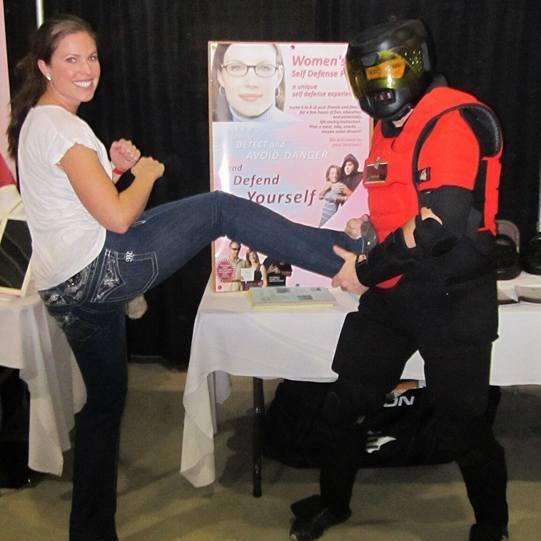
  • Today’s self-defense is often disconnected from everyday realities, like kids, strollers, overwork, physical handicaps, lack-of-sleep, age, illness, arthritis, depression, distraction, travel, traffic, pregnancy. Life! For reasons such as insurance premiums and convenience, self-defense is almost always practiced by people in comfortable clothing on smooth floors. No obstacles, no furniture, no cars, wind, rain or darkness. All of these things must be part of your consciousness or it will be like learning to drive by playing a video game.
  • Due to the popularity of stunt-heavy Hollywood movies and sports martial arts, we often see a lot of cool, creative moves I call Finesse Techniques that are more acrobatic than practical. These techniques might work for someone somewhere under very particular circumstances, but a self defense technique you depend on to save your life should be like a good doctor – reliable as much of the time as possible.
  • Self-defense is often unhealthy for our bodies, which is in direct conflict with safety, since bad health and injury put us statistically more at risk than most other things.
  • Martial arts and self-defense classes are often more about following a leader than expanding our own minds. And what could be safer than seeing and understanding more? If you ever find yourself in a martial arts class – or a relationship of any kind – where you are discouraged from thinking and asking questions, don’t just get annoyed, get out.
  • Most people think kicking and punching is the main aspect of self defense. In general, modern self-defense is primarily concerned with the moment of the attack and neglects the Before and After. It leaves out all the things we can do that will diminish our presence on the criminal radar and neglects the aftermath, where stress can affect us adversely and cause us to make things worse. Self defense is more about good decision-making under stress than any other single idea or physical technique.
  • Self defense is about empowerment. That’s a big word these days. We all want to feel empowered to be who we want to be and to take the world by storm. But HOW we do it is important and rarely addressed. Blind or reckless empowerment can get you in trouble if you think it means being assertive out of context. Not that plenty of people aren’t better off for having learned a few moves, but I think we can do a lot better. We love to hear about the grandma who fought off an attacker who tried to take her purse, but the fact is there are hundreds of other versions of this story that went badly.


New Women’s Self Defense should…

  • …have aspects of martial arts, but also psychology, sociology, health and fitness, among other things.
  • … include the study of trickery, goal oriented and criminal behavior.
    • … cover attacks the way they are most often perpetrated against women or whomever the class is meant to address. Men, women and children are attacked in different ways, under different circumstances.
    • …be based in reality. It should take into account the kids, strollers physical handicaps and other craziness life is made up of.
    • … be simple to perform and to remember. When your mind and body are under extreme stress they respond very differently than they do in a class under controlled circumstances. Time both slows down and speeds up. You freeze, you fail to hear someone right next to you calling your name, you drop things involuntarily. You’re unlikely to be able to remember, let alone execute, a series of intricate movements, even with years of practice.
    • …involve strengthening muscles and improving coordination and range of motion so our bodies get stronger and work better. What point is self defense if you are your own worst enemy, daily grinding yourself into dust.
    • … encourage us to think for ourselves and to question everything. An instructor should be a guide and a roll model, not a disciplinarian. A roll model should NEVER discourage us from forming ideas about our own protection.
    • …cover the Before, During and After of a crime event or emergency, rather than just the During.
    • …instill a healthy form of empowerment so you can be a big dog in spite of your size. You shouldn’t feel you need to bark right away. You want the space and peace of mind to sit back, watch and evaluate before making your decision. This is the essence of true empowerment. Self-defense should be a place women can draw strength from.
    • …include knowledge, tools and games women can pass on to their children, for obvious reasons. Imagine a daughter who won’t give a good-looking but predatory guy a second look, or who won’t allow peer-pressure to cause her to drink or have sex when she doesn’t want to, or who will never accept a drink she didn’t see the bartender mix. Imagine a son who has the decision-making skills not to do a favor for a friend that might get him into trouble. Or a son who stands up for his female friends even if it might cause him to lose face with his peers – a son who sets standards rather than following dysfunctional ideals of manhood.
    • …give us the means to practice daily in our heads or in small moments since we cant always get to a regular class. In other words self defense training should be scenario-based so it isn’t dependent solely on practicing physical techniques but on mental prowess and an understanding of situations, danger and how emergencies form. We need to cultivate the ability to extrapolate and learn from the mini dangers we experience every day.
    • …be about anxiety mitigation since worry and anxiety make us more susceptible to crime. Self-defense needs to help us name our worries and fears, put them into context and then remove the unproductive ones from our daily plate. This also makes real dangers easier to identify when the worry noise isn’t so loud.
    • …put Preparation in an exulted position as part of a daily routine. Preparation for the day, contingency plans, CPR training, etc. can all be made part of basic knowledge and life training.
    • If the highest goal of self-defense is to learn to protect yourself and your family from

    violent crime and the threat of death or severe bodily harm, then clearly it should train and utilize mental skills above all else, since avoidance is always preferable to survival and healing after the fact. Staying out of trouble first, getting out of trouble only if the first fails.

    Protective Offense, The New Self Defense

    Let’s take this concept of self defense even further and give it a new name. “Self defense” is how you describe to the judge why you hit him with the baseball bat. Let’s reserve it for legal matters. The “self” in self defense leaves out others we are responsible for and the word “defense” is too reactionary. What we want is something inclusive of the people who need us that is both more proactive and more powerful.

    Protective Offense is the term I’ve been using for about ten years now-Offense with the emphasis on “Off”. When I hear Protective Offense, I think offense for the purpose of self-defense, “Offense” as in Chess or football, seeing and thinking a few moves ahead, projecting your desired outcome and being able to map a course and make changes on the fly, being aware of patterns.

    When I did TaeKwonDo, in my teens and twenties, I attracted more than one drunken doofus. As it turned out, what I really needed then wasn’t a stronger side kick, but a brain. Actually, what I needed was for the guy not to be bothering me at all, but that goes more to a discussion of effecting culture. Looking back, the guy who came at me in a club when I was 19 and wouldn’t let go, was pushy, not dangerous, and by kicking him I could have escalated the situation to something physical when I would have done better by keeping my emotions at bay, smiling, telling him I needed to go to the bathroom, and then disappearing. After I pointed him out to the bouncer.

    My good friend Karim Hajee like to say, “Trouble doesn’t happen to us, it happens because of us.

    If strength were the only important resource we would all be out of luck. The bigger, stronger person would always win. And that isn’t the case. Things like instinct, determination, will to live and resourcefulness play a huge part in survival. In the wild, smaller animals scare off and outsmart larger, stronger ones all the time. Dealing with crap is part of life and dealing with it physically is not usually the best way. Since women are rarely stronger than men it’s a good thing we have lots of other resources to draw on. We need to get back in touch with those skills and hone them. Civilization supplies us with HGTV and heated seats, but an unfortunate side effect is that we put way too much responsibility on others for our safety and decision-making. Police, lawyers and doctors can all do their jobs better if we do our part.