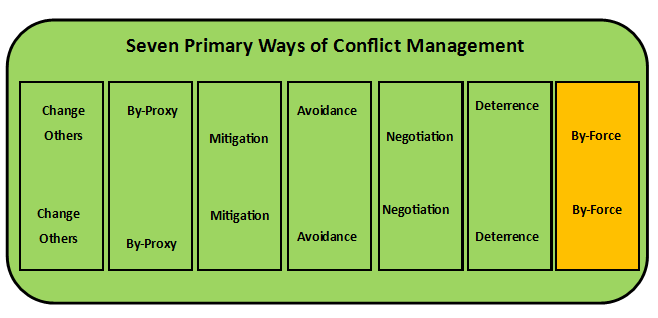
By-Force

When most people think of self-defense, they are usually thinking of the use of By-Force. By-Force is physical self-defense. It is also a form of enforcement. By-Force may be one of the primary ways of self-protection, but it is not reliably effective by itself. The use of By-Force is very closely tied to Deterrence.

While By-Force may be thought of as the last resort or the final option, it should also be thought of as an unreliable option in many situations. While By-Force may succeed spectacularly, it also may fail miserably.

Think of By-Force as a parachute you have packed a few days or many years ago. Maybe it will deploy when you pull the rip-cord or maybe it will not. The longer it has been since you have last used it, the more likely that it will not work as intended. But regardless, you always need to have it available for use.

By-Force is the physical enforcement of your boundaries. It is used when communication has failed. The use of force may be initiated by you pre-emptively, or it may be first applied by your assailant.

The goal of Change Others, Avoidance, Negotiation, and Deterrence is prevention of physical conflict. The goal of By-Force is to stop your assailant’s Intent and/or Means and/or Intent to do you harm with an appropriate physical response(s). An appropriate response is defined legally determined by society. But you are faced with making a decision in the heat of the moment. Therefore, not only is your use of By-Force subject to failure, it is also subject to judgement by society. Failure to use a reasonable amount of force may subject you to criminal penalties and civil lawsuits (a/k/a Over-enforcement).

Once you engage in By-Force, you are in a violent conflict. Prevention has failed. You are now an assault statistic. Invariably, the potential negative consequences of engaging in By-Force are much greater than engaging in Avoidance, Negotiation, and Deterrence. But By-Force may be successful where the others have failed.

In the context physical self-defense, it is common for people to think of it as fighting back against an attacker. In this case, your response to your attacker is going to be combination of instinctive and trained actions heavily influenced by your emotions and prior training and experience.  In addition, the effectiveness of your actions will also depend greatly up upon the physical and emotional makeup of your attacker as well as environmental factors.

Many stranger attacks are initiated by relatively lowly motivated attackers. These people are looking for easy victims who will not resist or can be quickly overwhelmed into submission. In this case, the use of By-Force will have a higher chance of success even if the use is technically ineffective. The simple act of resistance may be enough to cause your attacker to disengage. When this happens, By-Force is really a form of communication and a deterrence of a further assault.

But there are also highly motivated attackers who will not give up easily. These people will require a high level use of force response to stop them. Simply resisting is not enough. These people will use tactics and strategies to their advantage. If you are attacked by a highly motivated attacker, the chance of By-Force failing is much greater. Therefore, the best defense against a highly motivated attacker is the use of prevention. You want to avoid them at all costs. You don’t want to rely on By-Force as your only option.

It is also true that many highly motivated attackers are people who know their intended victim. This actually makes sense. It is the perpetrator/victim relationship that creates the high level of motivation to do harm. People who don’t know you don’t care about you. And thus, are usually not highly motivated to do you harm.

There are also many lowly motivated attackers that know their victims. In this case, these attackers use their knowledge of the target as part of their selection process. They attack their victims because they think they will not encounter resistance, particularly the use of By-Force. Therefore, the use of By-Force is more likely to create a successful physical defense.

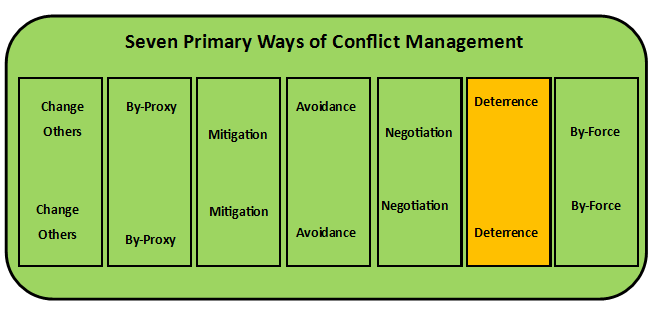
Most people who come to a self-defense class are looking for “moves” and techniques to use in case of attack. They view assaults only in terms of a physical attack and think the solution is some type of a physical defense. These people fail to take into consideration the other six primary ways of personal safety and how these six ways relate and interact with each other and By-Force. You need to know when it is legal to use By-Force and when it is not legal to use By-Force. You need to know when using by force is likely to make things better and when using By-Force is likely to make things worse.

It is only when By-Force is considered in totality with the other six ways of Change Others, By-Proxy, Mitigation, Avoidance, Negotiation, and Deterrence, and the limitations and risks of By-Force are fully understood that the use of By-Force can become a more viable option for self-defense.

Deterrence

Deterrence is a wide set of strategies and tactics that are designed to discourage someone from attacking you. Avoidance is really a subset of the overall concept of deterrence. Deterrence can be used with both strangers and people you know.

Deterrence focuses on reducing someone’s intent to cause you harm. For example, anything that you do that makes you a harder target has the effect of deterring an attacker looking for an easy victim. Anything you do that has the effect of raising the “cost” and or risk of attacking you is a deterrent.

The following are a few examples of deterrence for runners:

1. Running with other people.
2. Running with a dog.
3. Running in an alert and confident state.
4. Running with a visible weapon.
5. Running in well-lit and well-travelled areas.
6. Running in a powerful manner.
7. Running with a flashlight.
8. Running with a visible whistle or personal alarm.
9. Running a varied route.
10. Running at varied times.

The above is just a few of the many examples of deterrence that are intended to reduce your chance of being targeted. This next category of deterrence is for if you may already have been targeted, but you have not yet been attacked. In this case, the predator is still in the “selection” stage, but you have moved closer to being selected for victimization.

Remember, an attacker must have the intent and means and opportunity in order to attack you. These three concepts are separate, yet also intertwined. Means and opportunity can have an effect on Intent. If someone has the means and opportunity to successfully attack you, that fact may nudge his intent high enough to trigger an attack. If someone has a high intent to attack, then being provided with even minimal means and opportunity may still be enough to launch an attack.

Therefore, deterrence works by lowering intent directly or indirectly through lowering means and/or lowering opportunity. Deterrence has the effect of changing the risk/reward equation such that the risk of attacking you now outweighs the reward. The potential cost is not worth the potential benefit.
The primary method of achieving this result is communicating your undesirability as a victim.

• You are too much trouble to deal with.
• You are someone who will defend yourself physically.
• You are potentially dangerous to the attacker.
• You will be loud and make a fuss.
• You will not be quiet.
• You will not submit.

This message is conveyed through a combination of physical positioning, body language, and verbal declarations and warnings. The message is backed up by your willingness to use force to defend yourself. In order for deterrence to be effective, you must also have the option of using force. It is the knowledge that you will enforce your boundaries that provides the legitimately to deterrence.

Deterrence is also backed up by your willingness to engage in By-Proxy and Mitigation in the event of an attack. In this case, you will report the crime. You will get the police involved, and you will aid in the prosecution of your attacker. In fact, it is more likely that a potential attacker will fear the societal consequences of attacking you than the physical consequences of attacking you.

One reason for that is that he (or she) gets to choose who not to attack. If you are targeted for victimization, it is likely that the attacker has already discounted your ability to successfully fight back. You need to convince him he has made a mistake in his selection process.

Deterrence works by sending a strong message to your threat(s) that he (or she) should not attack or he will suffer the consequences of attacking you. Deterrence is an implicit threat of you using violence in your defense either directly by you or indirectly via By-Proxy. Therefore, the effectiveness of deterrence is dependent on you getting your message across to any and all potential attackers. It a nut shell, your message is “Do NOT mess with me!!!!”

How exactly you achieve this result varies from person to person. It varies from situation to situation. But a common tactic involves a strong use of your voice to establish clear boundaries. The closer a threat is to you, the more direct the message needs to be.

It is important to recognize that any level of deterrence may not be enough to be effective. The threat may choose to attack you anyway. But a low level of deterrence is more likely to be disregarded. When your boundary setting uses Under-enforcement it is likely to result in feelings of contempt and a continuing lack of respect for you.

On the other hand, boundary setting that is perceived as Over-enforcement may result in a backlash against you. In this case, your boundary setting is not effective deterrence. It actually serves the effect of making it more likely you will be attacked. An example of this is the use of naming calling. “Back off!!!!” sends a different message than “Back off you piece of shit!!!!” and “Step back or else!!!”. The first sets a clear boundary. The second is an insult. The third issues a challenge.  In order for deterrence to be effective, it must serve the result of making it less likely that the person will want to attack you.

Some Life Considerations – Terry Trahan

It is very easy to become convinced of how well our training is going, or how much progress we have made. Because of this, we may not pay attention to our weak areas, or overestimate our abilities. Sometimes it is simply a matter of not knowing the variables out there that we might face. In the interest of covering these holes, I have several things I remember to try and keep myself and my training honest.

#1) Some people are just too tough to be human.
Some of my motivators are people I have fought or knew. Some examples;
When I was a young buck, I met a guy named Patch. As you might guess, he wore a patch over his right eye.
He showed me underneath it once, his entire eye socket was crushed, and there was the shape of the bottom of a Jack Daniels bottle impressed into the bone. At a party, somebody tossed a bottle from upstairs. It hit Patch in the eye, crushing it, and breaking the bones around it. So, instead of laying down and getting help, Patch calmly walked up the stairs, busted eye and all, and attacked the bottle thrower, then had his Old Lady drive him to the ER.

Or the time I hit a Samoan in the head with a cinder block, twice, full force, and all the Samoan did was laugh and say, and I quote, “My turn…”

#2) Luck exists…
I was working at a gas station, and some junkie decided to rob me, pulling a gun, and yelling GIVE ME THE MONEY, at the exact moment a police officer came out of the bathroom right behind him…

#2b) Bad luck exists also…
I brought a bali-song into a federal building once. It was in a Buck sheath, so I checked it in at the security desk. Turns out they checked it out later, and it being illegal, paged me…
This was a MEPS Station for military entrance processing, as well as holding the US Customs House, complete with USMC guards. So, I blend in with the crowd and make my escape, with the guards following me. I pulled one of the best E&E runs ever, avoiding capture, the Sgt. in charge told me after they captured me. Wait, how did that happen if my run was so good, and I got away???
I hadn’t paid attention to the news. Timothy McVeighs trial was in process, one block from my location. There were snipers on the roofs of the buildings through downtown, so they just reported my progress, and picked me up when I thought I was gone. No, I ended up not re-enlisting.

#3) Cheap shots can happen, even when you’re not involved…
I was hanging downtown with friends. Unknown to me, one of our group insulted a girl. So, I turn a corner and get hit in the head hard enough to drive an earring through my ear backwards, and make me deaf. Then the guy apologized, because he thought I was the other guy.

#4) You can be your own worst enemy…
My mouth has gotten me in at least as much trouble as my former lifestyle. All the training in the world couldn’t stop the fights I got into, or the asskickings I received, simply because I couldn’t shut up.

I hope this helps you to look at things that may be beyond our control, that we can’t prepare for, or things to look at we can stop doing to make things easier for ourselves.

Tribe: On Homecoming and Belonging by Sebastian Junger – Review by Erik Kondo

I just finished reading Tribe. At one hundred thirty five small sized pages, it is a quick and entertaining read.

I think this book is relevant to divisive modern times. The main takeaway I received from this book is of the importance of “belongingness” to human beings. Modern humans are the result of our long evolution. For most of this evolution, we have existed in small tribes in which our survival was directly linked to being a member of a smoothly functioning and cooperative tribe. Modern life has changed all of that. We no longer need a tribe to physically survive. The problem is that while we may not “need” a tribe for survival, our well-being still requires this feeling of “belongingness”.

Throughout the book, Mr. Junger provides examples of how belongingness benefits people even when their circumstances are grim due to warfare, natural disasters, and more. In fact, in many cases it is the very existence of these adverse circumstances that created the tribal bonds.

In my opinion, many of political/social/special interest groups have become the default “tribe” for those people lacking this feeling of belongingness. The unfortunate result is many people whose very identity is bound to increasingly radicalized tribal views. At this point, the benefits of the tribe are far outweighed by its many disadvantages to both the tribe members and society at large.


Rape Prevention: Paedophiles – Kelee Arrowsmith

Rape is one of the most devastating personal traumas one can experience. Many victims feel as if their lives have been shattered and that their psychological and physical privacy has been invaded. The emotional scars last for months or years and sometimes never heal.

A great deal of information is available on rape and rapists but the fact is that rape affects the younger generation far more than mature adults. In South Africa, an average of one in three women is raped before the age of twenty five. For this reason, we need to focus our education and prevention efforts on teens and pre-teens.

A large contributing factor is that we teach our children to respect other (especially older) people. This leaves them vulnerable to predators, many of which are family members or friends of the family. These predators don’t randomly choose their victims; they manipulate and test their potential prey thoroughly before making their move. Often, they chose a child or teen who is a loner or has low self esteem and they begin to “groom” them. The predator makes the child feel special by giving them little gifts and telling them secrets and once comfortable that the young person is not telling anyone they will commence the abuse.

The “touching” usually starts as a game so that if it is reported, the perpetrator simply brushes it off as a joke. The relationship becomes important to the child, which strengthens the “no tell” message that they receive from their molester.

Of course, once the young person realizes that they are in a bad situation, the predator has made them feel that they (the victim) are responsible for what has happened, which makes it even more difficult to tell anyone about the abuse.

Grooming is just one of the most common ways in which rape occurs. Once a rapist has found a way to get away with his (or her) crime, he will use the same formula again and again – there is almost never only one victim. If the rapist is found out, the family usually will chose not to expose the crime because of the shame and so the abuser simple picks another victim.

In the case of children and teens, one of the best ways to prevent them from falling prey to an abuser, is to teach your children how to be assertive and set personal boundaries. Strong personal boundaries make it very difficult for a predator. A simple way to teach a young child about personal boundaries is to tell them that we are all the boss of our own bodies and let them know that that they do not always have to accept a hug or a kiss from a relative or friend if it makes them uncomfortable. Assure them that they will not be in trouble if the friend or relative comes to tell on them.

Roll play with your child so that they know exactly what they are going to say and do. Let them know that if anyone tries to touch them in any place that they swimming costumes normally covers, that they are to come and tell you immediately. 

You can also assist by scrutinizing the adults and older children that your child interacts with to make sure that their interaction is appropriate to their “job roll”. For example, a music teacher’s roll is to teach music. It is NOT their job to take your child to the movies or ice skating, remember that these predators look for kids AND adults with weak boundaries.

Instead of trying to find a “one size fits all” way of preventing rape, we need understand the various ways rapes occur and look at our individual vulnerabilities and how to mitigate the risks to which we are exposed.


Dynamic Decision Making Process – Schalk Holloway

“So when do I actually hit him?”

This is a question I frequently get in training environments or events we host. The reason for this is that all of our training includes a situational, or scenario, component. We role play different types of situations more prevalent within our context. We then teach our “aggressors” how to escalate the situation they’re role playing realistically. This however always leads to someone wondering at which point they should now react. This sounds easier than it actually is. Due to the inherent dynamism in potentially violent encounters, or even in verbal confrontations and conflicts, it is difficult to have catch all answer to this problem. In retrospect we can say that then or there was the perfect time to react. Whilst there it’s not always so clear. Also, if we think about training, our role as provider is to help others to think right, we need to teach them to evaluate for themselves when they should react.

This article will help you to explore, and hopefully better equip you to train yourself and others on, some the dynamics involved in preparing yourself to respond effectively in developing situations. It is going to do so through helping you to understand the importance of being able to make decisions dynamically as a situation develops. It will also delve into some of the challenges this progressive decision making faces and give you some tips on how to train it.

Just Right Decisions – Timing and Force

In self defense specifically, as in boundary enforcement (Just Right Boundary Enforcement, Erik Kondo), there is what we would call a Just Right Response. Just right specifically in terms of the timing of the response as well as the amount of force used in the response.

In terms of timing it’s easy to understand that responding either too early or too late can have negative consequences. If I respond too early I lose my ability to legally justify the response because it essentially means that I responded before there was a valid Confirmed Threat Indicator (as opposed to only a Potential Threat Indicator). If I respond too late it means that I have just lost initiative. I’ve now been forced into a reactive pattern. There are quite a few negative consequences here. First of all, we are much less effective when we are responding as our decision making ability is greatly hampered by all of the incoming data. Second, losing initiative means that I now stand the chance of being injured first, which could lead to serious complications and even death.

In terms of the amount of force that we use there’s also a just right decision that needs to made. Using too little force could mean that my response is ineffectual. This has a couple of negative consequences of which I’ll highlight two. First, there’s a psychological factor involved for both parties. I know I responded ineffectual and this could hamper my confidence going forward. He knows it too and this could fuel his confidence. Secondly, when we think about the physical side of a confrontation, too little force could once again bring us back to being injured and all of the bad stuff included there. Using too much force we now get faced with both the emotional and legal fallout that will follow. From experience I always tell others, whether you hurt somebody for good, whether you hurt them for bad, whether you used just enough or too much force, at some stage it comes back to haunt you. You never want to be the guy that puts his head down at night and wonders whether you were justified in severely hurting or killing another human being. If you can’t answer that question with a good conscience you have some problems on the way.

So our goal is to find a Just Right Response. Under extremely dynamic situations. This is what Progressive Decision Making Ability is about. It’s about training the ability to make those decisions effectively under pressure.

Progressive Decision Making

Progressive decision making is the discipline and art of arranging signals and triggers to support us in making Just Right Responses.

We arrange Signals, Threats and Responses like this. The Signals are all the indicators that a person or persons (or situation) is a potential or a confirmed threat. A Trigger is the imaginary line in the sand. It is the moment at which I feel I now have to respond. The Response is the action that I take when triggered. A Response can be Too Much or Too Little, Too Soon or Too Late, as already discussed. The goal though is to be able to pick up on signals, select or have pre selected triggers in place, so that we can set up a Just Right Response.

Without spending too much time Boyd’s OODA loop model, one large take-away is the fact that decision precedes action. When we are able to make a specific decision about something we set ourselves up to take action more in line with our preferred outcome. Our Triggers are these decisions because essentially that’s what a line in the sand is. A visual or conceptual representation of a decision. Procrastination is not the lack of action – it’s the lack of deciding to act. In self defense, or in most types of confrontation or conflict, procrastination frequently leads to timing related consequences. For now it’s important to understand that I need to make decisions when in a hostile encounter. The decisions are mostly IF THEN clauses. IF person or persons A does this THEN I do that.

Progressive Decision Making is the ability to make those decisions as the incoming data develops.

For example. I’m sitting in a pub having a beer. A guy comes in through the door. His demeanor is subtly aggressive. I make a decision (trigger) that “if he gets really loud, demanding or confrontational with anyone (signals) I’m flagging him as a potential threat (response)”. He orders a beer and starts talking to another guy next to him at the bar. He systematically gets louder and more confrontational. I now flag him as a potential threat. Due to many factors however he’s not really a potential threat to me. However, I make the decision (trigger) that “if he comes over and starts talking with me (signal) I will flag him as a potential threat to me (response).” Low and behold, he catches my eye and over he comes. I converse with him congenially but I make a decision (trigger) that (for example) “if he gets argumentative (signal) I’ll excuse myself and leave (response).” Surely he does become argumentative and I congenially excuse myself and get ready to leave. I make two last decisions (triggers), one, “if he insults me I will continue to leave,” but two, “if he touches me I will hit him so hard that his head will smack the floor before his feet lift from it.”

This is a process that most of us go through without being aware that we are doing so. The challenge however is that if you are not experienced or trained in these matters you either miss the signals or you don’t set the triggers. Failure in either of these leads to inadequate responses.

Relativistic Nature of of Triggers

It is important to understand that there are some factors that should influence the selection of triggers. These factors are based on physical attributes, training and experience background, and situational development.

First of all remember, signals are what the other party is displaying, triggers are your own personal lines in the sand.

1.  Physical Attributes

My wife has been struggling with one of her knees for a couple of years now. She struggles to run fast as she experiences a lot of pain. This means, that any response that is geared towards escaping or leaving an area fast, will be problematic for her. This isn’t necessarily a crisis – it just means that her trigger or her line in the sand needs to be a bit further away from the critical incident than, say, mine has to be.

For example, both of us are in a shopping centre, we pick up aggressive and demanding signals from a guy at one of the fast food outlets’ paypoints. There are some other signals as well. Aggressive guy is dressed anomalous, it’s warm weather but he has a jacket on. The cashier is glancing at his waist the whole time looking nervous. We cannot see if he’s holding something there and we cannot hear what’s happening. It could be a robbery or it could be an argument over a till slip he’s holding. The signals are the same for both of us. However, a trigger for me might be “if I see him pull a gun I’m out of here.” A trigger for her might be further from such a critical incident. It might be “if he starts yelling or someone screams I’m out of here.”

In this way your physical attributes like strength, athleticism, ease of communication, fitness and so forth might influence your own personal triggers.

2. Training and Experience

Let’s imagine that we’re in a situation that, if it evolves into a full blown physical encounter, it will remain within the sphere of hand to hand combat. Ie. No chance of weapons. I’m standing at the bar ordering a drink. All of a sudden the guy next to me looks towards me and shouts “hey man, what’s your problem?” I did not do anything to him. I didn’t touch him, bump him, look at him, spill my drink on him, engage with anyone in his party in any way. So as far as I’m concerned the signals he’s giving off is that he’s looking for a fight.

I attempt to de-escalate the situation verbally. Whilst doing so I start to make my IF THEN decisions. I set my triggers. Here’s the problem though. Let’s imagine I’m 5’6” and he’s about 6’6”. If I have no relevant training I might decide “if he shifts his stance to face me I’m out of here.” If I have some training I might use the same trigger but respond “then I’m going to punch him.” If I’m really well trained and experienced my response can be “then I’m subtly going to match his footwork, set up the range so it works in my favor, get my hands into a good position, start to pick the best attack vector, and continue to try and de-escalate.”

Training and experience essentially allows us to come closer to the critical incident before we act. It also gives us more options in terms of how we can act. Training and experience, in legal expectations as well as in my own personal opinion, also leave us with the responsibility to attempt to have a more positive impact in a peaceful resolution to the situation.

3. Roles and Responsibilities

This is the dynamic of how close or far we, as an individual, HAVE TO or EXPERIENCE WE HAVE TO set our triggers to the actual critical incident. It is easier and less complex to set up triggers and responses very far from the critical incident. Certain individuals though, either through choice, sense of responsibility, or employment expectations, are required to get really really close, even INTO, the critical incident. Think predators, law enforcement, military, security professional, certain bystanders, paramedic and so forth.

In all three of these subcategories it becomes clear that triggers are sometimes very subjective by nature.
The Self-Defense Hand: Part III – Marc MacYoung

PART I

PART II

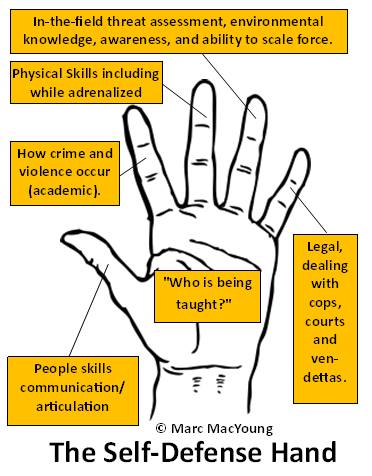
Your ring finger is In-the-field threat assessment, environmental knowledge, awareness, and your ability to scale force.

Notice I didn’t use the term ‘situational awareness.’  That’s because it’s one of the most misunderstood and abused terms in this business. It’s also the biggest handwaves in teaching self-defense. By that I mean, “Oh yeah we teach it, now let’s spend the next three hours teaching how to break someone’s neck.” Remember how I said there’s a problem about not knowing what self-defense is? It just came home to roost starting with not knowing when there’s danger around.

I have a saying: You can’t spot abnormal until you know what normal is. You can’t spot dangerous until can tell the difference between it and abnormal.  

Simple saying, profound implications — especially when it comes to keeping you from bleeding out on the sidewalk. I tell you this because if you can’t even recognize normal you won’t be able to see dangerous slithering up towards you.

Five points about this normal/abnormal/dangerous idea.

One, most of the time there is no immediate danger in an environment.  So constant tacti-kool/ninja awareness isn’t necessary. Being able to see what ‘normal’ (hence not-dangerous) for an environment reveals the lack of danger. This may not sound like much, but it is a critical element of long term survival and preventing burn out. (It is however, beyond the scope of this already too long article.)  

Two, normal changes from place to place and at different times. (You need to be able to read these changes — for example, when the families with children leave, the chances of trouble go up.)

Three, there is a difference between weird and dangerous. A guy riding a unicycle, playing bagpipes and wearing a kilt is weird, but it’s not dangerous. Even without taking things that far, there are situations that are abnormal for an environment, but not dangerous. In fact, there are some pretty standard variations of abnormal. To the point they become normal-abnormal — such as how a stranger approaches to legitimately ask for something in a parking lot.  

Four, there are certain ‘clusters of behaviors’ that indicate when danger is present. (Yes, they predictably show up together; if you’ve done your homework in index-finger-land you’ll know what they are.) When you see them danger is developing.

Five, the greatest danger comes hidden behind seemingly ‘innocent, but normal-abnormal social scripts,’ except their not. They’re abnormal and obvious, but with an extra set of behaviors that make them dangerous. Hiding danger these behaviors present both a flawed imitation and violate normal social boundaries. They have to in order to make the previously mentioned clusters work.

For example a stranger walking right up to you while pretending to be asking for directions — instead of stopping at a safe distance. This is why it is important to know normal, abnormal and dangerous. Normal is strangers don’t talk to you in parking lots. Abnormal is someone tries to. Normal-abnormal is that person stops about fifteen feet away, assumes a non-threatening body posture with hands clearly displayed while speaking. Dangerous is him talking covers the fact he’s closing the distance and his hand is out of your sight.  This parking lot robbery scenario is easy to figure out. Do this kind of break down of normal, abnormal and normal-abnormal in all the areas you regularly frequent. Then watch for anyone attempting to develop those circumstances on you. Normal, abnormal and dangerous are far more nuts-and-bolts practical standards than what people who use the term ‘situational awareness’ usually mean.

Taking this out of exclusively crime, let’s talk about recognizing when you’re in a potentially violent situation. How can your behaviors influence if it goes violent or not? Have you looked into that subject? (Hint, the answers are on the first two fingers.) If it does go physical:  How much force is appropriate given the circumstances?  Not every situation is a life or death struggle. Have you looked into scaling and controlling your level of force? If you don’t know that, and don’t know how to tell which ones aren’t and which one are, then you’re in trouble. You’re either going to over or under react. Either is bad; that’s why it’s important to be able to understand scaling your force before you’re called on to do it. The ring finger is where you have to apply it under pressure. Of course it also helps if you have the physical ability to do so (see the middle finger).

The pinky finger is legal, dealing with cops, courts and vendettas.

Want to know the difference between training for self-defense and actually doing it? When you do it, you’ll have to answer for it.

Remember how I said self-defense is legal, but most violence isn’t? Yeah here’s a real simple rule of thumb, the cops tend to arrest the winner of a fight. Why? In these days of mandatory arrest, somebody has to go to jail. Generally speaking when it comes to a ‘fight,’ you have Asshole #1 and Asshole #2. The winner is usually the bigger asshole. The loser is punished by pain. The winner is punished by arrest.

The second self-defense situation you’re going to find yourself is convincing the authorities you weren’t the bigger asshole. This is harder than you might think because after SODDI (Some Other Dude Did It), the most common dodge for illegal violence is claiming ‘self-defense.’ Now the really bad news, cops are really good at tripping up people who try this dodge. Unfortunately, it also means they’re really good at tripping people up who did act in self-defense.

Here’s a hint, your ability to talk-your-way-out-of-a-situation (thumb) also serves to articulate why people skills weren’t working, your knowledge of how crime and violence happens (index finger) helped you assess the danger, what  physical skills you used (middle finger), your awareness (ring finger) let you see it in time, try to avoid it and when that failed, allowed you to make a reasonable decision on the degree of force. All of those will go into what you have to tell the cops when you claim self-defense.

Sound like a lot of stuff to know? Well, if they don’t like your answer, you’re going down. Now the really bad news. It’s not going to be the officer-you’re-talking-to’s decision to arrest you, usually the order comes from above. Often it’s been decided by someone who isn’t even there. (While they were talking to you they made a phone call.) The officer talking to you might believe you. But, if that word comes down, he has no choice. Those questions you’ve been answering were to build a case against you. If that happens, then the only hope you have is that all those things you said in your statement can be used by your attorney to beat the charges.  If you don’t want to spend time in prison you have to know how to play this game — including knowing when to shut up and get your lawyer there.  

By the way, in case you think I just said shut up and lawyer up, no. You can’t. If you claim self-defense you have to make a statement, then it becomes a matter of when and what your lawyer will allow you to answer. (There are certain trick questions that if you answer, it will be deemed as an admission of guilt and the green light for an arrest — your lawyer knows how to spot them.) Then there are things that you have to get into your statement (like your threat assessment model).

Here’s an important idea. Take the tip of your thumb and pinky and put them together. Remember how the thumb represents people skills and communication? If you also remember there is a tag on there, articulation. That’s the finger press. When you make a statement regarding your self-defense, you will be interrogated. And yes, interrogated is the right term. One of the best ways to trip someone up during interrogation is coming at you with other possibilities. It’s not enough to be able to say ‘it was this.’ You have to be able to explain how you knew it wasn’t something else. This is critical because — if you remember– the set ups for high levels of violence (e.g., robberies) are commonly hidden under normal social scripts. For example, you’ll have to be able to answer, “No, he was pretending to ask for directions. If he was, he would have done A,B and C, instead 1,2, and 3 happened.” You won’t be able to do that if you don’t know what normal behavior is. This is another reason why people skills are important. They can keep you out of prison.

You may not want to believe it, but prison can be the warm fuzzy side of the aftermath of violence. The other version is the person you had to defend yourself against, waiting in the shadows with a shotgun for you to come home. Yeah, funzies. Welcome to the land of vendetta.

Equally bad news is if the guy you had to defend yourself against was the member of a criminal organization or violent family.  There are a lot of lowlifes out there who do not have a strong support network, so if you drop them, there won’t be a vendetta. Oh sure they’ll make noise about it (especially as they’re limping away), but will anything come of it? Usually no. This ‘woofing’ is a face saving retreat. Still there will be enough times that the guy backs up on you to warrant extra precautions for the next few weeks. You know all that uber macho codes and tactical awareness that wannabe gunslingers like to say you should be at all the time? Yeah, if you have a vendetta against you, you’re going to need that…

At the same time, there are also violent groups who will come looking for you for hurting a member or affiliate.  And oh yeah, just so you know, they aren’t above shooting at you when you’re with your family. Having said that, if you’ve pissed off some next-level-folks, nothing short of running off to another state (or province) and changing your lifestyle will be enough. Yes, it can get that bad.

I came up with this Hand of Self-Defense mnemonic to help you prevent the kinds of catastrophic failures that normally happen when people try to actually use their self-defense training. Last time I talked about a wing coming off a plane in mid-flight. That’s not a bad analogy on the degree of how things can go wrong. And how if you don’t know where to look you won’t see the potential problem until it’s too late. Self-defense is a lot more complicated than people think. The hand will both help you organize important information, but help you from doing the common mistakes people make when it comes to self-defense. But that’s not the only reason I came up with it.

It’s a diagnostic tool for your training. Come back to it now and then and see what aspects you’ve either been ignoring or overly focusing on. While self-defense is itself a balancing act, now you have a way to maintain that balance, both in your training and out in the streets.  A balance – that if you’re forced to defend yourself —  can keep you out of the morgue, hospital, prison or the poor house.


THE SELF DEFENSE CONTINUUM: DISENGAGE THE ATTACK, Part IV – Teja Van Wicklen

Your first target choice is the most important

Your first attack either creates an opening for your second and third attacks or notifies your attacker that you need to be immediately neutralized. Once he knows you plan to fight, your element of surprise evaporates along with any time to strategize. Depending on his level of determination your assailant will do whatever is necessary to make sure his plan goes smoothly including, but not limited to, knock you out, tie you up, lock you up or kill you. Put yourself in his shoes. You’ve invested time and effort into this project, if you’re injured in the process or too much attention is drawn, you lose. If your assailant is fully invested in you, he may put everything he has into the completion of this venture. Wouldn’t you.

Sometimes your first choice is the most important one. Sometimes it is the only one.

(Caveat: Almost everything changes if your assailant has a gun and intends to use it. You will need to know how to read signals and to trust your knowledge and instincts. Does he appear to know how to use the gun? Is he desperate enough to shoot you? Might he shoot you be accident because of his level of anxiety? You will have to choose whether to give him what he wants, attack him, or run. More on this in other installments, or check www.ConflictResearchGroupIntl.com, www.NoNonsenseSelfDefense.com and www.CorneredCat.com for detailed gun-related articles.)

If you create an opening with your first attack, you will have taken an important step towards the overall strategy of bombarding him so he can’t recover. This is how you damage either him or his plan and create an opening in time and distance large enough for your escape.

The first attack is where a mental shift must occur if it has not already. How you accomplish this daunting mental shift has been covered in earlier installments of this article and, if you remember, involves trusting your own decisions and perceptions, giving yourself permission to do whatever it takes to survive, even if it goes against everything you have been told about damaging another person. The ability to shift from what is essentially a social mindset to an asocial one is a psychological mystery of sorts. Some people do it easily and others can’t do it at all. Knowing where you fall is also an important part of this puzzle.

There is only so long you can defend against a determined attacker. The law says you may not aggress on someone unless you are in imminent danger. Once you have established that you are indeed in imminent danger, you must cease to be the rabbit in the trap and become the wolf feeding her cubs. This is to say you must become the attacker. In becoming the dangerous one in the relationship for this crucial moment, you remove some of his options (remember that the predator has more options than the prey). You want him defending, not attacking. The conversation must become a monologue in which he never has a chance to speak.

Subsequent attacks will also need to be fast and furious so he has no time to breathe, but they don’t have to be quite as perfectly chosen. Ultimately, you want to use everything you have together in a merciless barrage of targeted and brutal assaults that give him no chance to recover. This is how you survive a dangerous encounter with a violent criminal. Incapacitate him and leave. You have a wild animal inside you. We are educating that animal so she can be both wild and wise.