The Importance of Illumination – Toby Cowern

In the September issue of this magazine, I began to discuss details of Everyday Carry Items (EDC) We started with the premise of a ‘layered’ EDC system, distributing items between pockets, small containers and bags etc depending on their importance and access requirements.

I, like many, am constantly reviewing, revising and amending my EDC, not least of which because of the amount I travel but also due to the extreme environmental fluctuations we have here in the far north of Scandinavia! With the long lazy summer days firmly behind us, the dismal vestiges of late autumn will soon break to a dark and cold winter, not only here, but in many other regions as well. Even if you are not entering a winter phase, it cannot be lost on us, as sure as the sun rises it sets, and dealing with the dark is a topic often overlooked in defensive circles. In this article I’m going to briefly but comprehensively take you through some of the considerations when it comes to the Importance of Illumination and some EDC options.

As a serious minimalist when it comes to equipment carry, to the extent I am very rarely subscribed to the ‘multiple redundancy carry’ mindset often espoused  (I do genuinely have my reasons) a review of my Level 1 and 2 EDC (On my body or within arms reach) reveals 4 separate illumination devices(!) This may seem extreme, so what am I carrying and why?

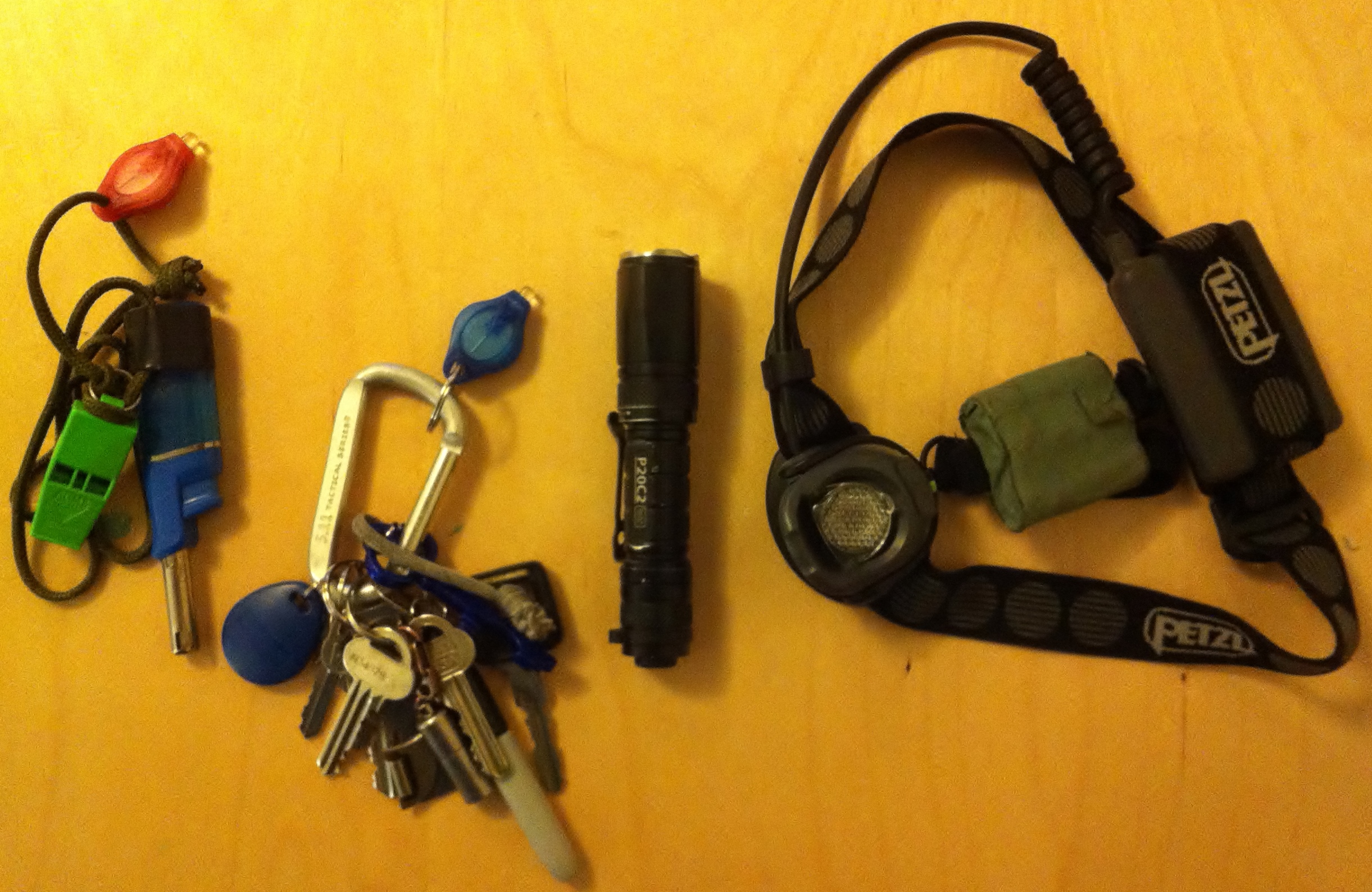
For an overview I am carrying, in order:

  • A small red LED light on a paracord neck chain. (Left of Picture)
  • A small blue LED light on my keychain. (Centre Left of Picture)
  • A Tactical Flashlight (Eagletac P20C2) in my pocket (Centre Right of Picture)
  • A (Petzl brand) Headtorch in my small ‘Manbag’ (Right of Picture)
Importance of Illumination pic.1

Before I continue, I want to highlight a twofold advantage of this approach. Not only does this EDC offer a good, robust and resilient approach to many issues, both small and large, but it has proved, to date, to be one of the best ‘conversion strategies’ I have had in terms of spousal/family type ‘buy in’, not only for my family but for students of mine as well. While this is a significant issue of its own that I will write about further in a separate article, it definitely is worth mentioning here at this time!

So why am I carrying this? This I’ll answer by item, but in reverse order:

The Headtorch – Not only in my capacity as a professional outdoorsman, but on numerous occasions throughout my regular daily activity, I will need to illuminate a specific area AND want to keep my hands free. While deepthroating a maglite is eminently doable, I can’t say it enables one to focus well on any given task. That, combined with the fact this action, when performed at extreme low temperatures will result in your mouth being frozen to the flashlight for ‘some time’, normally ensures alternatives should be sought (I reserve the right to provide no further detail on this particular ‘fact finding story’, thank you very much) However you get to this end result, we can be happy with the idea that being able to provide light and keep our hands free is often a very good thing. From writing notes, changing a tyre by the roadside, tying and untying knots, using tools, sharpening knives, or fiddling in the fuse box to fix the ‘blackout’ and much, much more not having one hand ‘occupied’ holding a light is a tremendous bonus.

One other, slight aside, but VERY useful tip on the headtorch. Look at the picture again. You see on the right hand side of the torch pictured the ‘battery box’? You see between the battery box and the light itself a small green colored object? This is a complete set of spare batteries secured to the strap of the headtorch with cloth tape. More on this a little later, but this tip has helped me more times than I can now count!

The Tactical Flashlight – For those of us living under heavy legal restrictions ‘weapon carry’ is exceptionally problematic. Even small folding knives in some countries will be dealt with in the most draconian way. A tactical flashlight has travelled with me through numerous countries, multiple security checkpoints, including American airports, and has never once been questioned or raised concerns. As well as offering a good, solid, white light source, useful for a wide variety of things. The strobe effect, hardened metal body, size and shape of this tool do give it some valuable ‘weapon level’ features. A lot of this tools power lies in its ‘pre-emptive’ ability. A good bright, light shone to the face is, at worst, distracting, can buy time and distance if used properly and can be used to conceal a whole bunch of other movement if you need it to. This is if you use the light when when directly facing a threat, but the ability to search an area more thoroughly (especially indoors) indicate or mask your location and clearly indicate your ability to see something are all additional and valuable uses. Even if living in a permissive environment where additional weapons carry is allowed, I still carry a tactical flashlight (as do many others I know) because of the advantages it offers.

The LED Keychain Light – In the first instance this is most useful when trying to find the right key and access locks. Having a light, right there on your keychain, prevents a whole lot of ‘fumbling around in the dark’. We are aware approaching our residences and vehicles is a time of particular risk, so minimizing any ‘faff’ time in these areas is highly desirable. I particularly like a ‘non white’ light here so it is not overly conspicuous and is not compromising my eyes adjustment to the dark as much. In this regard red or green light is preferable, but I am using blue for now for a specific, but separate reason.

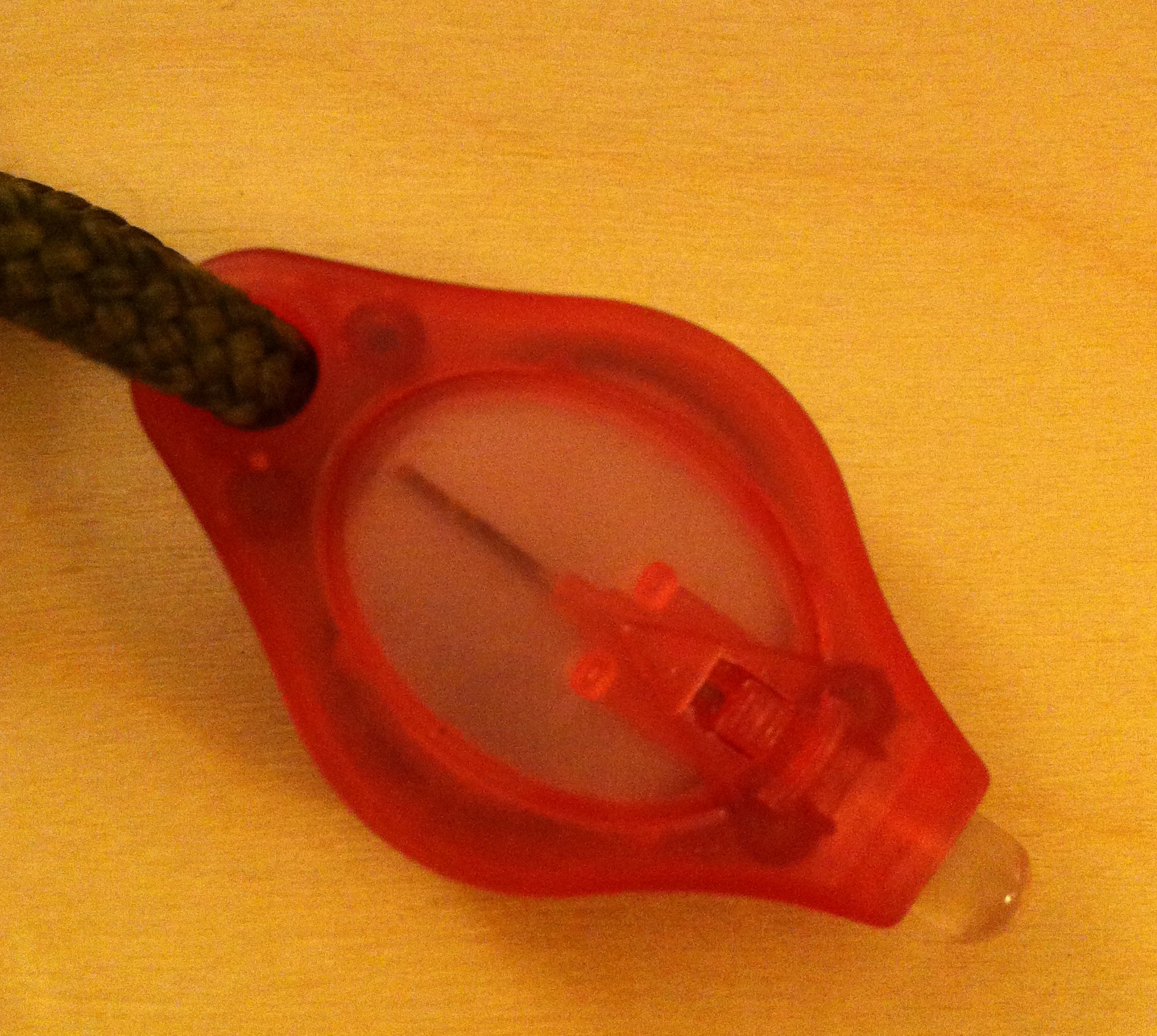
The LED Neck Chain Light – Having a small, discreet, easy to access light source is very useful. I typically use this light for signaling short distances at night when I want to remain quiet, or if I have a quick job I need to complete and do not need or cannot access my headtorch. You will see from the close up picture this LED light not only works by being squeezed (typically between finger and thumb) but also has an on/off switch.
Importance of Illumination Pic.2

So it is simple and easy to switch ‘on’ and be held lightly between the teeth to illuminate an area immediately to your front but also keep the hands free. Why not use the headtorch? It’s a good question, and I’ll tell you a little, frequently occurring experience of mine. I’m using my headtorch very often, now ask yourself, when are the batteries most likely to ‘die’?  Why when it’s in use of course, is the obvious answer! Now think, is it typically light or dark when using it? Hmmm, dark… And herein is the problem. Changing torch batteries in the dark is not the easiest of things, so with this set up, a battery change becomes easy, especially when I know exactly where the spare batteries are (Taped to the torch strap, remember!?!) As and when my illumination device fails, I use the small LED light that is immediately available to complete a quick and easy battery change. The same method could be used for any number of similar, small tasks.

I mentioned earlier the ‘spousal conversion’ benefits of this EDC setup. To touch on that again, briefly. Many of us committed to learning and training for conflict, face varying levels of resistance or concern from our families and frequently little ‘buy in’ from our spouses. This may be a general lack of interest to an active vilification of our lifestyle choices (“What do you need another (insert defensive tool name here) for, you already have so many???” is a frequent refrain heard by many)

While I will address this more in a separate article, I’ve found illumination devices a great ‘start point’ in getting greater understanding in families as to some of the benefits in EDC, and with these type of ‘small wins’ the stepping stones to greater acceptance and involvement are paved. I typically ‘gift’ these small LED lights to friends and family (especially kids), and often will actively put them on the keychain for them, so they ‘have it right there’. To date, no one has ever failed to understand the value in doing so. For a few this has then led the conversation to, ‘what would you do if you need a better, slightly more powerful light source, for instance in a blackout or if you had to quickly step out the house, for example to check something?’ Again, this logical progression makes sense to many and can quickly lead to the purchase (or gifting) of a tactical flashlight, especially given there are many excellent priced ‘entry level’ models now on the market.

Once they have become a proud owner of a tactical flashlight, almost everyone I know has enjoyed and been fascinated by it features and potential additional uses and most are very satisfied at the idea of carrying something that has ‘more than one use’. From this point, often, more ‘small steps’ can be taken in a positive direction. A number of people within a short time of owning a tactical flashlight have come back with some story of how it proved to be ‘so useful’ in some sort of situation they have faced, and this is one of those great occurrences that can lead to even more productive conversation and understanding of some of the benefits not only of EDC but development of a well rounded ‘resilient mindset’.

I’ve highlighted the main uses for my illumination devices and the details of my EDC here, but remember the possibilities are limited only by your imagination! I’ve left LED lights on and ‘discarded’ too lure students into ambushes, attached them to foliage for navigational way points, performed an impromptu shadow puppet show to calm a child after first aid treatment and seen the slickest deployment of CS gas ever, masked by a flashlight. As always, we should be challenging our equipment and our minds to perform above and beyond our expectations.

If you have a great story too share with regards to your use of an illumination devices be sure to post it in our Conflict Manager FB group, as we love hearing from our readers and learning from their experiences!

 

Training beginners – Wim Demeere

I am often contacted by clients who want to learn self-defense , but have no prior training or experience. They are total beginners, blanks slates. The question for me as an instructor is then: what is the best way to teach them? Throughout the years, I’ve developed my personal approach to answer that question and it has resulted in a basic self-defense system. It isn’t anything new, nor is it revolutionary, but it seems to work well enough, which is why I want to share a part of it with you here.
First some background.

There are many different aspects to self-defense training and there are probably just as many different ways to teach this subject. As a result, it can be difficult to get started on imparting students the skills they need to survive a violent encounter. One approach to do so is to look at common denominators: which aspects keep coming back in a majority of situations a student might encounter? Once you establish those, you have a place to start. Each individual person has his own specific context to take adapt your training to, but working from those common denominators allows you to cover a lot of ground quickly.

One of those common denominators is the timing of the attack in relation to the individual’s awareness of it. I work from three basic scenarios:

– Ambush. You only know you are under attack when the first blow lands. There is no advance warning or awareness of danger.

– He goes first. Your attacker throws the first punch, not you. You have some advance warning though, anything form a few seconds up to a few minutes if it takes the guy that long to work himself up to taking a swing. You are aware of the danger, but for whatever reason you don’t act first and he does.

– You go first. You spot the danger, try to de-escalate and escape, but this fails. You decide to use a pre-emptive strike.

Regardless of the context, these three scenarios seem to come up more often than not. Take some time watching Youtube videos of street violence in all its forms and you will recognize them easily.

Now that we know where to begin we have some choices to make: which techniques do you teach a beginner? I favor versatile techniques and constructive laziness: each technique must serve multiple functions so the student doesn’t need to learn many of them. This helps speed up both the ingraining process and the skill development. I teach a binary system that offers a hard and a soft response: techniques that disable (elbows, knee strikes, some other close-quarters techniques) and techniques that control (head and spine manipulations along with a basic elbow lock.)

The next step is deciding where to start. I choose to begin with the ambush situation because it is often what students fear the most.

Ambush

When an aggressor lands his first attack, you are already behind the curve and things are unlikely to improve for you as time goes by. Your first goal is then to avoid taking additional damage and hold on to whatever capabilities you have left. To that end, I teach a modified flinch guard that covers both the head and vital organs. From there, the student learns to open up with a sweeping arm technique to help orient him on the attacker and then follow through aggressively with elbows and knee strikes. The counter-attack needs to be fast and brutal.

This rarely looks pretty, even in training, but that doesn’t matter. The goal is to fight through the pain and disorientation and turn the tables on the attacker before he can take you out. At that point, you have nothing to lose as you are already taking damage, so this becomes a full-on counter-assault.

Most students struggle with this at first, so I build up the intensity gradually depending on their tolerance to adrenal stress. Once they have some training, the difficulty levels go up and we incorporate drills and scenario training to mimic real-life situations. I have found that this helps give them the confidence to handle the next two scenarios.  

He goes first

In an encounter where an attacker uses a form of interview or other set-up, the student has some time to assess the situation. In a perfect world, he would de-escalate and leave but that doesn’t always work out. Neither is it always possible to get the first shot in, so it helps to have experience handling things when your attacker throws the first punch.

I teach students to cover up with the modified flinch guard or use the sweeping motion to block what comes at them. They learned both techniques already and have ingrained them thoroughly by that point, so it isn’t too difficult for them to use them in a slightly different context. Their feedback is often that it is easier to handle an incoming attack because they already went through the stress of surprise attacks and scenario training in which I ambush them. As a result, they are both less intimidated by that attack and defend better against it. Flowing into the counter-attack is old hat as well by then and they typically do so with enthusiasm.

You goes first

Tactically speaking, it is often better to strike first when you know that violence is inevitable. However, simply knowing this doesn’t mean you can do it effectively. If you haven’t done it before, it can be mentally and emotionally challenging to “push the button” and launch that first strike, because this time, you are the one starting the dance. Remember that we are talking about students with no experience with violence; they often have reservations about using it.

My approach is to use the sweeping arm motion again and adapt it slightly to attack the eyes and other vulnerable targets with it. Once again, the student has already practiced this movement so much, it isn’t difficult for him to use it in this way. The same goes for the potential follow-up techniques.

This covers only a part of the technical aspects of what I teach them, but the other parts are beyond the scope of this article. My goal was to offer a framework you might find useful for your own training. As I wrote in the beginning, this isn’t the best method out there, nor is it cutting-edge stuff, but it works and is a good way to start the training. I’ve experimented with and fine-tuned this system for the last twenty years and found that the combination of versatile movement and the methodology of teaching the three basic scenarios in this specific order yields results quickly and ingrains lasting skills with beginner students. I hope you can apply some of this information in your own training.

Social Conditioning: Women & Violence, Part II – Tammy Yard-McCracken, Pys.D.

Rabbit Trail

I suspect there is an intellectual drift in our thinking as professionals in the world of violence. Whether it is as force professionals, martial art instructors, self-defense instructors, or etc., human nature is to normalize what we learn from experience and training. Once normalized, there is an unconscious judgment that wants to wiggle into our thinking. If we know it, then it must be common knowledge.

Really? Why? Remember how it is that you do, in fact, know better.

The social rules, the subconscious expectations many women follow unconsciously every day, have some obvious and significant implications when women face a violent encounter. These same rules will show up on the mat and on the range if she decides to train for personal protection. (How and what that looks like is better left to a different dialogue.)

These five case examples can be easily used to highlight how social rules set her up as a perfect target. If we stop there, the implication is pretty damning. Up side? There are a couple of hidden superpowers tucked inside what looks like a perpetual-victim default.

Here’s one, and it comes with a hell of a lot of gravitas. Once she slips the leash, she is all in.

I have a theory on this.

She grows up on social rules that can make her a pretty good mark. The flip side? She does NOT grow up with the social rules defining how a fight is supposed to go. She doesn’t spend her days wrestling and playing King of the Hill. She doesn’t get socialized on the football field and she doesn’t learn what a tap-out means on the wrestling mat. She is chided severely if she attempts to solve conflict the way 10 year old boys do by throwing a couple of wild punches and rolling on the ground. She doesn’t play with green army men who blow each other up with mud bombs.

If she does, it may be because she grew up in a neighborhood like mine where most of the kids my age were boys. If I wanted to play, I had to play the games that were running. Even here, she will hear comments about ‘letting the girl play’ and it will be the exception, not the rule.

She does not know the rules to male conflict and violence because she doesn’t grow up playing the games teaching the rules. If she played those games, she will understand it was by special permission and it really isn’t her game. She is only a guest. Consequence? She won’t generalize the rules of war to her own belief system.

These rules are not built in to her internal infrastructure. When she goes physical – she is in uncharted territory and she will do whatever has even the slightest chance of keeping her alive– there are no rules to follow because she was not socialized to the rules. There is a better than average chance her Threat expects her to follow the social rules of being female: acquiesce, be polite, hesitate, ask for permission. There is an equally decent chance the Threat does not expect to encounter a rabid chipmunk, or as one of my students recently said “an unleashed crazy-bitch”.

If she is armed? Like the first two case studies, she is far more likely to fire until the magazine is empty than she is to get off a couple of rounds and stop to see if she hit her target.

Unarmed? If there isn’t anyone nearby to pull her off, she may blow right by the boundary of when a “reasonable” person would disengage. Particularly if her children have been threatened. She will risk her own life without a moment’s hesitation to save her tiny humans.

Earlier, I mentioned a correlation between adrenaline rates and gender. We need to revisit it again. Rory Miller posits a theory for the gender-based adrenalizination delay; it resonates (R. Miller, personal communication, 2015). If his hypothesis bears any credence, combining the two theories has a doubly deleterious impact on women when a physical solution becomes necessary.

Here’s my summary of Rory’s theory on why women experience the adrenaline delay. When we were hunter-gatherer tribes the able-bodied men would be gone for weeks at a time following herds for enough kill to feed the tribe into the future. Left behind are the aged men, the children, and the women. Turn this into the able-bodied men leaving the village for war, in both circumstances if a Threat gets to the tribe, the women are the last line of defense.

It is on her to ensure the next generation lives to a reproductive age. Knowing this, she will go physical with an unfettered, vicious ferocity.

One theory is rooted social psychology; the other is rooted in evolutionary need. In both, once she goes physical she is all in.

I have seen a full sized dog high-tale it in the opposite direction when attacked by a 10-pound cat that thought her kittens were in danger.  One good bite and the cat would be done, but the dog was uninterested in the risk it would cost to try. Superpower number one in action.

Superpower number two. She is smart. Not that men aren’t, this is not a comparative dynamic so if you are itching to argue – take a breath. The center of the brain that processes fine details and retains them with attachment to meaning has more neuronal connections than the average male brain (Brizendine, 2006). A Cornell study (Wong, 2013) is a little less definitive as to the why women have this capacity but the science in the Cornell study may be a tad more sound than Brizendine’s suppositions.

Wong and Brizendine agree with an important bottom line: women attend to, retain, and recall details at a remarkable level of accuracy. As a natural process, this ability is far more dominate in women than in men.

A possible explanation for this reality ties into Rory’s suggestion about evolutionary need. Village and tribal life puts her on her own for long periods of time with others to provide for, to feed and nurture. Considering sociological anthropology as a perspective, there are probably a few men in the group and hances are, they are elderly or otherwise unable to physically endure the rigors of a hunt. If they couldn’t hunt, they are not going to be much help to her if violence shows up on the village’s metaphoric doorstep.

If she’s trekking out to the berry patch she may have tiny humans in tow and one strapped to her back. Running and fighting in the event of a stalking predator (animal or human) is automatically compromised by her circumstances. Her chances of survival, and the survival of her offspring goes way up if she notices the tiny nuances of the well-worn path that are different than they were on her last pass. A new print in the dirt, blades of grass bent the wrong direction, absence of prey animals, birds fall quiet or take to wing behind her…a soft sound that wasn’t in her hearing a moment ago…

For this information to matter she must have three things available. She must have a context for what the information means (prior learning), she must notice the fine details, and she must do the math (match memory to the context).

Dial this forward to lifestyles that are more common to us in 2015, how many of you can relate to this?

Him: What? You never told me your mother was coming in this weekend! It’s your mother (or whatever the situation is), I guarantee if you had told me that I would have remembered.

Her: Really? Seriously? How can you NOT remember this conversation! You were standing with your hand on the fridge door looking for something to eat in that blue shirt I bought you for your birthday two years ago. You looked at me and rolled your eyes and then you said ______________. Then you shrugged your shoulders and went out to the garage to work on the lawn mower.

Him: Silence – thinking…what the hell? What blue shirt?

Or, try this one.

Him: Hey, do you know where the charger to my old mp3 player is?

Her: When did you last have it?

Him: I don’t know, I can’t remember. You know, the old one.

Her: Silence, thinking. Look in the drawer in the hallway or on the shelves in the corner of the your closet. If it’s not there, it’s probably in your…..

And she is usually right, isn’t she?

She remembers the details, stores them and assigns meaning to them. She does this with people and behavior too. If you have read DeBecker’s work, or you work in an industry like mine where you get to hear story after story of victim events, you know this:

Her intuition told her something was wrong.

This intuition is not magical. It is biological. It is this powerful capacity to manage details, remember them and use them instantaneously, unconsciously. She cannot always articulate how or why she knows what she knows, but she knows. This makes her capable of a marked degree of tactical intelligence.

And the question that wants to be asked next is this: if she is naturally, tactically intelligent, why doesn’t she use it? Why did she get raped, stalked, why did she ask permission to fire?

Both superpowers can get tangled in the sticky web of social conditioning; sometimes to the degree she may not be able to access them at all. This doesn’t mean her superpowers disappeared. Slowly, over a lifetime of experiences, they have been lulled into a deep sleep.

That’s the good news. If those superpowers are still there and they are only sleeping, we can wake them up again.

The Dangers of the Killer Instinct, Part II – Rodney King

The Misunderstanding Of Applied Martial Technique

If you agree with my line of enquiry, then the question is why is this hyped-up aggressive approach to dealing with interpersonal violence so widely taught, and not just that, often as the primary go to strategy?

Most reality based self defence instructors often start teaching from the moment of the attack itself. Little or not time as I have seen is spent on anything other than dealing with the actual attack. Most everything else is cursory at best. Of course there are times when attacks happen without warning, but I would argue, and based on the students mostly being taught (i.e., civilians) there is a strong likelihood that what they will more than likely encounter in their lifetime (probably more than on one occasion) is someone bumping into them in a bar. As noted earlier in that situation, awareness, verbal jiu-jitsu skills, and a sensible, mature attitude are far more practical self preservation skills for the average Joe to have, than how to eye gouge someone.

Secondly, many reality based self defence instructors have never actually been in interpersonal violence themselves. This sets up an unrealistic mental framework of the reality of violence, which is, as I have been notting not something anyone who really cares deeply about their safety would want to be engaged in. However avoidance, verbal jiu jitsu etc, seems never to be adequately if at all taught in reality based self defence systems. For all the practicality expowsed by these reality based experts, much of what they teach isn’t reality at all. How could it be, they have no real experience themselves to begin with. If they did, they wouldn’t then glorify the violence as they do. It also wouldn’t be their default strategy to use violence to solve violence.

Thirdly, when these reality based instructors do train under someone who has real world experience in interpersonal violence they often choose ex-military personnel, preferably someone from a special force unit (it just looks cooler on a resume too). I am the first to admit, that someone who has gone to war and survived has a lot to teach the average person about managing fear, explaining the reality of real violence, and the psychological dynamics that underpin it. However fighting on a battlefield is not the same as defending oneself on civvy street. The mandate for a soldier (relevant to their role of course), and the level of violence that a solider is allowed to apply, not to mention the context — is very different to that of a civilian. Civilians not only have to protect themselves, but they also have to seriously consider the legal ramifications of the force they use.

Finally and my greatest concern, which harks back to the notion of a killer instinctive mindset to deal with interpersonal violence. Using my favourite resource on the topic of reality based self defence training YouTube — clip after clip one watches an attacker who attacks, a defender who defends, who then goes on to obliterate the attacker with a barrage of fast, dynamic, aggressive striking. While the attacker stops hitting after the first blow, proceeds to cower, folds under the pressure and then falls to the floor. Anyone else see a glaring problem with this?

There is an unconscious assumption in these demonstrations that the person you are fighting doesn’t know how to fight. I don’t know about you, but seldom did I find working as the head doorman outside some of Johannesburg’s roughest nightclubs for several years, where a person would only strike me once then allow me to do what ever I liked to him. People actually fight back. What is equally not taught is what happens when your super fast, vicious, merciless, counter offence doesn’t work?

Lets say you teach a person to preempt a potential violent encounter with another person, or lets say you teach to aggressively, and mercilessly mount a barrage of counter offensive moves when a punch is thrown at a person (all of course with the killer instinct that is required). But lets just say reality steps in, as it always does, and the permeative strike, or that barrage of vicious counter offence doesn’t work? Lets say the other person now not only fights back, but fights back even harder because they now want to survive at all costs (imagine that?) Now all of a sudden, not only didn’t the physical technique work, but neither did that bezerker killer instinct.

Now what?

The defender may now find himself going from winning to losing. He may have started off pumped up, and hyped up on aggression, but now finds himself in a situation with all his physical resources depleted. Added to this his confidence has now taken a major battering, which may result at worst that he freezes or turns his back on the threat. When killer instinct doesn’t work, there is only one way to go, and that’s down into a negative spiral that most people who are not used to surviving violence will likely never recover from.

The Body Is Already Primed To Survive

The reality is, when faced with any kind of danger (real or unreal) the body is already primed for danger. For a long time the general consensus when talking about fear was that it was activated through a cognitive appraisal of a threat, which then invoked a fear response. That feeling of fear then drives the expression of behavioural defence responses. In other words we run from a bear because we see it, recognise it as a bear, and are afraid of it. More and more though, researches like Joseph Le Doux have argued that the amygdala circuit detects threats non-consciously, and in turn controls the subsequent behavioural and psychological aspects of the fear response. It is the cognitive systems secondary role to interpret the feeling of fear.

What does this mean? It means, that for the most part the body primes itself for a potential threat in absence of conscious awareness and control. It is in other words automatic. The ingredients for survival then are automatically set into play the second a threat is detected (often as noted unconsciously). Using an approach then that seeks to heighten that survival response though cognitively arousing the mental state and bodily attitude even further by getting a person into a more killer instinct frame of mind — at least from my experience — interferes with the bodies natural ability to attend to a fearful situation as it has been designed too.

Not to state the obvious, but our ancestors adequately survived much harsher survival situations than we would likely encounter as civilians today, and they did this before a martial art school ever existed. More over, the overlaying of more cognitive demands on the system, can have unintended consequences, often negative as I have outlined in this article.

This is why, I teach my clients to be completely trusting in their training, done through progressive stress inoculation, to the point that as best as we can, everything has been given over to unconscious motor skills, which then allow for space within the mind to decide how one would want to attend to the situation one finds himself in (i.e using the prefrontal cortex, instead of being ruled by the reptilian brain). In this respect, my approach is to teach my clients how to stay calm, centred and mindful in a survival situation, not to make them more hyped up. The body is already primed unconsciously to deal with the threat, you don’t need to now either hype it up more, or force it to work for you. All you need to do is apply a grounded strategy and subsequent tactical system to neutralise the threat you face. As the saying goes a clear mind, is a determined and focused mind.

The Samurai, born and breed for battle knew this all to well. Togo Shigekata, a Samurai, proclaimed: “One finds life through conquering the fear of death within one’s mind. Empty the mind of all forms of attachment, make a go-for-broke charge and conquer the opponent with one decisive slash.” In other words, true performance in a life and death battle requires a mind that is clear, focused, expansive and aware — not one clouded by aggression!

About the Author
Rodney King M.A., RSME is the creator of Crazy Monkey Defense, and its sister self-preservation program Combat Intelligent Athlete. He has taught army special forces and law enforcement teams how to survive a life and death encounter when all they have is their body to defend themselves with. You can find out more about Rodney and his work at www.coachrodneyking.com or www.crazymonkeydefense.com

The Confusion Between Conflict Resolution & De-escalation, Part II – Gershon Ben Keren

In last month’s article, I looked at the times when deescalating aggressive situations is an appropriate solution i.e. when the aggressor you are facing is involved in a “spontaneous” act of violence – one that they haven’t planned or orchestrated; but have become aggressive and potentially violent due to your actions or behaviors, whether real or perceived e.g. you have, or they believe you have, spilt a drink over them, jumped ahead of them in a queue, taken a parking space they were waiting for, etc. This is contrary to premeditated assaults, such as muggings and sexual assaults, where an aggressor has planned the incident and knows what they want to achieve/get out of it – they have a defined goal. Because in spontaneous situations there is no defined goal or specified outcome (the person you have spilt a drink over doesn’t know what will make the situation right for them), you may have the chance and opportunity to get them to consider non-violent alternatives that might resolve the conflict/dispute. However in order to do this, you must first take some of the emotion out of the situation so that they are able to consider these alternatives – this is the purpose of the de-escalation process.

To understand how this process works, we must first gain an appreciation for the way that people think, and interpret your actions and behaviors when emotive and aggressive. As you are reading this article, you are using your brain’s reasoning capacity, however if you were to become angry, this would start to shut off and you would start to process information using your limbic system brain. Your limbic system brain doesn’t understand reason and rationale, it is used to understanding disputes and conflicts at the social level, as a dog or a wolf would. Dogs and wolves are social creatures (bereft of reason) who resolve disputes through posture and submission e.g. one growls, snarls and makes themselves look big, whilst the other roles over and exposes it’s neck in a display of submission (conflict resolved).

When a person becomes emotional and aggressive, they start using brain functions and paths which are more animalistic – dog-like. They stop using their reasoning brain to process information, and start to see conflicts in a more dog-like way, with the person they are dealing with either posturing to them, or acting submissively. If you have ever told an angry person to calm down, you have probably been met with the response, “I AM CALM!” Instead of interpreting what you said in the spirit it was meant, they can only see and hear things from the perspective of them being either an act of posturing or submission; when you tell somebody to calm down, stop shouting etc., you are telling them what to do, and so they posture back to you – this escalates rather than de-escalates the conflict.

If they are extremely emotional, they may be using their reptilian brain, rather than their limbic system/mammalian brain. Their reptilian brain will interpret everything as being either fight or flight – reptiles are not social creatures in the way that dogs are and so their interpretations of threats, conflicts and disputes are much more basic; they either disengage or they attack (they can give warning signs, but these are different to acts of posturing, as only disengagement – flight – rather than acting submissively will avert and attack).
The goal of any de-escalation process should be to get an individual to stop working with their limbic system or reptilian brain(s), and start to use their reasoning brain again. If you can get an aggressor to start using and applying reason and rationale to a situation, rather than emotion, they will be able to consider alternatives to violence.

One way to get an aggressive individual to start using their rational/reasoning brain, is to recognize and inform them of their emotional state. Saying something like, “You seem really angry”, can be one way of doing this. Feelings and emotions, are not the same thing. Our emotional state is the physical state we are in, such as being adrenalized, our feelings are the conscious interpretation of that state, such as feeling angry or scared, etc. When we are highly emotional, and our reasoning brain shuts off, we are not able to “feel” our emotional state, we are just in it. By pointing out how an aggressor is “feeling”, such as being angry, will often cause them to register their emotional state; something that they have to use their reasoning brain for. A common response to this statement is, “Of course I’m angry, you spilt a drink over me!” This is a good starting point, as the emotional individual is now starting to process what has happened to them, and the reasoning brain has been engaged, even if it is not in full control of that person’s actions and behaviors.

To keep the person processing the situation from a rational perspective, you can follow up with the question, “what can I do to sort this out?” This question forces an aggressor to start using their reasoning brain to consider different alternatives, which would potentially satisfy them in the situation. The emotional limbic and reptilian brains, are unable to weigh up the pros and cons of different outcomes, and so have to hand over this decision making process to the reasoning brain. It may be that the individual responds that you can buy them another drink and pay for their dry cleaning. The fact that it is the aggressor who has determined the solution to the situation is important, as it allows them to posture in a controlled and directed manner, which means by accepting their solution, you are acting in the submissive role – in the animal kingdom – or when people are processing information – this submissive response will end the conflict.

If you were to make the suggestion that you should buy this individual another drink and pay for their dry-cleaning, it is likely that your idea would have been interpreted as you posturing to them, i.e. telling them how the conflict will be resolved – you setting the terms. There may of course be individuals who make preposterous and ridiculous demands e.g. you can buy drinks for them and their friends for the rest of the night, etc. In such cases, you can still keep the person engaging with their reasoning mind by saying something along the lines of, “I’m sorry but I’m not able to do that, can you think of anything else that might resolve this situation?” As long as they can keep on track, coming up with alternatives, their reasoning brain is engaged.

In some cases, usually when a person is working with their reptilian brain, they may be so emotional that de-escalation isn’t an option. The clearest signal that somebody is about to assault you, in a spontaneous act of violence, is when they lose verbal control and reasoning. When a person meets your statements or questions with silence, garbles and jumbles their words (“you drink my spilt!”) and/or simply keeps repeating the injustice over and over again, faster and faster e.g. “you spilt my drink!”, “You Spilt My Drink!”, “YOU SPILT MY DRINK!” these are clear warning signs that they are unable to understand or process what you are saying and they are in fight or flight mode; more likely fight. This is the time when you need to ditch your de-escalation process and prepare to respond physically either by creating distance for yourself, or by attacking pre-emptively; the time for talking is over. I have heard many people in the security and self-defense industry talk about other warning signs, such as changes in a person’s complexion, etc., and whilst these do occur, they can be hard to notice and identify, especially if lighting is low-level, such as a in a nightclub or bar, or if the person has been consuming alcohol. Checking a person’s ability to reason verbally is a much better indication of their emotional state.
Whenever you attempt to de-escalate a situation, you should do so in a non-threatening stance, with your hands out in a placating fashion, so that your body language and posture reflects what you are saying (see photo). With your hands out in front of you, in the international language for both “stop”, and “I don’t want any trouble”, you will be both confirming your desire to de-escalate and resolve the conflict as well as putting yourself in a good position to both defend yourself and attack pre-emptively; in any crisis negotiation you should be prepared to respond physically if necessary, even if this isn’t your primary goal.