Knowing Your Audience – Richard Dimitri

As a self defense teacher/instructor I believe it is important to remember what it was like when we first started learning along with a good understanding of who our audience is when it comes to teaching certain tactics and technical applications as we tend to often get locked down on absolutes.

For example, and this one is very popular amongst the self defense crowd who, for better or worse, seem to be divided on the issue of which is better; striking with an open hand or a closed fist? There are of course sub-arguments within the said argument such as the ‘open hand neck up, closed fist neck down’ but that also is kind of absolute isn’t it?

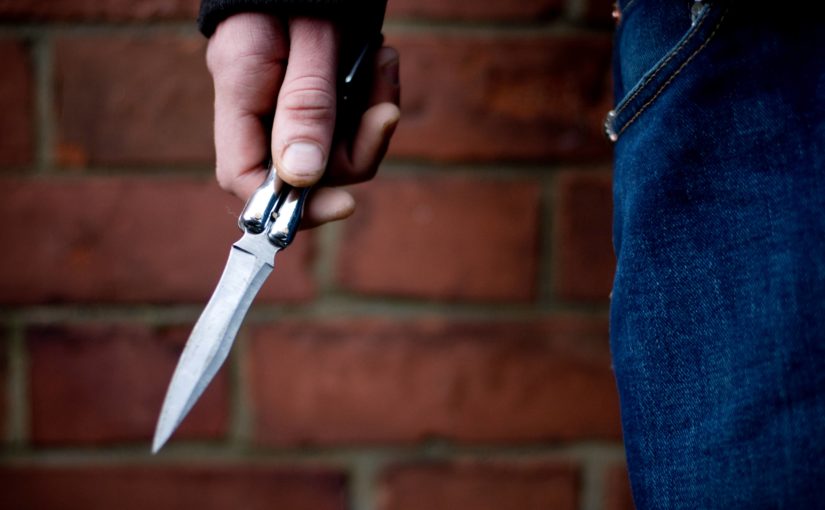
It doesn’t have to be this particular bone of contention either nor does the argument have to be about a physical response, it could be about any strategy, tactics or tool for that matter such as ‘In a knife attack, is it better to stabilize the weapon hand or fuck stabilization and just ‘attack, attack, attack!!!’?

It does indeed depend; as to eliminate either or restrict anyone of either based on the factual statements made on each could very well be limiting someone’s natural or already trained capacity at doing so and who are we to tell anyone that what has worked for them before all of a sudden won’t, and worst, could cost them their lives?

This is where knowing one’s audience in this field in my opinion, becomes critical.  For example, if a very average 70 year old woman concerned about an immediate potential threat in her life was to learn self defense, it would be somewhat ignorant to believe that teaching her any kind of closed fisted striking (to go back to the original example) would render her effective at such strikes, assuming of course the threat she is facing isn’t from an older, blind and paraplegic woman either eh?

Now if a 30 year old, athletic strong female was interested in learning self defense based on the same concerns; offering her the options of both while also explaining the pros and cons of each, and allowing her to figure out for herself which tactic is most natural, suitable and sensible to her being, and then allowing her to experience each in training to ease her decision would be the way to go.

Switch that to a 25 year old male, heavy weight golden gloves champion, who is interested in learning self defense. To take his natural and proficiently trained ability to strike with a closed fist and ask him to change it to open handed striking as the main and only method of defense doesn’t make sense either.  

The same approach should be taken as of the one of the 30 year old athletic female.  Teach both, show the pros and cons of each, and allow the student to experience them in real time/real speed via training to formulate what is best for them.

How do you do that in a large and varied group consisting of young teens, seasoned fighters, elderly folk and everything in between? Always cater to the weakest link in the chain.  The mechanics for a lead palm strike are the same as that of a boxing jab. The mechanics of a horizontal elbow strike are the same as that of a hook punch, etc. The tool itself is incidental and preferential.  

Here is where the argument heats up however.  Once on close quarter/grappling/wrestling range; striking becomes obsolete for the most part as striking requires 3 integral elements to make it functional: 1. Distance 2. Grounding, and 3. Torque. Remove even 1 of these elements and you’re left with at best 70% capacity of whatever chosen strike.  

Now, perhaps the athletic female and golden gloves champion could end the confrontation before it got extreme close quarter with a precise strike, but the average 70 year old or early teen? Generally, not so much.  

The lack of expertise, power, training, timing, precision and clarity in the moment once the initial strike didn’t end the fight, but instead escalated it by bringing it closer quarters would make their punch at best; a distraction. Relying on any kind of striking at this point (or grappling submission for that matter) wouldn’t be functional simply because boxing and grappling require regular training and practice to upkeep the functionality of it.

Not to mention, we’re talking about self defense here…. most people who come for self defense training do so because they feel an immediate threat, only a miniscule percentage of the population train self defense out of pure fun and passion or a possible/potential or imagined what if?  

Those that don’t are there for more pressing reasons and need strategies, tactics and tools that they could manifest fucking tonight if it was necessary. The arm bar taught and learned in one day to an average 70 year old woman won’t give her the ability to perform it under stress were she to get attacked the week after she learned it…. A primal scream coupled by a barrage of gross motor rip/tear/gouge/bite/strikes paired with her already driven adrenal state however most definitely can. and has on more than enough occasions to make it scientifically proven (for those deemed as victims, not necessarily just the 70 year old woman case).

And here’s why in a mixed group, the teaching of the strategies/tactics and tools aimed at those who are unfortunately perceived as the weaker/victims of our species, are paramount simply because if an average 70 year old woman could wreak havoc on a much larger and more violent assailant with these tools and tactics, imagine what the seasoned golden gloves champ could do with them?

One set of tools & tactics works for both individuals while the other set of tools (not necessarily tactics here) works for only the strong/athletic/attributed/attitude individuals. In many instances, it’s the ego of the strong and athletic that won’t allow them to acknowledge, perhaps, the tools and strategies aimed at the perceived victims, for in their mind, it places them in that category.  

Whatever the case, it doesn’t change the fact that they work and work well and are even more devastating in their hands as they also possess an athletic and sport oriented delivery system to back it.  

It’s all in the timing of it as well. Is it a 5 to 10 hour workshop? Is the individual in question taking regular and weekly ongoing private or group classes? How pressed are they to learn self defense?  What are their physical limitations if any? Answering these questions allows the instructor to formulate the class(es) to fit their audience.  

But to simply reject a strategy, tool or tactic, no matter what it is, even a spinning back kick for that matter, is ridiculous… prioritizing them as per the student, the level of immediate threat they are facing as well as taking into consideration their natural abilities, previous training and potential limitations (pointless to teach a spinning back kick to someone in a wheelchair for example) as well as the amount of training time they have should be how one constructs their daily curriculums and not on one’s own personal abilities and beliefs of what works and/or not.   That’s up to the individual in question.

What works for you may not work for all but what works for all will definitely work for you, at that point, it becomes matter of preference hopefully based on logic and sense as after all, this is self defense we are talking about, in the end, it’s your life on the line; choose wisely.

In my opinion anyway.  
Blazzing Saddles UK – Mo Teague

As a child I was raised by cowboys and brought up the cowboy way, I don’t mean cowboys as in builders but as in the ones who ride horses, herd cattle and fight injuns (native Americans, first generation peoples).I gotta tell ya it was tough but it made a man of me. Being brought up as a young cowboy taught me a lot that would stand me in good stead through the years and saved my sorry ass on more than one occasion. Cowboys are tough with a work ethic second to none. They work hard and party harder, they live basic but meaningful lives close to nature and to one another forging friendships that endure over lifetimes. It’s also a dangerous life, working with unpredictable animals in harsh conditions and extreme environments, scorching summers and freezing winters not to mention bears and rattle snakes, and all this on bad food , low wages and scarce female company (no mention of Brokeback Mountain please) So whilst not a glamorous lifestyle there are compensations and you just can’t beat a sing song around the old camp fire with a mess of beans, a slug of whiskey under a starry night sky with your fellow cowboys after a long day in the saddle…….is that a wolf howling in the distance….or those pesky injuns ?

Ah the golden age of cowboy movies, you see I wasn’t as you probably already know, brought up by cowboys, at least not directly. Let me explain. My father was sailor and away for long periods of time (years) so as a young boy I was bereft of male guidance and searching for a male role model, searching that is until we acquired our first black and white TV and the Lone Ranger (and Tonto) appeared on our screen, I was hooked and a cowboy from that day onwards. Now I understand it’s a generational thing so when I talk cowboys I don’t mean the anti hero Eastwood type or God forbid Brokeback Moutain, I mean real cowboys , Gary Cooper, Jimmy Stewart, Alan Ladd, Henry Fonda and of course the cowboys cowboy John Wayne. Now I can picture you reading this and thinking WTF where is this going, but bear with me and I will get to the point!

The point is information can be gleaned, interpreted and adopted from almost any source, even cowboy movies if you have an open mind. So what did I learn from cowboy movies you may ask?

Well the first thing I learned and understood was that there were good cowboys and bad cowboys, good cowboys were handsome and wore white hats whilst bad cowboys were ugly and wore black hats, both sets have lived by an unwritten code, one good , one bad , the clash of codes obviously became the movies story line. Now as I grew older I started o understand the good cowboy code and adopt certain values and attitudes such as calling my parents Ma and Pa and eating more baked beans than was good for my intestinal tract not to say the atmospheric conditions within the ol’ homestead

I also started to understand that good manners were central to the cowboy code especially regarding women and children as was kindness to animals and the weak and the vulnerable, and most important that violence was always a last resort after the hero has been pushed too far and with no other choice, hence the big shootout showdown in the final scenes which despite being wounded the good cowboy always wins and kills the bad cowboy or at least runs him out of town.

You see the point of this article thus far is, you gotta have a code, a personal code that articulates your values and guiding principles to life, see if you don’t know what you stand for you will fall for anything. What will you fight for? because someone spilt your beer or looked at you the wrong way? (Bad cowboy code) or will you walk away with your honour and integrity intact because you were true to your code. Any damn fool can get into a fight it takes a man of character to walk away if he can, especially when he knows he can whup the other guy. Only when there is no option other than to fight, well that’s when the metaphorical six guns come out of their holsters. OK I gotta rodeo to git to so take care.


                     To be continued……..


Matrix Download Syndrome, Part I – Marc MacYoung


“Don’t think that your book learning is the same as my experience.”
Terry Trahan

Someone recently asked me how to keep calm when someone is in his face (threatening him). My response was:  Start with the fact that your ability to do it is developed BEFORE you need to do it. Without previous work, there is NO way to succeed on the spot. You asking “How do I do it in the heat of the moment” is too late. You’re screwed.

Hold that thought, we’ll come back to it.

This is going to be a series of articles about what you can do to keep yourself from getting killed out in the streets. But I’m not going to talk about techniques, combat mindset or even legal details. That’s because being able to easily access that kind of information is part of the problem. Instead, I’m going to help keep you alive by addressing assumptions, modern thought, how you’ve been conditioned to learn/think, how changes in technology, how “internet intelligence” and easy access to excessive information is negatively impacting our ability to safely navigate dangerous circumstances.

Here’s the booger about that. You won’t even know this problem exists until you’re either laying on the ground bleeding or sitting in the back of a cop car in handcuffs. Even then while you recognize something went horribly wrong, you won’t know what.

Let me start out by pointing out that you cannot learn self-defense in the classroom, training hall, dojo or even at firing range. This is biggest misconception there is and it often shades into an outright lie. A lie we are told and worse yet, a lie we tell to ourselves to bolster our confidence. But it won’t be until a situation turns into bloodbath that this lie will reveal itself.

Simply stated we can’t see these inherent flaws with our approach to self-defense because it’s how we’ve been educated. I’m talking public schools here. University education is years down the line. Here’s a news flash: Learning how to effectively defend yourself is not the same as learning geography. Here are some bullet points about that.

  • Self-defense is not a fixed subject; it’s a reaction. On both mental and physical levels, it’s on-the-spot and high speed problem solving. That requires assessment and judgment abilities be in place before the situation requiring them.
  • Self-defense doesn’t have a fixed way it happens, there are many levels of danger and even more ways things develop. Unfortunately many people train for only one level of response and believe that will cover ever possible scenario. Mostly these training scenarios are imaginary. They train for their fear about how they believe violence happens, rather than how it occurs (or how to recognize its development).
  • Nor is self-defense a set of techniques, a formula, a ‘mindset’ or a just-do-this ‘strategy’ you can learn on the internet; it reaction to changing circumstances and conditions  you find yourself in. Circumstances that are going to be impossible to predict before. Conditions that are completely situational  and impossible to develop universal tactics to handle. Circumstances and conditions that will change depending on what you (and others) do.
  • Nor is it just physical skills (whether punching, kicking, stabbing or shooting), it’s assessment. It’s knowing when to use those physical skills, when not to, when to start and most importantly when to stop. Self-defense is way more than physical. It’s also knowing what is danger and how to asses its development and degree (including that danger exists outside of perception). It’s having an understanding of human behavior and how your actions are going to positively — or negatively — influence the other person. It’s understanding how adrenaline and emotions can distort both our perceptions and thinking — and overcoming that to still make appropriate calls.
  • Most of all, it’s self-control. That is not something one develops in a class room or from reading the internet. You need to understand what self-defense isn’t, because come that dark and lonely night, it’s not what style you know. It’s not the caliber of gun or ammo. It’s not who your teacher was. It’s not whether he was a bad ass, a cop or a soldier. It’s not about your past, your self-esteem or empowerment. It’s not about your fears, emotions or ‘what ifs’. It’s about your ability to function and make good decisions under pressure.

    If you can’t do that, you’re screwed.

Does this mean classroom training is useless for self-defense? No. Not at all. One of the foundations for making good assessments, is having a working knowledge of multiple topics and –stable –data about those subjects. There are many issues related to self-defense that can only be learned from quality classroom time (e.g., what are the legal parameters, limits and consequences of self-defense?) You can’t gain a full understanding from just reading. You need class time where you can ask qualified instructors questions about the subject.

Does this mean reading on your own isn’t important? Au contrarie mon frere. The reading you do on the widest spectrum possible of topics is critical. But do NOT get all your reading materials from one source. For example, martial arts sources are not the last word on self-defense. They certainly suck as a source of legal expertise — starting with what is self-defense.

Read up on boundary setting, psychology, law, anthropology, conflict resolution, negotiation, leadership, social graces and anything else on human behavior you can lay your hands on. The wider the range of your knowledge, the more options you will have and the better you’ll become at managing conflict before it escalates to physical self-defense. Nobody has a monopoly on this subject, reading show you this truth. The wider the scope of your reading, the more you’ll realize how limited certain perspectives are about this subject.  Better than that though, such knowledge helps you in relationships, career and just getting through life.

Does this mean physical skills aren’t important? Oh this is a can of worms question. It’s especially problematic when someone has Matrix Download Syndrome. Hey Neo learned kung fu and karate by downloading, why can’t I? Ummm. How about, because this is real life and real life is more complicated than movie tropes and sound bites?

So why, even without MDS are physical skills when it comes to self-defense a can of worms? Short answer is: They’re critical, just not in the way you think.

Physical skills are a complex chicken or the egg issue. You do need to have physical skills that work. Yet even that is a multifaceted issue. Starting with dividing two fundamental concerns  so we can see how they interrelate. One is: What does it take to ingrain physical skills so you can do them under pressure? Two is: Is what you are being taught actually effective?

Someone can be extremely well trained in a bad system. This is the basis for my detailed -car -without-an-engine analogy. If important parts are missing, no matter how shiny and polished it is, that car isn’t going anywhere. Another way of looking at it, is just because an instructor can make it work, doesn’t mean you can. This especially because how often an instructor can have internalized an element so well he doesn’t think to mention it. It is therefore missing from his instruction. That’s the happy version. The not-so-happy version is the only reason it works for him is because of his strength and speed. Without those, you have a snowball’s chance in hell of pulling it off.

So ask yourself. Are you being trained so you can do something or are you being trained in what the instructor can do? Does the instructor identify the components of movement that must be present in order for the move to work and then drill them until they are ingrained? (Literally, you can’t do the move without these because it feels wrong.) Or does he show you a move, have you do it a few times and then move onto more sexy stuff?  If that’s how you’re being trained, you won’t be able to make those moves work in a situation.

You also need to have physical skills so ingrained that you don’t have to think about doing them. By that I mean not wasting bandwidth to figure out what’s the best move or where you have to step to do it. When either circumstances are right, you recognize something bad is happening or you’ve given yourself the go order, the process is automatic. That’s the result of understanding the move so well that you know when (and how) to do it without conscious thought. This, no matter how stressed or emotional you are.

The third can of worms element of physical skills is what I call faith. This concept is best exemplified with a simple question: Are you willing to bet your life on that move working? Do you have faith in your physical skills to get the job done?

If the answer is no, not only will you freeze, but when you can move, you’ll do it half-heartedly and without commitment. You will not commit to something you do not trust to work. Which increases the odds of it failing.

The final element of good physical skills has nothing to do with the physical. More than that, it flies in the face of the old maxim about “If all you have is a hammer, everything looks like a nail.”  Good physical skills give you the confidence to try other options. Will those other options work? Well you can’t really say until you try them, but having the physical ability to handle it if they don’t gives you the confidence to try. That’s a confidence you won’t have if you don’t have the physical elements ingrained.

Going back to the “Does this mean…” line of questioning.

Does this mean that scenario/adrenal stress training is the cat’s ass? No. It’s critical, for you to be able to apply your information, but like any other single topic approach to the subject it’s a failure waiting to happen.

Many people from traditional martial arts go into scenario-based training and fall apart — the first time. Much wailing and gnashing of teeth comes from this experience. In fact, many people use this as the basis of their claim that traditional martial arts are useless (and why this new, scientific and reality based training is superior). What these nimrods are overlooking is what happens when someone who has many years of training takes scenario training and finally learns how to function under adrenal stress.

There’s an entire mythology that has sprung up around scenario training. A mythology that often overlooks a simple truth. That’s in order for scenario training to work, you have to have ingrained skills beforehand. Skills that you’ve developed and ingrained over long practice.

Mix physical skills with class room knowledge and understanding and you end up with a process that can be understood akin to swimming. You learn how to swim in the current-less and shallowness of a pool. That’s where you master the component parts and refine your techniques. After that, you add another level of complexity to it by trying to swim in the ocean or river. The currents do not change what you already know, you learn to apply them under different and variable conditions. Scenario training can be best understood as “Okay, you know how to swim in a pool. Now it’s time to learn to swim in the ocean.” That’s a next level of issues affecting your swimming. And yet, when you’re playing in the surf, you’re still under the watchful eye of a lifeguard. This oversight is critical because, there’s a plethora of next level mistakes that a person can make.

Scenario training (or at least well run scenarios) can help you debug your reactions so you don’t make these common mistakes at the same time you develop faith in what you know working. But having said that, it’s still training. It’s not self-defense.

The final ‘does this mean…’ I’m going to leave you with is: Does this mean all training is bullshit?

No, but what it does mean that any training (no matter how good) is a simulation of reality. Training is not the same thing as doing. More importantly, training doesn’t mean you can do it. If we stick to the swimming analogy all that training, reading, classroom and scenario training isn’t the same as being swept overboard (an actual self-defense situation). But they will all contribute to you being able to swim to the life preserver (or to the shores of safety).

I liken training to building a bridge across a canyon. Many people believe if they find the ‘right’ system/approach/teacher, then it’s going to be like driving across the bridge. No problem at all, they just cruise right on over to the other side. When they end up falling off the end of an incomplete bridge they wonder what happened? Why didn’t it work? They’ve done everything right! It should have worked!

This is why I tell you you can’t learn self-defense in the classroom. The best training in the world will only partially complete the bridge, you have to make that final jump yourself. You have to reach inside yourself and pull that out of you to make the jump. Without this final component — and it can only be found in the situation — your training will not work.

At the same time, this is why the quality of the training is important. If the bridge is three quarters done, it’s a lot easier for you to complete the last quarter when you find yourself in a situation. But, if through bad training, the bridge is only one quarter done, then odds are strongly against you being able to make that leap. Some can, most fail.

The thing is, it’s entirely too easy for someone to decide that an instructor is offering them everything they need. This is a big part of why people buy into bad training. They have no frame of reference about how violence happens (and this includes someone who had one bad experience and decides to train). Instead they pick a training program based on their Hollywood based or imagination fueled beliefs about what violence is — and train for that.

In the rest of this series we’ll talk about other cognitive biases and misunderstandings that hinder your ability to act in self-defense. And how the belief that your training will do the work for you is a disaster waiting to happen.

Part II

Part III

A Woman’s Toolkit for Recovery from Violence and Trauma by Anna Valdiserri – Reviewed by Toby Cowern

I have followed the blog writings of Anna Valdiserri for some time now and have been consistently impressed and interested in her observations and conclusions drawn, around a number of aspects of violence dynamics and conflict management.

When I heard she had written a book, I must confess, I ordered it straight away, without a second thought, despite the title leaning heavily towards female readership. If ever there was a case of ‘Don’t judge a book by its cover’ this would be the epitome of it. Valdiserri herself writes early on:

“What I am trying to do with this booklet is… to provide women with some of the recovery tools we are not taught we may need. Having said all this, I don’t think there is anything in this book that men can’t use too”

That statement is astoundingly accurate. My first thought when sitting down to read this small book was that it would help give me an insight into some of the issues that women may need to address or have concerns with following trauma. This is a vital area of development and understanding I personally need, not only as a self-defense instructor, but also as a husband and father (too girls) On diving into the main sections it felt very akin to reading the “Armored Rose”, this small guide having a power in it’s detail, message and delivery to give me many things to think about and reflect upon.

I found the structure of the book to be excellent.  A list of key headers is provided in the beginning and taken in turn and expanded upon as the book progresses. The power of this book, in my mind, is Valdiserri’ ability to get significant concepts and depth of ideas over to the reader in such minimal writing. With so many writers getting wrapped up in overly expressive styles or wrestling with political correctness, Valdiserri goes straight to the heart of an issue and tells it exactly as she sees it. Not only does this make for a refreshing change (especially in the genre of ‘Self Help’ books) but it enables the reader to understand and engage with the strategies being laid out in appropriately sequential steps, without confusion.

I was reading this book ‘out of interest’, but can imagine how it would feel for a reader to open this book out of necessity, having been the subject of violent trauma and looking for a path to heal. The brevity of this book, I do believe, makes that journey far easier for any reader who may literally be reading and then trying to apply what they have just read.

At only 79 pages long, the author refers to her writings as a ‘booklet’ and that could be a fair description. With that in mind I actually hope that this ebook can find it’s way into physical publication, as I can see it taking an essential and much needed place on desks and side tables through doctors surgeries, hospital wards, police stations, support centers and other venues where those that need the advice most can receive it the quickest and most discreet way.

All in all I found this book to be compelling reading, offering excellent, well thought out strategies, presented in a clear, concise, unambiguous manner in enough detail, but as few words as possible.

I have already purchased copies for friends of mine (The highest endorsement I know how to give) and would definitely recommend this book. Gender regardless it’s content informative and of value, exceptionally well priced and can be read and assimilated quickly.

It is rare a book is released that achieves so much in such few pages. I hope you get as much benefit from reading it as I did, and it’s worth noting, some of the strategies contained within “A Woman’s Toolkit for Recovery from Violence and Trauma” even worked for me…

Available for purchase at the CRGI bookstore.

Talking Knives: Part II – Marc MacYoung

Robbery, although wounds or killing are not common (unless the victim attempts to resist) this can be best understood as a ‘stalled attack.’ Violence routinely comes with instructions how to avoid it. These instructions tend to occur before a physical attack is initiated. With muggings this order is reversed. Basically using deception to cover the significance of his actions, the criminal sets up the range and positioning for an attack, starts the attack, and then stops before it lands. What was an attack stops and is followed by instructions how to keep the attack from finishing (e.g., give me your wallet). If the person resists, the completion of the attack often follows. While a single slash as punishment is common to the face, neck, upper chest and arms. Depending on the degree of resistance by the victim depends on the amount of injury.


Message blade use is common among criminals and certain ethnic groups. It is sometimes fatal (e.g., decapitation) sometimes not (i.e., nostril slitting, cutting off ears and nipples). The use of a blade is very deliberate in order to send a message to others, often through sheer savagery. For example the individual is not just killed with a blade, but hacked apart for intimidation. Especially in situations where more effective weapons are available, the use of a knife sends a clear message about crossing or betraying certain groups. Whereas deliberate but non-fatal maiming (i.e. nostril slitting, cutting off ears or fingers) combine sending a message to others about crossing a group, a lesson for the maimed person, and also demonstrates contempt for the individual left alive (i.e., you/your group are not strong enough to stand up to me/my group).

Brandishing/Menacing is fundamentally a threat display, negotiation tactic— that also happens to be illegal. A distinguishing difference between this and robbery (or kidnapping) is brandishing usually occurs in the middle of an altercation. There is usually conflict, build up and instructions to avoid before the weapon is drawn and displayed. This is repeated when the blade is drawn.

Like other kinds of threat display, brandishing can be based in either ‘do what I want or I will hurt you’ or  ‘I’m too dangerous to attack.’ While either type can result in the blade being used, both require closing distance. If the draw and deployment occurred outside of knife range, somebody has to move into range for there to be wounding.

The question is: Did the aggressor (using it in the first method) close the distance to enforce his demands when he perceived the desired reaction didn’t occur fast enough? Or perceiving this, did the aggressor attack in rage? Or did an aggressor unexpectedly encountering a knife, close the distance to show the defender his (the defender’s) knife didn’t scare him (the aggressor)? Or did it turn into a fear attack by the defender?  All four will result in knife wounds.  

A fifth option is the knife is drawn and deployed with intent to brandish, but is done inside attack range. Due to ‘compression’ and proximity, this attempt to ‘scare someone away’ often backfires in various ways. In these sorts of situations, the question inevitably comes up: Why didn’t he flee when under threat? Simply stated fleeing is only a realistic option when

1) the range is great enough

2) when the person fleeing is in better physical condition than the potential attacker. Failing either or both criteria, turning one’s back at close range is a high stakes gamble for being attacked from behind.

Defensive uses of blades tend to have four common elements. First, even though only one side typically has a knife, there must be immediate threat of death or grievous bodily injury by the other person’s actions to warrant the blade’s use. More often than not that danger comes from other means than a knife (e.g., clubs, guns, improvised weapons or conditional disparity of force). As stated earlier, knife to knife is exceptionally rare, but that doesn’t mean other dangers don’t exist.

Second, typically, once the threat stops the defender stops his actions. This tends to cause a limited number of wounds as when the initial attacker stops and breaks off, the defensive action stops as well.

Third, except in specific circumstances, wounds are to the front of the attacker (that the knifer was defending against).

Fourth, defensive wounds on the attacker tend to be non-existent or minimal. In essence while attacking, very little attention is paid to defense and arms are not used as shields. Often what could be described as ‘defensive wounds’ line up with other wounds (e.g., a cut to the arm that aligns with a cut to the chest from the same slash).

As a subpoint of #2, defense stops when threat stops, the amount of damage an attacker takes is often dependant on his or her commitment to attack. A committed — usually intoxicated —attacker can often take multiple fatal wounds and continue attacking before being overcome by those wounds. Again, usually on the front.

Fear can be considered a catch all category. It can be viewed as a third subset of brandishing gone wrong, sheer panic, or a defensive action that turns into a frenzy.

Under the combination of fear and adrenaline,  the individual—to use layman’s terms— ‘freaks out’ and starts attacking or leaves defensive action moving into excessive force. This flavor of knife use tends to create yet another pattern of wild, untargeted, multiple wounds. These wound pattern are indistinguishable from a rage or FMA attacks.

Fear knife use is also the basis of someone chasing a person down the street and slashing at the other’s, back, then later claiming ‘self-defense.’  Due to adrenal stress, fear and continued proximity the person honestly — although not reasonably — believes the other person is still a threat.


How to Stay Safe in the Age of Terrorism – Avi Nardia & Tim Boehlert

This 10 Question interview originally appeared in Black Belt Magazine, but has been edited by Tim Boehlert at the request of CRGI staff.

Q: Should the average person be worried about lone-wolf terrorist attacks?

A: Terror cells, like the Boston Marathon bombers, that are not connected by anything other than ideology will become increasingly common. In some ways, lone cells are more dangerous than organized terrorism because lone cells are difficult to monitor, control or discover. The more we go after the larger terror organizations, the more they will split into smaller cells. This is exactly what has  happened with the drug cartels.

Q: Do you think the Internet is becoming the prime tool for terrorist organizations to recruit lone wolves in any part of the world?

A: Yes, the Internet is a major tool today for recruiting, teaching and spreading terrorist ideologies around the globe. The Internet can be used to traffic information and gather intelligence, and as a meeting place for finding others with the same ideas. It’s very easy to create fake accounts, use them while they are viable, then disappear – maybe completely. Terrorists are becoming increasingly tech-savvy.

Q: Are there any parallels between how terrorists recruit lone wolves and how gangs recruit members?

A: Terror groups share the same mentality as gangs — exploiting hate, spreading anger and practicing brutality. Terrorists also practice the same indoctrination techniques as gangs. Using ideology to ‘persuade’ others that are malleable has been highly effective.

Q: As high-profile targets get extra security, is there an increased likelihood that soft targets — and civilians — will be attacked by lone wolves?

A: Nowadays, we are seeing sick people understand that the more brutal their methods, the more media exposure they gain. As governments and sensitive targets continue to invest in more security, we will begin to see more and more independent terror attacks on soft targets such as bus stations, schools and any place that will instill fear into the public. Terror’s main goal is to create an atmosphere of fear, for control purposes.

Q: In light of all this, what measures can people take to stay safe?

A: Citizens need to push for government to be less tolerant of terrorist ideologies. We also need to educate the public and law enforcement on terrorists and terror culture. It seems to me that people have too much tolerance for terror — sometimes even the police are more strict on normal civilian criminals than on terrorists who walk free among us. One must study and understand what terrorism is before we decide how to fight it. People must understand how terror feeds from the media.

Q: Is increased awareness the most important precaution a person can take?

A: Awareness of who lives around us is important, but it is also important that we protect our freedom from pervasive surveillance and a society wherein anyone could frivolously call the police and have a person arrested. Security and surveillance must be approached in a measured manner. We are seeing instances of abuse as a result of increased surveillance daily it seems.

We should demand more security in schools for our children. In and around our homes, people need to take it upon themselves to study and train in counterterrorism. You are the first responder, not anyone else, and if you always rely on someone else to arrive, they might be too late. We need to take responsibility for our own safety – at hime, at work, on vacation even. Simple things can make a difference.

Q: Do you recommend that people consider lawfully carrying a firearm — assuming they have an interest and have had the proper training?

A: It’s easier to carry a gun in a bag than to carry a police officer. If most normal civilians carry firearms, it will reduce crime as well as terrorism. Switzerland is an example of a country where most civilians own guns, and it’s one of the safest places in the world. People need to take more than just the standard 8-hour course as prescribed in many states. They should know how to use it, how to clean it, how to clear jams. They should know how to shoot in low-light, how to re-load, with either hand.

In Israel, firearm owners must complete 50 hours of training every year to hold a permit. We have seen many situations wherein the first responders were normal civilians who defended and stopped terrorists before any police cars showed up. We also have civilian police volunteers who get training by the police and carry police identification cards. These volunteers patrol sensitive areas and help prevent crime and terrorism. In my system of Kapap, we teach firearms, CPR, surveillance and counter-surveillance as part of our Martial Arts. This training develops awareness and the ability to effectively respond in emergency situations.

Q: How useful could a knife be in the hands of a trained martial artist who’s facing a lone wolf terrorist?

A: Knives are effective weapons and very important to study. The only problem is that it’s hard for a person to use a knife in a real situation. The knife is not a simple weapon unless you are well trained, and overcoming the psychological barrier of fighting with a knife is difficult for most people. People need a lot of training to overcome training that they’ve had since childhood – “Be Nice!”, “Don’t hurt them!”, ” Don’t be rude!” etc. These are simple examples of how we are taught to be courteous and kind, even when facing violence. To overcome this pre-conditioning takes a lot of specialized training. We need to learn to give ourselves to BE RUDE, to strike first – preemptively.

I would also recommend learning about the gun before learning about the knife. Nonetheless, knives are great weapons and are readily available — e.g. in the kitchen. Improvised edged weapons, such as a broken bottle, are also great for self-defense.

Q: How is fighting a person who’s willing to give his life for a cause different from fighting a mugger, a gang-banger or a rapist?

A: Most criminals are not ready to die. That simple fact makes self-defense easier because even rapists and other criminals are just looking for easy victims. Terrorists look for any victim, and therefore anyone is a potential target. Terrorists may fight to the death, which makes the fight very difficult to finish. This is why guns are better to carry than knives. A knife will also require one to be close to the threat, whereas a gun allows one to fight from behind cover. There’s a huge mindset difference. One’s goal is to get resources from you – cash, jewelry, sex. The goal of the terrorist is completely different.  Both may treat you as less than human, for different ‘needs’ to be fulfilled.

Q: Realistically, what chance does an unarmed martial artist stand against an armed terrorist?

A: The first rule is to never give up — regardless of whether you are unarmed and the attacker has a weapon. You should always maintain your awareness and carry your hand-to-hand skills, as well as your gun-disarm skills. Assuming that an attacker does not have a gun can be a deadly mistake.

***
Avi Nardia is a a former hand-to-hand combat instructor for the Israel Defense Forces (IDF) Reserve, the Israeli counter-terrorism unit YAMAM and the Israeli Operational Police Academy. He teaches the martial art of Kapap, as well as Judo, Brazilian Jiu-Jitsu and Krav Maga. Kapap is also being taught around the globe through a network of affiliated schools. Avi has produced a series of DVD’s through multiple vendor sources such as BUDO.

Charting the Principles – Garry Smith

For the record I really find Erik’s 12 Principles of Conflict Management an excellent piece. Equally Rory’s exploration of the deeper reaches of each principle certainly moves us forward as we develop our understanding. It is really important that we do this as CRGI was never established so we could all pat each other on the back and tell each other how wonderful we are, how clever. The search for the truth often leads us up blind alleys and sometimes we end up travelling the long way round to get there when there was a quicker more direct route all along, we just did not see it. The thing is sometimes what we see on the journey is as important as arriving at the destination.

When I read Rory’s article I thought it resembled a trip to the opticians for an eye test, where you wear or look through some contraption that they drop different lenses into whilst you read off a chart. So looking through different lenses allows Rory to tease out the pros and cons of each of the 12 principles Erik rightly identifies, it works well. However, as we debated this prior to finishing our articles something did not click for me. I felt a slight intellectual discomfort with how, rather than what, Rory was presenting. When critiquing a list it makes sense to follow the list, I get it, it works. However, I felt that there was the need for a simpler more abstract presentation to sit alongside both Erik and Rory’s articles, splendid though they are.

When I first read Rory’s response to Erik I got a strange picture in my head, (not an unusual experience).  This is it.

Neville Chamberlain returning from meeting with Adolf Hitler in Munich bearing aloft the piece of paper that guaranteed ‘peace in our time’, the rest, of course, is history.

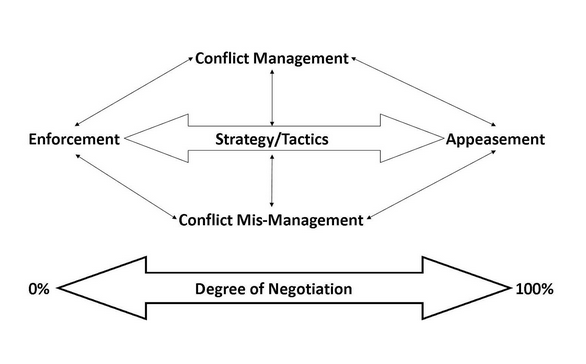
My problem was why was this picture in my head, well the term appeasement jumped out at me from Rory’s article along with the use of force as kind of polar opposites of managing conflicts. I began to see a continuum for conflict management with two polar ends, one being unmitigated enforcement of a settlement at one end and abject appeasement at the other,  this leaves every possible variation on the line in-between, neat. Well let us see.

Once you take each of the 12 principle and observe and explain its deeper context, lets extend the eye test metaphor here and looking now through a microscope, we begin to see in each the multiplicity of variables that may or may not be present in a conflict what happens when we overlay one principle with another, and another and it was this thought that gave me a feeling of information overload. Each one is explored and explained clearly enough, each one is massively open ended.   What Rory does is open up each principle so that we can see more, but the deeper we probe the more we reveal and, this is the big one for us all, how can we use this list to assess the effectiveness of conflict management or the ineffectiveness of conflict mismanagement?

Well the obvious answer is lists can be checked against events to see if what they described was present or absent, we can then evaluate how this may have contributed to the outcome, then we can judge whether this was intended or not and how effective. That seems like a logical process to me but we all know that variables interact and the complexity involved in any given situation or conflict will produce, even using this logical sequence of analysis, a best guess result based on interpretation and perspective, nobody is claiming any different as far as I can see. Nobody has attempted to claim the mantle of expert, indeed we all reject it for obvious reasons.

The thing is we do need to develop useful tools to measure conflict management techniques, responses and strategies, call them what you may, as well as the flip side of conflict mismanagement as it is often here that most productive learning takes place.

Now I love the list and I love the critique but as I began to suffer from a little conceptual overload. I did what I normally do, I shut it down and went for a walk with the dog, let the subconscious work on this whilst I had a little fun.  

A day or so later I decided it was time to let my thoughts pop out of my head and I drew myself a diagram, here is my diagram.

Garry image
OK it is not a replacement for either of the afore mentioned articles, rather it is an aid to understanding. A framework that allowed me to get to grips with some of the complexity, a simple(ish) model, let me explain.

Underlying most of what Rory looks at is the fair assessment that successful conflict management is achieved by many strategies and tactics and is never simple or straightforward, however, I am pretty sure that if we can use a continuum that ranges from enforcement at one end to appeasement at the other we capture everything in between, (that’s the neat thing about continua). Apply the right strategy/tactics with the right balance between enforcement and appeasement and everything is cool, we hope.

The flip side is true of conflict mis-management, choosing the wrong approach strategy and tactics to manage a conflict and you are quickly in trouble.  

Each situation will have its own dynamic, each situation will have multiple variables. It is the possibly infinite ways these variables combine that make the subject of conflict management so interesting and so challenging if not downright confusing.

The degree of negotiation provides us with a scale to help contextualise the continuum, if you can simply impose enforcement then no negotiation is really necessary, the alternative at the other extreme is what Rory calls begging, I think this is where I got the Neville Chamberlain thought, with no power or will to back up your intention you simply cave in, you are dictated to, you will have to negotiate like hell because that is all you have. It is a crude method of measurement and is a work in progress not a solution.

In fact the whole model is crude, I am not trying to be sophisticated, I am keeping it simple (stupid), remember that. The model is simple and you can use it as a backdrop to your thinking, like this if I take one of Rory’s points at almost random. ” Negotiation only works, negotiation doesn’t even exist, except for the threat of what will happen if negotiation fails. You never do hostage negotiations without a tactical response on standby and a country without an army may make themselves feel important by mediating a treaty… but negotiation without an alternative is begging”

The problem for me is not just the range of variables, legal, cultural, linguistics, environmental etc, the things we can see/hear/smell even, the empirical evidence, that may be present in a conflict management situation, but the things we cannot see and often can only guess at, motivations, morals, feelings and emotions, these are powerful drivers for all the actors engaged in a conflict. The list can never be expanded to encompass all possible components of any given conflict. We would need a much more powerful analytical tool or toolbox to help us to achieve that, this is what fires the agency of the actors involved.

So we can place conflict management strategies and tactics on the continuum as they are applied and then watch them move around the diagram as variables and agency collide and produce a unique recipe for each conflict we see, no two dishes will be exactly the same even if we try to use the same recipe.

My simplistic diagram is not an answer, for me it is a starting point in conceptualising a grand theory of conflict management if that is not too ambitious and outrageous thing to aim for. Can I do this on my own, I sincerely doubt it, can I add to a debate with informed and insightful others, Erik, Rory, YOU, to perhaps help us shuffle along towards such a thing together? I hope so. Maybe these three articles are the first tiny steps that start a big, big journey.


Navigating Negotiations: Part II – Lawrence Kane

Conflict:

The challenge with conflict negotiations is that more often than not you’re emotionally involved, which is why many companies and agencies employ professionally-trained facilitators to help navigate the process and resolve disputes. Successfully negotiating resolution to conflict depends on the underlying causes. If it is a clash of personalities that requires a different approach than an intentional ethical violation, for example. Consequently the first thing you’ll need to do if you are the independent party brought in to resolve things is to interview stakeholders and try to ascertain what truly happened. If you find yourself in a situation where you may be the cause or the aggrieved party and have to take care of things yourself you will still want to do as much fact finding as feasible before working toward resolution.

Keep in mind that perception is reality so just because something isn’t true doesn’t mean that it doesn’t matter to the other party. But, misperceptions can be cleared up. For example, I used to start work at 6:00 AM on the West Coast when I’d have several meetings with folks on the East Coast. Two or three hours later, whenever my schedule opened up, I would go out, say good morning to my team, making sure I was visible for a while so that folks could tell me if they had something urgent on their minds or ask for help. They called that “management by walking around” in business school. I saw it as being there for the team (as opposed to hiding in my office which was around the corner from where they sat). One of my employees, however, saw it differently. She thought I was checking to see if everyone was at their desk working, a thought which never even crossed my mind. If I didn’t trust the team I never would have hired (or retained) them. That misperception wasn’t particularly hard to correct, but it did cause morale issues for a short while until I realized what was going on.

Armed with whatever background information you are able uncover, you can formulate a strategy for dealing with the disagreement in a way that will keep it from reoccurring. When you speak to the parties, especially when you have a vested interest in the outcome, it is vital to keep your cool and focus on behaviors rather than making things personal. Folks who feel threatened or insulted stop listening, often becoming defensive or aggressive and poised for (verbal or physical) battle. In fact, when someone is losing an argument they virtually always take things personal. At that point the disagreement is no longer about the action or error, often turning to animus that is not easily resolved.

You can feign anger on the job, but it’s a tactic that should rarely (as in no more than once every couple years) be used and then only for special purposes. If folks think you’re bound to blow up at them it will undermine their trust and your career. If you’re actually angry, walk away and re-approach the subject when you’re in a better mood. Saying something along the lines of “I’m having an emotional reaction to this” can both help you calm down as well as have a good reason for tabling the conversation. The only time that feigned anger is appropriate is when you’re dealing with an ethical breach or similarly serious event. It takes years build up an emotional bank account with those around you, yet in seconds you can withdraw all the credit you have gained if you act out inappropriately.

Conflict negotiation can be tough, but it’s also a time to pull out your bag of “dirty tricks,” so to speak. There are a variety of tactics that are often used by conmen and criminals for nefarious purposes that, when turned to a more positive intent, are appropriate in a professional setting. This includes things like forced teaming, coopting, and loansharking. Forced teaming is tactical use of the word “we.” Instead of “I have a problem,” say “We have a problem.” It shows that you’re in it together, both vested in the problem as well as the outcome. It feels inclusive too. Coopting is designed to get other people on your side before they’ve determined what they really think about you. If you can turn critics into advocates, which takes a bit of social and communication skills, you strengthen your position, gather allies, and get help in resolving the issue. If helps if you focus on the superordinate goal of helping the business so that it doesn’t come across as self-aggrandizing. Loansharking is typically done by offering small favors designed to evoke feelings of indebtedness in others. Yeah, it’s cheesy, but even simple stuff like getting coffee for the other person every so often, can make a difference in their feelings toward you. Those may appear to be shallow tactics, but they are highly effective psychologically, especially when you are well-intentioned.

Some final thoughts:

No matter what you’re negotiating begin by keeping the endgame in mind. Know your goal, know your boundaries (non-negotiables), and stay on track. The better you know the other party, what’s urgent and imperative to them, what they need, and how they are compensated or measured, the better. Know yourself and your objectives so that you can stay on track too. Creativity is good. There’s more than one appropriate way to solve most anything, but guard against an agreement that unduly alters what you were originally aiming at. It’s easy to get caught up in the moment, especially if the other party is a very experienced negotiator and more than a little manipulative. If in doubt, sleep on it before agreeing to any final resolution.

Make sure you’re talking with someone empowered to make a decision before you get started. There’s no point in wasting your time otherwise, so if you discover you’re dealing with the wrong people escalate. Or play them off against each other, though that’s tough if you’re not a professional and not a game that most folks ought to play save in special circumstances.

Negotiation is more about communication than anything else, so you will need to exercise active listening skills throughout the process. Silence can be your friend, as the other party will often feel compelled to fill it, oftentimes giving away more than intended. Ask before you assert, aim for clarity and cooperation, pay attention to non-verbals to see if it’s working, and don’t hesitate to course-correct as needed (so long as you don’t stray from your goals, of course) The best deals are those in which both parties find a win. Be courteous, patient, and respectful, but always stay within the parameters you decided before you got started.


About the author:

Lawrence Kane is a senior leader at a Fortune 50 corporation where he is responsible for IT infrastructure strategy and sourcing management. He saved the company well over $2.1B by hiring, training, and developing a high-performance team that creates sourcing strategies, improves processes, negotiates contracts, and benchmarks internal and external supplier performance. A bestselling author of more than a dozen books, he has also worked as a business technology instructor, martial arts teacher, and security supervisor.

The Warrior Legend – Kathy Jackson

We tell our children myths and fables. These are very powerful stories that carry the messages and core values of our culture. That’s how cultural knowledge passes from one generation to another. Humans are motivated by stories. Those stories, those fables, those myths, those legends – they all hit something at a very visceral level. They hit your gut.

Within the firearms and self-defense training community, we have often benefited from the Warrior Legend. This cultural myth hits something deep within the heart of every good man. It is the story of the strong head of household who defends his family. It is the story of the warrior who protects his people. It is the story of the knight who rescues the princess. The Warrior Legend hits a very powerful node in the best and the strongest among our men. And that’s good!

We have often used that goodness to our advantage within the self-defense training community. When we use the word “tactical,” that’s one of the words that strikes this same chord. We have lots of words and phrases that activate the same feeling: Sheepdog. Fighter. Warrior. Soldier. Protector. The man who runs to the sound of the guns. Or puts his own body between his beloved home and the war’s desolation. The strong man loves his woman and he faces danger for her sake. That’s the story we tell, in short form, when we use those words.

Within the training world, we’ve gotten very good at hitting that button, hitting it from a lot of different angles, over and over. And it’s been very effective in motivating male students to buy classes, to pay attention in class, to practice what they learn, to drive forward and learn more. It’s a very powerful message that draws many students into our schools and motivates them to continue their efforts to learn.

The problem is, this message – as powerful as it is – is not one that resonates with the average woman in western culture. Little girls don’t grow up being told that someday, they can ride up to the castle and rescue the enchanted prince. They aren’t encouraged to dream about slaying dragons. Nobody tells their baby girl, “A real woman stands between her husband and any danger that would threaten him.” That’s just not a message we give our daughters.

So this powerful legend that drives men into classes won’t necessarily hit potential female students in the gut. Nor will it encourage them to take their training as the serious business that it really is, or drive them forward to learn more. Culturally, women just don’t hear that message in the same way that men hear it. We’re more likely to react to it as a legend (a fantasy, a myth, a fairytale, an un-reality) than we are to be motivated by the emotion it’s intended to provoke.

Boring

Here’s the awful truth: effective self-defense training is … boring. For those who want to use firearms for self-defense, we spend a lot of time drilling the basics. That’s sights, trigger, follow through. We spend time working on a consistent grip, on a safe and smooth drawstroke, on being able to access the gun from a variety of positions, on good gunhandling and efficient reloads. Students should learn these fundamentals to the point of automaticity. Simply being able to handle the tool without thinking about the tool itself goes a long way toward establishing good preparedness for everything else that follows.

When talking about the humdrum, practical matters that make up the bulk of reasonable self-defense instruction, firearms trainer John Farnam wryly observes, “Everyone wants to know when they get to jump out of the flaming helicopters.” So, thinking about the Warrior Legend that motivates good men, we write class descriptions in terms that would attract the people who want to jump out of those flaming helicopters. We do this because it works very well to attract adrenalin junkies and strong-hearted men, who make up the bulk of the self-defense community. We appeal to the Warrior Legend.

But then we’re surprised and a bit sad that more women won’t come to our classes or learn the skills that would help them learn to protect themselves. Don’t women care about staying safe? Don’t women want to have fun learning cool new skills?

We don’t write our class descriptions thinking about boring, mundane things like, “This will help you stay safe and keep your family safe.” That might be true, but it isn’t sexy. It doesn’t give the reader an adrenalin jolt and it doesn’t promise that they can be the hero of their own legend. It’s the steak without the sizzle.

Who needs this?

The problem is, strong men and adrenalin junkies don’t derive nearly as much benefit from defensive training as the people who aren’t motivated by the Warrior Legend.

The message that women want to hear and need to hear is that serious self-defense training is practical. This training will help you do the things you want to do, in the ordinary happy life you live right now. These skills and this mindset will fit into your everyday life. We don’t train, and we aren’t inviting you to train with us, just because we want to fulfill some virile fantasy, but because we’re concerned about simple reality. This is where the rubber meets the road. This will make your actual day to day life better. That’s the message that women need to hear, and in some ways, it’s almost the opposite of how self-defense training has traditionally been marketed.  

So we need to find more ways and better ways to get this message out to good women as well as to good men: Training is not a fantasy or a game. It provides you with important knowledge and experience on a very practical level that can help you take better care of the people you love. The hard work of learning how to defend yourself will help you enjoy the life you want to live. Learning how to protect yourself will help you stay safe and keep your family safe.

When we get that message to our potential students, they come to class. Better than that, they learn how to protect themselves and the people they love.

Overtly Covert: Stepping Out of the Shadows – Karl Thornton


My World is a juggling act of the Overt and Covert Worlds, and it is not a position I want to be in, more a position I have found myself in.

An overt World of training and advocating the need to deal with the global child trafficking epidemic. And the Covert World of dealing directly with the dangerous undercover world of fighting child trafficking and rescue operations.

I run MDTA (Modern Defensive Tactics Australia), my training services business. Part of my service is to train NGO (Non-Government Organisations) Field Personnel, Covert Special Operations Operatives as well as Law Enforcement personnel.

I provide a specialised training program for personnel deployed into high risk environments. Training for covert surveillance, intelligence gathering and physical response personnel. Also training Law Enforcement in Anti-Human Trafficking.

This obviously puts me in an overt environment where my face and services are known Worldwide.

I train undercover operatives for operations that many times are one-up missions, where our training in the physiology and psychology of the realities of the environments and dangers faced, is based on individual survival skills. We train for the specific environment faced by one-up operatives that have minimal if any help and or support when it hits the fan. Depending on the mission involved, and the organisation they are deployed by.

Then on the other hand, I run an NGO myself. Silent Integrity.

Silent Integrity’s mission is to raise funds for training, deployment and rescue missions globally to help fight child trafficking. Silent Integrity also provides volunteer personnel to complete these services. My team and I are directly involved in rescuing children from child trafficking specialising in rescues from the child sex trade.

Once again I train operatives that will deploy with my team and I in the skill sets required for covert undercover operations that place us in high risk environments, where survival can be a based on WILL and SKILL. Training not only in the physical aspects of unarmed combat and weapons defence, but in optimal situational awareness.

In the Covert world of dealing with undercover operations you need to be trained in intelligence gathering, and a unique set of combative skills. You also need to be trained in rapid acclimatization and being able to think and respond under pressure. You need to be trained in Observation skills, Behavioural Analysis and your survival skills will be based on training in RPD (Rapid Prime Decision) Making.

So what qualifies me in this area? Other than my formal qualifications.

Been there – Done that.

For many years now, I have been working in High Risk CPP. Specialising in mainly 1 up protection in the area of Anti-Human Trafficking. Entering high risk zones, offering CPP to NGO (Non-Government Organisations) personnel and individuals that need to enter high risk areas. Obviously this is mainly what we classify as low profile. Covert.

It takes a different set of specialist skills to undertake this type of role, and one I have had to adapt many existing policies, procedures, and learn skills to deal with this specialist role.

Blitz Martial Arts Magazine.

“A lifelong martial artist and security professional’ Karl Thornton today teaches the Modern Defensive Tactics Australia system to security and law-enforcement personnel. Karl is one of Australia’s most accomplished, security professionals, Karl Thornton used his 30 years of martial arts training to create Modern Defensive Tactics Australia.”

Although my job description has changed over the years where I offer a unique service. A service that grew out of what I do dealing in high risk environments, in a one up situation, taking individuals into high risk areas. I am still always aware of the precarious position I have found myself in.

On the Overt side, I am training specialist personnel, raising awareness about child trafficking, and providing services throughout the anti-human trafficking environment. All you have to do is Google “Karl Thornton and child trafficking“ and there I am.

Then on the Covert side, I am undertaking Intelligence and surveillance operations and rescue operations, saving underage children from the child trafficking epidemic. Placing myself in environments and situations that are basically do or die.

I have been personally and directly responsible for the rescue of 23 children from the child sex trade, and indirectly responsible for hundreds of rescued children.

Unfortunately, as I stated earlier, I am not in a position I want to be in, more a position I have found myself in.

My fight to help eradicate child trafficking has led to the need to be overt in my push to effect change and to offer my services wherever I can to deal with this epidemic. Yet on the other hand, I am still active in operational missions where I am “hands on” in environments that I may not return from.

My team and I, are under no illusion that we are not placing ourselves in harm’s way, we deal with and against individuals and criminal syndicates that will do whatever it takes to stop us from disturbing the cash flow. Taking what they classify as assets, the children they are trafficking.

We know we work in areas where professionals like us disappear and are later found murdered, dismembered, burnt and just simply disappear. But the fight MUST continue.

So why am I writing this article. Well, two reasons really.

One, to give those in the martial arts, defensive tactics, and reality based self-defence world an insight to the diversity of work that can be achieved with their skill set.

Two, and more importantly, in my overt role, push awareness of the realities of child trafficking and that it is a growing epidemic that needs the world’s attention to try and stamp it out. I know we will never stop it, but we can fight to make a difference. Even for one child, and that is our belief. If we can save one child at a time, then we are making changes. I have been involved in operations that have saved one child, as well as operations that have saved more than one child. The point is we need to fight for these children.

For more information on what I do, and what my team do. Visit www.mdta.com.au as well as www.silentintegrity.org.au