The Fear Factor Part III:  Developing the Objective Mind – Paul McRedmond

You’re not you when you’re scared.

More precisely, you’re only a small part of you, that part where your normally rational mind-set has been hijacked by the survival brain and its adrenaline response (freeze, then fight or flee).  The freeze takes time, time you may not have.

To reduce freeze time (the perception-action gap) requires developing the objective mind (OM) through knowledge, training and experience.

OM is the 4th Brain, the one that is NOT the rational, emotional or survival brain but is a coherent (hierarchically consistent) synergy.  OM is the ‘anchor’ of the personality, a ‘place to stand’ and view the internal (psyche) and external (the world) environments.  By realizing, and remaining anchored in OM, you are able to act, correctly and successfully, without waiting for the rational mind to grind through its processing procedures.  It’s a type of mental reflex:  see it, it’s done.

First, knowledge – the academic pursuit of information – reading, listening, contemplation and discussion.  Think about these basic questions in order to gain a better understanding of the self:   what are the levels of the personality and how do they express and interact, how do the three brains perceive, process, store, recall and share information, what are your ‘buttons’ and how do you react, and recover, when they get pushed – is there a pattern?  What do you need, what do you want, which environments and activities make you feel happiest, saddest, fearful or angry?  

Second – training in the inner and outer environments.  Inner training (developing mindfulness) must include some form of meditation, a way to still the still the incessant chatter of the rational mind and the pressure of the emotional mind to act on feeling instead of thought.  As with any training, meditation should be done daily.  How many hours do you spend on fitness, or forms, or drills?  There should be, must be, Balance.

Outer environment training should include all of the martial arts from the Spectrum, with emphasis on that category necessary to your needs.  For instance, in the criminal justice field, the ability to CRUSH THE BAD GUY (defensive tactics) (following a sensitive and caring conversation, of course) is necessary.  

Last is application of your knowledge and training.  But, absent getting into the criminal justice or military career fields, finding environments and situations where your life might be on the line is difficult.  You can get at least a dose of adrenaline from certain sports such as rock climbing, skydiving, bungee-jumping and tournament competition.  Whatever makes your heart pound, mouth dry, bowels loose, palms sweaty and eyes a’google will give you some inoculation against the stress of startle adrenalization – the fear factor.

Then, if you get scared, you’re more than you.

Texan Bar Etiquette, Part II – Clint Overland

Part I

  1. Know your limitations. I have had to cut people off that wanted to argue that they are not drunk while piss runs down their leg. (Notice I said people not person, it happens regularly.) I watched as a young sorority girl who was dancing shit herself and just kept dancing till her friends grabbed her and took her out. I was headed that way but couldn’t stop laughing quick enough to get there on time. Drinking is fun, it relaxes you, it help’s deal with stress. I get it. I have been known to imbibe myself heavily at times, but I stay at home to get that fucked up. I won’t even go into the horror stories of watching another human being throw up in a glass then drink it because he was that far gone. If a bouncer, security/bar staff cuts you off, it is for a real good reason. You are a problem or are on your way to becoming a problem.  Also, you can and will be cut off for being an asshole. Don’t argue with the staff. You are there as a guest. You can and will be asked to leave. We reserve the right to refuse service to anyone and that includes you! Think about this, do you really want to make someone mad who is going to be serving you something to drink? The head bartender at a bar I worked at kept a vile of what he called Tijuana Tap water behind the bar for patrons that pissed him off. Not real sure what was in it, but two or three squirts in your drink and within fifteen minutes you’re running to the bathroom with the worst case of explosive diarrhea that you’ve ever known short of dysentery. Think about that next time you bitch at a waitress or bartender. Sure, it was illegal but that didn’t help you at the time and your night was ruined all because you were not nice.


  1.            Know where you are at.  In other words, if you decide to go “slumming” and step away from your socioeconomic level bar and go to a rougher establishment then know the rules that apply there. Every culture and subculture has its own rules that were never written down and posted for you to read but they are there as solid as any law passed by legislation. The joints that pay me my asking price do so because there is a reason for me to be there.  I am paid well to keep a lid on the rules and do my best not to let anyone get killed or maimed. If you go to a biker bar, don’t sit on someone’s motorcycle, touch someone’s patch or colors, do not hit on the women, mouth off or disrespect the waitresses. Bikers are territorial and you are the stranger in a strange land. Oh you’re a respected business man and pillar of the community, that’s sweet. See how far that gets you when 8 or 9 guys get mad at you and want to have fun playing field goal with your testicles for crossing a line you didn’t know was there.  Be nice, respectful, and polite. Manners do not cost anything and can save hundreds on your health insurance.  This goes for any bar or nightclub you might go into. A Hispanic bar is completely different from a club that caters to black or Asian people. Each one has its own rules. The regulars at any bar are protective of the staff. They may even consider them family or friends. My wife bartended in a pretty rough little joint, she was the only staff there during the day but if anyone got out of line with her there were 30 to 40 regulars there that would jump on the offender with no restraint. You are visiting another world when you go to a new bar, and most of the regulars don’t like you for coming into their territory without being asked.


  1. Bartending and waiting tables is a rough job. Long hours, standing on your feet all night, dealing with drunks, people thinking that because you work there they can put hands on you because that is just part of the deal.  Listening to crappy bands who mistake playing well for playing hard and loud. Listening to karaoke singers butcher the newest top 40 song or think they can croon like Sinatra. All for less than minimum wage. Hoping that by the end of the night your tips will be enough to cover the rent and electric bill due Monday morning. So please tip your bar staff. It is sad but when I have to interview people to work in a bar and the first thing I ask them is, “So, do you like people?” If they answer yes, then I know they have not been in the business for very long. If they answer, “I hate people!” I know this is someone that has some experience, and can probably do the job correctly. Do not holler at your waitress, or act like a bitch to them (LADIES)! Whistling, shouting and demanding is not a good thing to do. All they have to do is come and get me and your ass is out of here. I don’t care who you are, what you think or if you can have me fired (good luck on that). Don’t be an asshole! A good tipper can get away with a lot more than a shitty one. Waitresses are less prone to involve me in your life if you are taking care of them.


  1. Don’t prod the bear!!! I am talking to you young guys who by chance might read this. You’re young, full of life and testosterone. You think you are tough and can handle yourself. Probably not! There are individuals in every bar that it is best to leave the hell alone. They will hurt you as quick as a snake strikes for messing with them. Youthful exuberance is one thing. All that Martial Arts and BJJ/MMA you do at the dojo is great. None of it will stop a bullet from blasting through your heart or a broken beer bottle from ripping out your throat. Life is a marathon, not a 40 yard dash. Men and some women of a certain age got there by being tough, and/or smart, maybe even lucky. They do not have the time nor the patience to deal with you. Being older does not mean that they are any less of a man. It means they were smarter (or just luckier) than all the friends they had to bury along the way.  There is a reason that some people are referred to as OG (Original Gangster), Tusk Hogs, Bad Men and other terms. If you are going to be frequenting certain bars, you need to learn that respect and courtesy is a lot cheaper to give than paying for hospital visits or funerals.


One bar I worked at was frequented by an older gentleman that had lived a very interesting life. He was so mobbed up that people would still call him Don as a term of respect. He never got mad, he paid people like me to get mad for him. The guys in his employ did not care who you were, what you thought you knew or what Martial Art you trained in. One would beat you with a hammer while the other one tried to punch your kidney throw your torso.


  1. Leave the Bouncer/Security staff alone guys. They have a tough enough job to do. They are watching 300 plus drunken monkeys play grab ass with each other.  It’s not a fun and glorious job. It’s a nerve wracking headache every shift. You are hoping that no one gets stupid and puts a knife in your kidney. They don’t need you there asking questions or pestering them.


Now let me try and answer a few of the questions I get.


  • No, we don’t want your help. If you come up to the bouncer and tell him you have his back in a fight you have just red flagged yourself as a trouble maker. You are looking for a way to fight without getting into trouble.  The first thing I will do is from that point on is keep my eye on you and see what kind of bullshit you are up to.


  • No you don’t have to be big to be a bouncer, and no, just because you are big does not mean you can bounce. It is people skills and critical thinking that makes a good bouncer. 95% talk 5% ass puckering terror not knowing if you are going to go home that night.


  • Yes they are tougher than you. Most bouncers fight more than the average patrol cop. So trying to prove that you are tougher than them is a losing bet. Plus, with a bouncer it is not about social dominance it is just business and the quicker it is over the better for everyone. As Ron White said, “I don’t know how many it would have took but I knew how many they were going to use. All of them”.


  • You have to volunteer for the bouncer to get involved in your life. Your actions and behaviors at the bar are all signs, and believe me, they’re watching. Just like a poker game certain things you do, tell them what you are capable of or thinking of doing.


  • It’s not personal. Asking you to leave or cutting you off is just business. Don’t come after them when the night is over. Sure you may win but you will go to jail or, on another night you might meet a bouncer that remembers…and paybacks a bitch.


  • Leave your ego behind. Who you are, what you are, and what you can do are just red flags. WE DO NOT CARE!


  • Show your ID when asked, it’s the law, even if several people ask for it, the bar is simply covering their investment.


  • No you are not my friend. You are a patron and a customer. Friends are earned; not just because you drink where I work.


  • This is a business. Just like a grocery store or a Walmart, the bottom line is it’s about money. Don’t interrupt the flow of it. If you do be prepared to either pay the cost of a good old fashion ass whipping, being banned/barred from the club or going to jail.


  • If the bouncer or security staff are looking for a fight and are known to be quick to hurt a person, don’t frequent that place. Call and complain to the owner or the management. Tell your friends and family not to spend their money there. It can and will make a difference. A security staff that is prone to violence is usually an underpaid bunch of bullies looking to get their rocks off in a fight. Use your money to force the owners into bringing in a better quality of staff. Red Adair said it best, “If you think it’s expensive to hire a professional wait till you figure out the cost of hiring an amateur!” As a bouncer my number one job was being a conflict manager. It’s hard enough dealing with you shit slinging primates when you are sober, Add alcohol or drugs into the mix and WEEEEE you go from just an asshole to God I really want to skull fuck this twerp in his eye socket.  But I am there to protect the owner’s investment, so I am going to do my absolute best to treat you correctly and be nice to you till you choose the course of actions that it will take for you to either calm down or be thrown out. But I will get you out of the establishment one way or another. And chances are I know the cops on patrol and guess whose side they are going to take.


                Look folks it’s really easy to die or get hurt in this world. In the long run you and your safety are up to you. You can be the greatest conflict manager in the world and act like an ass-hat one time and wind up with your guts on a dance floor. Nobody ever wanted that but I will be dammed if I haven’t seen guys volunteer for it.


You Are What You ATE, Part II – Erik Kondo

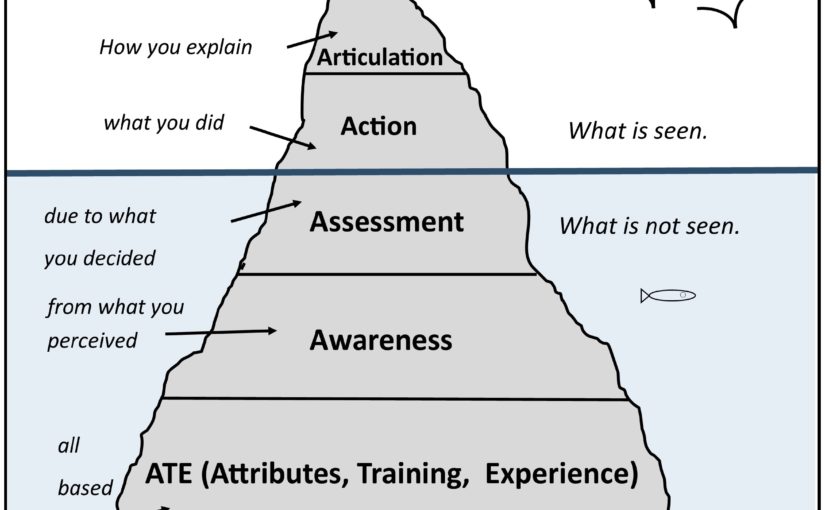
  1. In Part I, I listed my 5As of Accomplishment/Performance which are:

    1. ATE – Your Attributes, Training, and Experience.
    2. Awareness – What you perceive based on your ATE.
    3. Assessment – What you decide about what you perceived based on your ATE.
    4. Action – What you do based on what you decided based on what you perceived based on your ATE.
    5. Articulation – How you explain what you did based on what you decided based on what you perceived based on your ATE.

The idea is that your skillful accomplishment of a task is the result of five interdependent steps. Each successive step is based on the previous ones. The foundation of these steps to accomplish a task begins with your natural attributes, your formalized training and education, and your life experience.

In terms of the Iceberg diagram above, when we observe other people accomplish a task, we see what they have done. We see how they explain what they have done. But what we don’t see is how they decided to do what they did. How their perceptions influenced their decision. And how their individual attributes, training, and experience affected all of it.

In terms of Teaching

Given that no two people begin with the same ATE. It is unreasonable to expect that those two people would accomplish a given task in the same manner. Yes, you can theoretically provide two people with the very same training and education. But their individual natural attributes and life experience will differ. Therefore, their results will differ.

If you are teaching a class of twenty people to respond (accomplish a task) to a certain stimulous (a punch for example), you should expect twenty varied responses. If some of them respond in a manner vastly different from what you would do, then mostly likely, they have a vastly different ATE than you.

When an instructor’s ATE is very different from his students’ ATE, his “qualifications” may actually interfere with his ability to teach his students effectively. Unless, the Instructor consciously takes into account how his own ATE differs from his students. But to do so means being aware of how an individual’s ATE influences his or her accomplishment of any given task.

Take basic juggling for example. Once you are able to successfully juggle three balls, it is a relatively simple task. You are just throwing balls into the air, catching, and throwing again in a certain order. It doesn’t take great hand-eye coordination to accomplish. But it looks impressive. After you have been juggling for a while, it is easy to forget how difficult it was for you to learn. You can demonstrate juggling with ease.

What you have forgotten is that the Now-You is different from the Before-You who didn’t know how to juggle. The Now-You has a different ATE then the Before-You. Your Attributes may be the same. But your Training and life Experience has changed. Your brain wiring has been modified. You can never go back to what you were before your learned how to juggle.

Let’s say students come to your class saying they want to learn how to juggle. Yet they are only willing to devote a few hours to your class and will not practice afterwards. Can you really teach them to successfully juggle? There are always those few people whose extraordinary natural Attributes allow them to skillfully accomplish a new task quickly, but the majority cannot.  In this example, you must realize that unless the students have prior juggling training or life experience, they will not learn to juggle three balls. But they could learn to juggle two balls (which is not really juggling).

So what do you do? Try to teach them to juggle three balls which is more fun for you and allows you to demonstrate your skill, but knowing the majority will fail. Or teach them elementary two ball throwing which is unexciting, but something that all your students can realistically accomplish given their limitations?

Or do you tell them that their stated goal of learning to juggle is unrealistic? That they need to reconsider their commitment to learning to juggle. That they can learn to juggle, but it will require more time and effort on their part. All of which they will not want to hear and will most likely make you unpopular. Or do you just take their money and pretend that they will actually learn how to juggle due to your specialized teaching methods?

The Importance of Feedback

Your ATE is not static. It is only fixed in any given moment in time. It is always subject to change and evolvement. But if you are unwilling to train yourself and you limit your life experiences, then your ATE will remain in a narrow change. Your ATE is analogous to a Closed Belief System. People with a Closed Belief System are not open to new information. Their Belief System does not evolve. It is effectively static over time.

On the other hand, people with an Open Belief System are constantly evolving their beliefs in response to new information. And so it is with your ATE. You ATE will grow and evolve overtime if you allow it too. And you can actively evolve it by seeking out new training and new experiences.

What causes an ATE to change is a willingness to respond to Feedback.

Having static ATE is like being a computer running a fixed program. The computer responds in the same manner to identical input. It disregards feedback.  Computers with artificial intelligence on the other hand modify their programing in response to feedback. Their programming evolves.

But the quality of a person’s learning is limited to the quality of the feedback received. You can’t develop a high level skill without realistic feedback. This applies to both physical and mental skills. You need to know what you are doing correctly so you can keep doing it. And know what you are doing incorrectly, so you can stop/limit doing it. The more complex the skill, the more feedback is required.

Think of these main concepts in terms of self-defense instruction. The accomplished student is able to Articulate why he or she Acted in a certain manner, based on what he Assessed, based on what he was Aware of, in response to a particular threat, with all steps taking into consideration his individual ATE.  

There will be a result stemming from the student’s Action. This result is feedback. If the feedback is realistic, then the student’s ATE will evolve and improve. If the feedback is unrealistic, then the student’s ATE will evolve in an undesired manner. If the student rejects the feedback, then the student’s ATE will remain static.

If you can’t provide your students with realistic feedback, then they can’t really accomplish skill. But, they can develop the belief that they can accomplish a skill.


Vital points – Kevin O’Hagan

When I was a child at school one day I got into a bit of a playground scrap with a boy who was bigger than me and a bit of a bully. During this struggle he was attempting to apply some sort of crude strangle or headlock upon me when I managed to pull free and swing around and quite by chance I ‘clocked’ him one with the back of my fist on the side of the neck.

I saw the shock register on his face (he must have also seen the bigger shock on mine!) I then saw pain register and that closely followed by fear. He held his neck and mumbled something about ‘next time’ and wandered off. I never really had much more trouble out of him after that episode. I didn’t realize then that I had used an attribute so often taught in Martial Arts systems.

When I hit him it wasn’t because I had suddenly become bigger, stronger or harder, that wasn’t the reason that made him back off. It was because I had hit (totally by accident) a vital point on his body that hurt and confused him and he didn’t fancy getting another! What a stroke of bloody luck for me!

Years on in my Martial Arts journey I began to learn about weak spots, vital points, pressure points and began to understand that no matter how big or muscular a person can be, these areas are vulnerable on everybody.

I was curious and enthusiastic to learn as much as I could on this topic, as most of the people I began to encounter in my life were larger than me.

The more this area of skill was tried and tested the more things I learnt and the more myths I dispelled about the subject of vital points/Atemi, waza etc. Some areas of the body as soon as they are struck give an immediate profound and instant reaction to an attacker, i.e. eyes, groin, throat. By attacking these areas it also opens up other vital points, i.e. finger claw to the eyes, knee to the groin. Other areas are highly sensitive but very difficult to hit accurately. Accurate targeting is a big factor, knowing exactly where and how to strike and knowing what potential effect and affects the strikes will have is also essential.

Here is a short test, do you know where these following points on the body are if you had to strike or attack them? Clavicle, spleen, patella, cervical vertebrae, mastoid, coccyx, femoral artery, sciatic nerve, liver, sub-clavical artery?

How well did you do? It is important not only for your own self-protection but also for your ability as an Instructor.

‘Play a mind game’

I used to play a little mind game with people that I came into contact with. I would play the ‘what if’ game. What if this person wanted to attack me then how would I go about striking them? What are their obvious strengths or weaknesses? How big are they? How tall? How heavy? Etc. I still use it now and it’s a great way of running through planned pressure point strikes and routines. Learn to study people’s body shapes and think where best would it be to attack them.

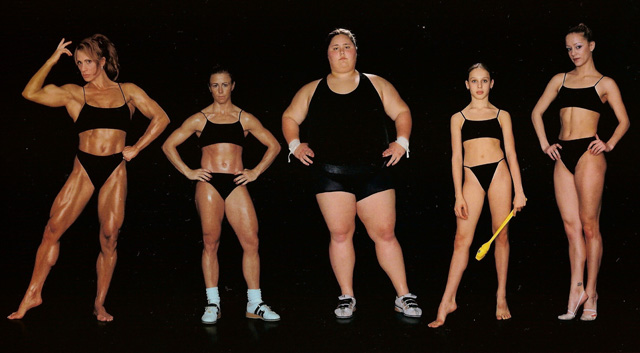
There are basically three body types: Mesomorphs, Endomorphs and Ectomorphs.

  1. Mesomorphs are naturally athletic build with wide shoulders and narrow hips. They tend to have thick bones and muscled readily.
  2. Ectomorphs have naturally slim build with long, lean limbs, little muscle and narrow shoulders and hips.
  3. Endomorphs have a stocky rounded build with wide shoulders and hips. They tend to have an even distribution of fat and muscles.

Body types and physical characteristics can affect how you may attack the various vital points. Confronted by a tall opponent, who is slim, you may decide to attack their legs with kicks and sweeps to bring them down to your size. A smaller person you may decide to grab and grapple and hold them in place while you pick your strike.

Attempting to attack the neck area of someone like Mike Tyson for example may not be the best of strategies. His bull-like neck and heavily muscled shoulders protect his windpipe and carotid arteries. These things can be considered when studying potential opponents.

You can have a situation when there are two people who have strikingly different body structures and characteristics, by looking at this you can see how a strike can be instantly effective or not.

Again for example the chin/jaw can be a great KO target but if you are 5 foot 2 and your opponent is 6ft 6, how the hell are you going to reach the target without help of a stepladder (more details of this in my book ‘I thought you’d be bigger’). So you will have to go for something else first. Punch the opponent in the groin and bring him down and forward and you can then execute a perfect blow to the jaw.

If you are faced by a 17 stone body builder, whaling punches at his chest or abdomen isn’t a smart tactic but if you strike the sternum (breastbone) with the point of the elbow it would have an effect. Just by targeting and being accurate you get a result. Again faced by the same opponent and you ‘kicked off’ with a hard stomping kick to his shinbone, no amount of pumping iron can protect this vital spot, then followed up with a thumb gouge to the eye you could be on a winner! There are no muscles in the eyeballs.

But these things have to be practiced on a daily basis to work. The difference between gouging an eye and a cheekbone can be a matter of whether you win or lose.

In my training and teaching I have noticed how people, even senior black belts, have an idea where vital points are but not the exact spot and that makes a big difference to what works and what doesn’t. Time spent studying and practicing Atemi to vital points is time well spent. Don’t just throw something in the general direction, but try and hit the right spot. Remember my little story at the start?

As a training drill you could for example use a knife hand strike to the carotid artery (the exact point for striking the carotid sinus is underneath the angle of the jaw line an inch or so back from the windpipe and not the side of the neck where a lot of people hit.) Now start off slowly and ‘touch’ strike the spot and then build up gradually your speed. If you perform a dozen touch strikes try and accurately hit the carotid sinus a dozen times without fail. If you manage 9 or 10 at speed that’s good, 6 out of 12 you’re halfway there but must improve, any less and you need to get to work on your targeting. You can do this with any strike and improve the targeting immensely.

Another drill is for your partner to call out a vital spot on the body and you must instantly and accurately hit that spot. This not only improves the targeting and your reaction time but also gets you familiar with the names and placement of the vital points. These are just two ideas to work on to improve your skills.

When you also study a person’s characteristics other things can be taken into consideration in relation to what may motivate you to go for certain targets.

Trends can also have their disadvantages. Long hair can be pulled; twisted and painfully manipulated, earrings can be tugged and wrenched free. Long facial hair can be grabbed and twisted for control or ripped out. Glasses can be shattered into the eyes etc.

Also certain dress can go against you. A motor cyclist’s full-face crash helmet can inhibit most face strikes; heavy leather jackets can nullify a good body shot etc. These are all useful things to consider in the reality world of combat.

If you are studying a potential assailant then become attentive. If his hands are covered in heavy rings, know they can be lethal knuckle-dusters. If he has heavy boots on he may favour kicking and stomping. If he’s wearing a muscle vest he may want to maul and grapple you. If he’s wearing a dress run like hell! No, but seriously these things all go hand in hand with your vital point’s knowledge. They can give you the edge you need.

Much rubbish has been pedalled about pressure points. Striking a compliant person where you have also planted the suggestion in their mind that the strike will hurt or drop them is a world apart from some ‘crackhead’ coming at you in fighting mode.

Some of the pressure points being mentioned are so small you just wouldn’t have the accuracy to strike them. Remember one of the first things to deteriorate in real combat is fine motor skills. Any technique that replies on fine motor skills is going to fail.

We have even got demonstrated on face book now ‘no touch knockouts’ were so called experts will point at an opponent and they will hit the floor as if they have been shot. What the f..k? If these things work why haven’t we seen them in the Octagon.

A human being in full fight mode is a formidable creature. The body can take untold punishment. Most pressure points will fail or come up short. You will need the ‘big guns’. These are what I refer to as ‘Manstoppers’ using my ABC system. They are based on empirical knowledge not bullshit.

Now close your eyes and imagine your worst nightmare. He’s in front of you now. Huge, strong, ugly (par for the course) face like a road traffic accident. He’s foaming at the mouth; he wants a piece of you, he says he is going to tear you limb from limb, then start on your family. What are you going to do? Are you really confident you can hit those recommended spots that the Guru’s online tell you will magically work or haven’t you done your homework and your training to really be sure? Don’t wait until this nightmare materializes get to it now so if your nightmare becomes a reality you know what to do!

If you enjoyed this then maybe you would like to download my MANSTOPPERS FREE REPORT now at the link on my homepage of www.kevinohagan.com.


Calm Down Please, Part II – Iain Abernethy


Another simple but effective part of verbal de-escalation is to avoid “you statements” and as much as possible stick to “I statements”. “I statements” show you are taking responsibility (or at least give the impression you are) and are more likely to help people calm down and promote co-operation. “You statements” however can come across as argumentative, judgmental and accusatory. Saying, “I’m sorry but I’m having trouble understanding” is more effective than saying, “You are not making yourself clear.”

Remember it is not about being “right”; it’s about calming things down and avoiding things getting physical. It’s time to put your ego to one side and say what needs to be said to de-escalate not saying what needs to be said to “win the argument”.

Violence can often be triggered by “the small things” when we are dealing with volatile or agitated people. We need to avoid making the other person feel weak, small, trapped, frustrated, pressured, afraid, and so on. Say what needs to be said to calm the person down and know that you are not “loosing face” but being smart enough and skilled enough to prevent things getting physical.

Tone of voice is also an important consideration. Here in the UK raising your voice can be seen as a sign of losing your temper or trying to dominate the other person. Keeping an even tone is therefore very important if we wish to calm a situation down. Things are different in different parts of the world of course and in Southern Europe raising your voice would not be automatically associated with aggression. It is important to be aware of the cultural norms and work within them. This is especially important for those who travel a lot as judging things by the standards of another culture (or subculture for that matter) can cause problems. Both we and the person we are trying to calm down are likely to judge what is said, and how it is said, and all aspects of non-verbal communication, by the standards of our own culture. We need to be aware of this in order to avoid confusion.

A simple example is the distance at which people talk to one another. In the UK and the rest of Northern Europe conversations typically take place at just outside an arm’s length. If a person were to move inside that space while talking it could be taken as an attempt to invade “personal space” and hence a threat (quite legitimately). However, in other parts of the world (i.e. southern Europe, the Middle East, etc) it would be the norm to be closer when talking and hence a negative reaction to a person being a little closer could inflame things unnecessarily.

Generally speaking, people are more trusting of those who speak and act like themselves. This could make you think that “mirroring” the person you are trying to de-escalate could be the way to go. However, “acting the part” is unlikely to work with a person from another culture, part of the world or subculture. It can be taken as mocking, belittling, or being false and is unlikely to help. Looking for common ground can be helpful though, as can trying to develop empathy by using the LEAPS communication model discussed earlier.

One other communication model that is relevant here is “Betari’s Box”.  Basically “the box” is made up of four parts and essentially can be summed up as:

“My Attitude” affects “My Behaviour” affects “Your Attitude” affects “Your Behaviour” … affects “My attitude” and so on in a cycle.

To give a simple example: Person A is in a bad mood (their attitude) and hence they overreact (their behaviour) to Person B accidentally bumping into them. The behaviour of Person A affects the attitude of Person B towards them. If Person B were to take an aggressive attitude they are likely to respond with aggressive behaviour. The aggressive behaviour of Person B affects the attitude of Person A who, now convinced that the accidental bumping was an act of aggression, responds in kind. Before we know where we are the situation escalates out of control and physical conflict ensues. The trick therefore is not to let the cycle run away with itself in a negative way, and to break the cycle if it looks to be heading that way. Also, and this is very important, know that controlling your own attitude and behaviour can have a big effect on the attitude and behaviour of the other person. Don’t fuel the situation, but remove that fuel.

To take the example I’ve just given, if Person B had immediately apologised in a warm and sincere fashion that could have affected Person A’s attitude toward them and hence conflict could have been avoided as different cycle could have ensued. Essentially, your behaviour will affect the other person’s behaviour so be sure you do what you can to avoid unintentionally promoting aggression.

So far in this article we have looked at some of the basics surrounding verbal de-escalation. I now want to quickly touch on a few key points of the verbal side of self-protection generally. I’m not going to go into much detail here, but I feel it is important that I mention these things in order to put what we have discussed so far into some kind of context.

Firstly, be aware that sometimes the criminal wants to talk so they can engage you, detain you or distract you. Get good awareness training and trust your instincts about people and situations. Don’t talk to people you should not be talking to. Just keep on walking and flee if appropriate.

Secondly, don’t try to talk your way out of a situation when you should be fighting your way out or fleeing. Remember that you can’t reason with the unreasonable and you can’t talk your way out of all situations.

Thirdly, be aware that it could go physical at any moment and that processional criminals will be experienced at lulling potential victims into a false sense of security. Just because it looks like a situation is de-escalating does not mean that it is! The criminal could be playing along in order to get you to drop you mental guard. The old samurai saying of “when the battle is over, tighten your helmet straps” applies here. Keep your awareness up and be ready to go physical at any moment: even if it appears as if things are being de-escalated. It could be a ploy.

Finally, don’t try to de-escalate when the situation has progressed beyond that point. At that point you should pre-empt and flee. You’ll know when it has gone beyond the verbal by what the person does; not so much by what they say. The person who is walking away issuing threats is much less of an immediate danger than the guy who appears to have calmed down, but who is not backing off. If that person should try to close space then it would be a good idea to “stun and run”.

I think we have touched upon the main points I wanted to address in this article. Before we start to wrap things up, I’d just like to draw attention to what should be the obvious fact that all skills need to be practised if they are to be useable. Just as the physical side of what we do needs to be honed and refined through training and practise, the non-physical skills, such as verbal de-escalation, also need to be practised.

Those interested in teaching and practising realistic self-protection should ensure that realistic role-play, where things may or may not get physical, is included in what they do. In many martial arts schools / self-protection training the mistake is made of all scenarios ending up being physical. This reinforces the notion that physical technique is always the solution to all situations and that is obviously not the case. Our training needs to include verbal de-escalation as the useful and effective methodology it can be.

If we can avoid the physical through verbal de-escalation then obviously we should do so. However, if we don’t have that skill set then we will needlessly put ourselves at risk as situations that could have been avoided will escalate to the physical. There are times to walk, times to talk, times to fight and times to flee. Don’t mix them up or believe that one solution is right for all situations.

As I said at the start of this article, verbal de-escalation is a huge subject and it’s impossible to do it justice in an article like this. There is much left untouched, but I nevertheless hope you’ve found this article interesting and it has encouraged those new to the subject to seek out further information on it. There is lots of really good stuff out there and some very knowledgeable people. Those interested in teaching and practising true self-protection should be seeking that information out and not limiting themselves to the purely physical or believing martial arts / fighting to be one and the same as self-protection. You can be a skilled martial artist and a good fighter without possessing verbal skills. For self-protection verbal de-escalation skills are vital though and I hope you’ve enjoyed this brief look at some of the key issues surrounding them.

Symbolic Interactions – Garry Smith

Today I saw this picture of some Goths, the ones with the pale faces dressed all in black, it was juxtaposed with a picture of another type of Goth, a version of either a Visigoths and the Ostrogoths who were two branches of East Germanic people who, along with the Vandals, were associated with the downfall of Rome way back, remember that? The original Goths were fierce warriors who dominated vast parts of Europe by the 4th Century. If you messed with the Goths you generally got your fingers burned, and your village.

The picture I cut from a meme on FB it asked what the hell happened? The question implies all sorts of things and the main message is that we have gone from Warrior to Weirdo in not that many generations. I had one of those, I get this moments when I saw this pic, and it was to do with the nose to mouth jewellery of our black clad Goths of today. You see it is made of Jet, Unlike most gemstones, Whitby Jet is actually fossilised wood, similar to our present day Monkey Puzzle or Araucaria Tree. which has been compressed over millions of years. The colour of Whitby Jet is unique; its blackness is so intense that the expression ‘as black as jet’ has been a commonly used phrase for hundreds of years. Whitby is a seaside port in North Yorkshire commonly associated with Captain Cook and Dracula.

The Abbey ruin on the South Cliff inspired Bram Stokers epic novel, that and a few white lines of a certain powder, and that is what drew the first modern day Goths who now hold two festivals here a year, My wife and I love Whitby and travel there several times a year, we just spent a week there, I always get asked if I am off for the Goth weekend, and there are always a few Goths wandering the streets, last time we saw a family of three generations of Goths crossing the bridge over the Esk. The modern Goths descend on Whitby not to burn and pillage but to drink, dance and shop (no doubt boosting the trade in Whitby Jet no end that was a bit of a wash out after the boom in Victorian times).

Apparently the Goths, who have been coming here for years now do not gather and party alone, they are now joined by Punks, Steampunks, Emos, Bikers, Metallers and all genres of the alternative lifestyle. It sounds like I may be off there in October, especially as Spear of Destiny are performing. http://www.whitbygothweekend.co.uk/

https://www.youtube.com/watch?v=ohN0KIyP8m0

Anyway, get to the point Garry. Well often it is the more dramatic sub-culture that allow us to see ourselves better. Not that we must all be Goths or Emos, Bikers or Skinheads, Mods or Rockers but there are subcultures in virtually every culture, they are mostly associated with youth but youth is no longer a determining factor of membership. Indeed our fascination with the different, the spectacular and the weird is largely associated with youth culture and its emergence alongside, and stimulated by the explosion in popular music in the latter half of the 20th century.

However, the old Goth, the warrior Goth as represented above is also key to this article. Just look at the pic for a few seconds. Look at the clothes, the weapons, the hair, the adornments, jewellery. If we look closely the amazing thing is not how different the two representation of Goth are but how strikingly similar. Centuries apart and as one in their expression of their identity. Each culture and sub-culture has at its core its own idea of its identity, identity is central to culture, shared identity as expressed in how we are, how we speak, how we eat and how we look.

Clothes, music, dress, jewellery, hairstyle are all part of the rich cornucopia of artifacts we use to express our identity and by extension interact with others.

Think just for a moment about how you dress. What do you wear, what influenced your choices and what are you saying to others in the wearing? What you wear and what you do may be different for different occasions, think about that too?

We cover ourselves with symbols, we badge ourselves up from cradle to grave, we put on our patches to tell the world who we are, and, which tribe we belong to. Everyone is in a tribe. Please do not try to deny it, the thing is we may not recognise it, we may not wear the spectacular clothing of the Goth, Emo or Punk, we may not wear the leathers or the 1%er patches of the biker gangs, we may wear the grey suit of the corporate tribe, the colours of a sports fan or the mom and dad suitable clothing sold in the department store but even that identifies us as who we are or who we like people to think we are.

We interact using symbols, it is called symbolic interaction. We humans, unlike other animals, attach meaning to things and social actions. Sometimes a simple symbol can get everyone all fired up. Like this one.

Well no points for guessing why the symbol used by the Nazis upsets many people, because of their evil actions the symbol has become, for many imbued with evil as its meaning. If you want to shut down a political opponent then calling them a nazi generally does the job, that and painting Swastika on their door. I used to be a window cleaner and one home I worked on had two of these painted on their doorstep. If you knocked on the door to get paid you were not greeted by your stereotypical (yes you have a picture in your head don’t you) white power supporter as in American History X but a lovely old Indian lady (as in Indian sub-continent).

You see the swastika is considered a sacred and auspicious symbol in Hinduism, Buddhism and Jainism, it appears as a Chinese character and has been in use since Neolithic times. A bit earlier than the rise of Adolf Hitler. However, the catastrophic events of World War II and the Holocaust have left the negative association of the swastika (also called  a Gammadion Cross, Cross Cramponnee or Manji) remains dominant in most minds.

It is impossible to live without belonging to a tribe, whether you identify as part of a sub-culture or part of the ‘mainstream’ culture, you have an identity. Every aspect of your behaviour is related to that identity including the central characteristic of all groups, language in all its wonderful complexity. Much of that complexity is handled by our use of symbols. The very colour black is symbolic for the modern Goth, so for those involved or in contact with those involved in martial arts, self defence or related fields, you will have come up against the powerful symbolic meaning connected to the revered black belt. But symbols do not only convey messages to others, the act back on the user too, so what happens with this whole black belt thing?

This article is not a tease, there is more to come next month, for now I want you to do some homework. I want you to do an experiment, come on it will be fun. I want you to adopt the position of anthropological strangeness. Anthropologists study human beings, usually in their natural environment. I want you to study yourselves in your environment for a short period. To do so you need to have a kind of conscious out of body experience.

Pretend you are a visitor from another planet, you have no experience of human behaviour of any kind. Suspend ALL your values and beliefs for a few minutes and take a look around you and at you. Reflect upon what you see. Look at how you look, how others look, at how they interact, what appears to govern those interactions, free the mind to see what is actually happening in your day to day life and how we use symbols to interact (like the letters and words on this page), it is far more interesting than you think.

Here is a little clip from a comedian I really love doing a little ‘anthropology’. It should give you a few clues how to do the experiment. See you in July.

https://www.youtube.com/watch?v=YyPOb-cRv1I


The Self Defense Continuum, Part II – Teja Van Wicklen

Last installment we covered the first part of The Self Defense Continuum and what it means to Deter a criminal’s Intent to harm us. But what is a criminal Interview and what does it look like?

An Interview is the way a criminal, who thinks you have what he wants, makes sure he won’t be injured or captured in the process of attacking you. This, by the way, is your last chance to read him, figure out his game and take off. Once he pegs you as a good bet, you will be peeling him off you instead of walking away.

Five Types Of Interview

According to Marc MacYoung, there are five basic types of criminal interview. Get the full scoop directly from Marc at www.nononsenseselfdefense.com (or NNSD.com). No need for memorization it’s the concepts that count. Even if these aren’t familiar they will make perfect sense. This is the highly abridged version.

The Regular Interview A criminal will approach you expressing a need–the time, a cigarette, whatever. He’s distracting you. While he’s talking, or you are, he’s checking your awareness and also your commitment to defending yourself.

The Hot Interview is a sudden, usually loud, mind-jarring emotional bombardment.  Marc says, “The success of this strategy relies on you not being accustomed to dealing with extreme emotional violence and reacting in a stunned and confused manner.” A stunned victim is an easy victim.

In an Escalating Interview, the criminal tests your boundaries with behavior that quickly goes from normal to nuts and will increase until it becomes physical if he gets away with his strategy. This is basically a Regular Interview that quickly ramps up to Hot.

The Silent Interview is where a criminal watches you. You may never have a face-to-face encounter until he attacks. This is the one that scares people most since they feel they have the least control here. The criminal goes through the Intent and Interview stages as he follows you through the grocery store and into the parking lot, hopefully (for him) without you noticing.

The Prolonged Interview can take weeks or more. Think stalking.

Just knowing there is a bomb is pretty important information. Action beats reaction. Once you see the bomb or hear it ticking, you can begin to disarm it or get away. If you don’t know what a bomb even looks like, you are fodder. The five types of interview give shape to your instinctive feelings about a situation.

Gavin DeBecker’s work is another very important part of honing the ability to read a predatory interview. If you haven’t already, grab a copy of The Gift of Fear. DeBecker writes about the kind of stuff you would usually see in Regular Interviews.

Regular Interviews can be perpetrated by well-dressed people with nice manners. The Persuasion Predator’s motto is, you get more bees with honey. This is true in general, but the Persuasion Predator raises it to an art form. This guy’s primary goal is gain your trust and keep you off guard so he can Position himself to get what he wants. This is where being able to think like a criminal can help you out, but you don’t have to go quite that far in order to tap into your persuasive side. Have you ever made promises you didn’t intend to keep in order to get something you wanted? Or told a lie in order to persuade the officer to let you keep your driver’s license?

There are ways to persuade without dishonesty as well. Persuasion Predators use those too. Whatever gets the job done.  Of course, not everyone using these methods is a criminal. The key is to use what you’re learning to spot groups of signals together. If you spot more than one ploy there may be something more going on.

DeBecker describes Forced Teaming as a stranger implying a connection between the two of you in order to get under your radar, as in “we are in this together”. There’s a certain natural distance with strangers that only time and trust will change. The idea here is that anyone trying to rush the natural progress of trust should be watched.

Another Ploy DeBecker discusses is Charm, which he explains is a verb not a adjective. People use charm to get what they want. Sometimes all they want is conversation, but sometime they want more.

DeBecker goes on to describe Too Much Information, Unsolicited Promises and others. Go get the goods, it’s on Amazon along with everything else.

If there were a 6th “D” it would be Deescalate. Deescalation plays an important part in deterring some forms of social crime. Deescalation is about slowing or stopping the flow of energy in an exchange that is gathering heated momentum-starving the fire of oxygen. Staying calm while someone berates you is easy and natural for some and near impossible for others. We can all probably think of lots of times things didn’t need to go wrong, but someone lost his cool and the interaction went to hell in half a second. This is a social skill so practice on your kids, on your loud obnoxious neighbor-every day and as much as possible.

Deescalation is a tool you can use to change or redirect an interaction with someone you’re starting to recognize as unstable or aggressive.

Peyton Quinn came up with a few things not to do in response to someone’s excessive anger. These may seem obvious, but common sense is less than common.

Don’t insult him. Insulting is escalation not de-escalation. Usually we only insult people we aren’t afraid of, but we all do dumb things in the throws of anger and other high emotions. Marc MacYoung says, “four letter words have no place in Deescalation.” Don’t tell him to calm down or relax. We all know this never goes well and yet we all say it in that same sarcastic tone every time. Telling someone to calm down is an insult. You are in essence telling him he is nervous and out-of-control.

Don’t challenge him. When you challenge someone with an unstable ego you are forcing his hand. “What are you going to do about it!” can only be construed as an escalation.

Provide him with an honorable exit. Make it easy for him to disengage without feeling like a coward or a looser. This often means you back down first. You have to be willing to stop making your point in the middle, or to apologize even if you’re right. Easier said than done, especially when emotions are high. Try phrases like, “I see your point”, or “I was out of line.” Give him the benefit of the doubt. Get more on Peyton at www.rmcat.com.

Deescalation is about remaining calm in the presence of someone who wants you in an emotional state that makes you less rational and less likely to see the truck coming. Here comes the caveat. Rory Miller says de-escalation techniques don’t work with asocial predators. They don’t see you as a person anyway, so your apology means nothing. This means you may not know what’s going on until you try deescalating the situation, but you will understand what it means when it doesn’t work.

Erik Kondo came up with a wonderful concept called the Goldilocks Principle, which says any response that is out of proportion to the situation upsets the balance. If you under react you may be seen as weak. Apprehension can look like fear, which can have a galvanizing effect on a predator. On the other hand, if you are aggressive in return you have nitro and glycerin. The Goldilocks Principle is Erik Kondo’s way of describing the Just Right Reaction that says, I’m not looking to make a big deal, but I’m not cannon fodder either.  You can find more on Erik’s work at Not-Me.org or ConflictResearchGroupIntl.com.

To all this I would add, watch out for the power of wanting. When we want things it makes us vulnerable. Any decent predator can use what we want against us, whether it’s a good deal on a car, a pair of shoes, or the opportunity to audition for a television commercial. Wanting is the bait on the end of the hook. Always check yourself when you are in the throws of want.

The criminal Interview is one interview you really want to fail. Whether it’s up close and personal or from a distance, what you know, how you walk, your general demeanor and awareness and the power of preparedness are your weapons.

There is no award or parade for de-escalation and avoidance or for failing a criminal interview. There is no sign that says, “phew! You just escaped dismemberment by a serial killer.” But you do win another day to eat spaghetti in front of the television or toss a frisbee with your kids. And that counts for quite a bit.


Principles-Based Teaching, Part I – Rory Miller


Part One Laying the Foundation

Managing conflict can be approached as a huge and complex field. You can find books of techniques, lists of indicators to watch for. You can fill your mind with endless datum and detail. This approach, whether in a verbal communication class or a martial arts class, is common. It is also, in my opinion, largely ineffective. It is teaching and memorizing trivia so that one can give the impression of understanding. This gives the student reams of knowledge and completely bypasses understanding. This approach is the downfall of much of the technique-based training in the martial arts, producing people that can throw a visually perfect punch, but can’t fight. Useless to the student, but the teacher has nice clear lesson plans and infinite detail to correct.

Conflict management can also be ignored: “It’s a natural part of your life, something you see every day. You don’t need to be taught this.” This approach leads to improvement only through trial and error, and error can be expensive in conflict. It doesn’t even require a teacher, and I have seen it used as an excuse not to teach critical skills to rookies.

And conflict can be deliberately mismanaged and mistaught: “I don’t need to learn how to manage conflict! Everyone else just has to learn to be nice to me.” Which is not just an expression of pure selfish ego, but designed to keep anyone who takes that stance as helpless and dependent as possible.

All three of these approaches are easy to teach. I mean that the process is easy for the teacher. They are not good ways to develop complex skills in the students.

Principles-based teaching is more challenging for the instructor. The instructor can’t get away with just parroting what he or she was taught. It requires a depth of understanding.

“You must turn your toe out at 45 degrees in this technique,” is sufficient for technique-based instruction. The foot position is part of the technique, defines whether the technique is correct or not. The teacher and student can both see it. The teacher can grade it, and if it is taught consistently, the foot position will be part of the system far into the future. A tiny bit of information is all that is necessary, and no real thought whatsoever.

You must turn your toe out at 45 degrees either has a mechanical advantage or it doesn’t, simple as that. There is a simple law of physics or physiology that makes that foot position important (in that position/time/situation) or there isn’t. And if there is, that 45 degrees will be completely wrong in a different situation.

Technique based: “You must turn your toe out at 45 degrees in this technique.”

Principles based: “Generally, you want to keep your knees bending over your toes to keep your knees from getting injured.”

Learning your principles is getting into the “why” of things. Why do techniques work or fail? What are the physics of techniques in general?

The “why” leads to the “how.” Once you understand the principles and start learning how to apply them in action, the “whats” (the techniques) flow from that. They don’t need to be taught, because they can be automatically derived.

That may seem counter-intuitive, and it would be if the training methods of rote training were applied. More on methods later.

You need a few things to get skilled at this way of teaching:

  • You need to understand the principles of your system inside and out
  • You need to understand the goal of your training
  • You need to have a way to gauge (I did not say measure) progress towards that goal
  • You need to know your audience/students
  • You need a thorough understanding of how humans learn complex skills
  • And you need humility, because your students will get good, maybe better than you, very quickly

After outlining this teaching method to a very successful school owner in another country I got one of the best compliments of my life. “I see what you’re doing, but you couldn’t keep a school running that way. The students will get too good too fast. There’s no way to make a living at it.” Cool. But I don’t think he meant it as a compliment.

Understanding principles will come in a later article. If you want homework, though, here it is: Sit down and derive a list of the principles critical to your system.

How do I define a principle? Principles are the underlying things that make techniques work. It’s a principle if it applies to striking, grappling and weapons and there are no exceptions. Leverage, for example, is critical to all three and good leverage is always superior to poor leverage. Now, I went with my hand-to-hand core there, but you can pick anything– business, gardening, negotiations, auto mechanics– and there will be a solid core of principles.

Understand the goal of your training. This one blends with gauging, knowing your audience and humility. Quite simply, many people are not teaching what they think they are teaching. They intend to teach self-protection but put hours into how to win a one-on-one sparring match against a friend in a controlled environment.

Gauging your training. People like measurability. “That which gets measured gets improved.” But in certain fields, measurability has almost no correlation with applied ability. The arrest and control techniques taught at police academies are often complex, multi-step locks. Very easy to grade the students in class, almost impossible to apply in real life. In high school or college, were the people getting A’s in English or Communications the ones getting dates?

For physical skills, and particularly self-defense, there is no way to measure. The only applicable measurement would be whether someone survived, and the possible range of dangers makes survival in one situation likely irrelevant to the next. You can’t truly measure it, but you can and should develop ways to gauge progress and to see what progress is needed. Conflict management is an open-ended skill. Neither you nor your students will ever get to the end point where you know it all.

You need to know your audience/students. In my mind, the biggest division between martial arts and self-protection is that in MA I am teaching subject matter, and in SP I am teaching students.

Each student is different. They all have different abilities, strengths, talents, resources and weaknesses. They will be targeted for very different types of conflict. Further, they will each have different learning styles.

Understand teaching. Most of what we know or what we think we know about teaching comes from our own experience as students in schools, primarily grammar school and high school. Those were places of regimentation, top-down training, with huge power disparities between the instructor and student. Measurability trumped applicability. And everything was aimed at teaching children, not adults.

It would be hard to design a worse model for teaching assertiveness or conflict management. You can’t teach people to be strong while demanding that they obey.

Principles-based teaching has to be applied with principles of teaching. And principles of learning.

Humility. In conflict training, the instructor’s ego is probably the student’s most dangerous enemy. The instructor will be trusted, will be seen to have the answers. If the instructor needs or desires a sycophantic relationship, it will be toxic to the student. If the instructor is too prideful to acknowledge what he doesn’t know and makes shit up to answer questions, he actively endangers his students. All of teaching is about creating students who will be better than you. If you can’t emotionally handle not being the best, you have no business teaching.

This is the end of Part One, laying the foundation. I’m going to make a suggestion. If you can get a copy, watch my video “JointLocks” available from YMAA.com, Amazon and, I believe as an app. It’s not really about the locks. My stealth purpose for shooting that video was to get a solid example of the principles-based approach in front of people. Locks have a reputation for being difficult. The method we show in the video has gotten untrained rookie cops improvising locks under stress in one hour of training. If you get a chance, watch the video, but for the training method, not just the locks.— Rory


Two Keys To Communication – Alain Burrese

I have a unique background in that I’ve dealt with conflict on numerous fronts, and in different capacities. As a former member of the U.S. Army and a student of martial arts and physical self-defense for over 30 years, I’ve dealt with conflict on a physical level. Working various bodyguard and security positions throughout the years provided experiences in dealing with conflict on a different front. And as an attorney and mediator, I’ve both represented clients in disputes and acted as a neutral to assists parties in resolving their conflict before turning the authority over to a judge or jury. One unifying constant in all forms of conflict is that the communication between the opposing parties directly influences how the situation will be resolved and where the conflict will go next. In every mediation, and in all of my communication skills workshops, I teach these two simples keys to effective communication. Because, as I like to say, we are always communicating, but we are not always effectively communicating. We must listen to understand, and communicate to be understood.

Listening to Understand

The first of the two most important skills regarding communication is listening to understand.  When people express themselves, they want to be heard.  FBI negotiator Gary Noesner has stated, “Listening is the cheapest concession we can ever make.”  I agree with him one hundred percent. Listening is crucial for the mediator and anyone who wants to resolve conflict.  But it’s not enough to just listen, or pretend to listen, that’s because people also want to be understood.  Therefore, you must listen to understand.  Sometimes people don’t even understand themselves, but want those listening to understand.  This is why this is the first of the two important rules.  First you must make it your goal to listen and understand, and then you can communicate to be heard and understood.

You want to understand on both an emotional level, and an intellectual level.  You want the other party to feel that you understand what they are feeling, as well as understand what they are saying.  You can achieve this through what is most often called “active listening.”  This is just what it sounds like, “active.”  You don’t want to be thinking about what you are going to do later, what happened earlier, or what you are going to say next.  You want to be actively engaged in listening and understanding what the other person is communicating to you.  It’s harder than many think, but easier once you practice and make a habit of being fully engaged in understanding what is being communicated to you.

Ways to do this include blending with a person.  You do this by nodding in agreement with those things you agree with, making occasional and appropriate sounds of understanding like “uh-huh,” “oh,” and “hmm.”  Sometimes you’ll want to repeat back what they’ve said so they know they’ve been heard.  Everything about you, including body posture, voice, tone, eye contact, must convey an impression that you hear and understand.  And the true conflict resolution professional truly does want to hear and understand!

As mentioned above, sometimes repeating something back to the person helps with understanding.  You don’t want to be a parrot and repeat everything back, but depending on the situation, some things will definitely be worth repeating.  You may also want to ask questions to clarify certain things.  Actually, you will want to clarify anything you might not fully understand.  Remember, the goal is to understand.  

Summarize and confirm what you have heard.  Make certain you really do understand and don’t assume anything.  Be sincere in asking if the other person feels understood and ask if there is anything else.  Remember, it is not only your job to listen to understand, but to ensure the person you are listening to knows that you understand and feels understood.  Once you achieve this, the person is much more apt to be cooperative going forward toward resolution.

Obviously, the rules I’ve shared so far relate to conflict that is in a more civil setting, such as a mediation or even a negotiation that isn’t volatile. But listening is equally important in those situations where violence may erupt, maybe even more so because of the stakes at hand.

When I’ve assisted Peyton Quinn with classes in Colorado, we’ve demonstrated the difference between passive, aggressive and assertive responses and how they affect the outcome of situations. But we’ve also addressed the differences between territorial and predatory woofs. A predatory woof might be when someone says he’s going to stomp you, while a territorial woof would be having him say he is going to stomp you if you don’t get out of his territory. When it is territorial, you can often just leave and avoid the violence. That is, as long as your ego doesn’t get in the way with something like, “No one is going to tell me where I can go or not.”

Listening to understand, and recognizing the difference, can go a long ways toward avoiding violence, and resolving conflict easily. Just leave if it is territorial. There is obviously more to it, but this should illustrate why the concept is important.

Communicating to be Understood

If you start your communication with, “You dirty rotten so and so,” how much of what comes next do you think the person you are communicating with will listen to?  Unfortunately, many messages are sabotaged by such ineffective methods of communicating, resulting in misunderstanding, messages not being heard, or sometimes just simply being ignored.

Therefore, the second most important skill when communicating is to communicate to be understood.  We must remember that the signals, symbols, and suggestions that constitute our communication output provide the opportunity to influence relationships in a positive manner if we choose to do so.  Unfortunately, signals we send, even unconsciously, can negatively affect relationships and the communication process as well.  It’s important to monitor the signals we are sending to ensure are message is being received and understood.

Many experts suggest that the non-verbal communications we make are more important than the actual words we use.  Things like the tone of our voice, our body language, and general attitude toward the communication process are all part of the whole, and have an impact on how your message will be received and understood.  You might be saying you want to resolve the conflict, but if you tone and body language project that you don’t care, it will be more difficult to reach resolution.  If you don’t listen to understand the other party, why would you expect them to listen and understand you?

Other things that can help you communicate to be understood include tactfully interrupting interruptions and telling your truth, not the other person’s.  The tactful interruption is done without anger and blame.  It is done without fear.  You can simply say the person’s name, over and over if needed, until you get the person’s attention.  Once you gain their attention, you can proceed forward by stating your intent, clarifying something that needs clarification, and further engaging in effective communication.  Telling your truth involves using “I” language rather than “You” language or absolute truth.  “The way it appeared to me” is less apt to be confrontational as the absolute, “You did X.”  “I felt hurt by what happened,” can be more effective than, “You hurt me.”

The key is to use language, tone, and body gestures that help convey the message you want to convey, while at the same time ensuring that the message is being understood.  If the other party is not as practiced at listening to understand as you are, you can assist the process by making sure you are clear and understandable.  And during the process, always remember that you must also take your turn at listening to understand.

In a conflict that has the potential to become physically violent, I often illustrate the three responses I mentioned that I also assisted Peyton Quinn in demonstrating them. The three responses are passive, aggressive, and assertive. The first two generally end up with the situation going physical, while the third, assertive, has the greatest possibility of deescalating the situation and resolving the conflict without violence.

Using profanity and calling the other person names, combined with aggressive body language and other behaviors is almost a sure way toward punches flying. While assertive language, combined with assertive body language and tone of voice will most often resolve conflict that has the potential to go violent without anyone getting punched in the nose.

Conclusion

These two skills of listening to understand and communicating to be understood are important for mediators and parties involved in conflict. And as you can see, they are as important in the bar or street as they are in the mediator’s conference room. Because so often in mediations the parties are having difficulties communicating (almost always), I started briefly discussing listening to understand and communicating to be understood in my opening statement. Providing the parties with a short communication lesson to assist with the process has paid off with more successful sessions and resolved conflicts.

I recognized that these same two communication principles apply equally to many self-defense situations where the conflict has potential to be deescalated and physical violence avoided. So I started including them in my safety and self-defense presentations too. Much conflict is the result of ineffective communication, and by learning and practicing these two keys to communicating effectively you will find yourself in fewer conflicts and able to better resolve the conflicts you do encounter.


Injuries in Firearms Training Classes – Kathy Jackson

Had an interesting talk with a friend and colleague awhile back. This was a late-night conversation, during which I mentioned that nearly all long-term, experienced firearms trainers have had students injure themselves during their classes. That was a euphemism: I actually meant that some students have shot themselves during class. My friend was horrified and a little disbelieving.  But it’s true.
Whenever we as instructors get together to compare notes with other professionals who teach people how to work and live with firearms, it won’t be long before we realize that nearly everyone in the room has at least one horror story of their own to share. Many of those who have been doing this a long time have more than one such story.

The Commitment

As a trainer, my personal motto is, “Not on my watch!” It means I’m going to do everything in my power to stop injuries and accidents before they happen. If someone injures themselves, it will somewhere else at some other time than in one of my classes. It will not happen on my watch.

Every time I step up to teach, I’m acutely conscious of the risks we face when we handle firearms. Every class starts with a detailed safety brief. Every student signs a liability release. Every program begins with dry fire so I can see how students’ trigger fingers habitually behave and so we can fix any bad habits before we go live.

When students learn to draw from the holster, we start very slow and make sure everyone is doing things correctly, and in the proper sequence before we load the firearms. We start slowly and add speed only after students have demonstrated proficient levels of safety in slow motion. We don’t work from concealment until I’ve seen that every shooter on the line can work safely from an exposed holster.

We enforce a “hard break” – a brief rest at the low ready position to give students time to change mental gears – before allowing anyone to put their guns back into the holsters. When they do holster, I make them keep their fingers flagged away from the side of the gun so there’s little chance that the edge of the holster will force a straightened finger onto the trigger as the gun enters the holster. We use a technique that anchors the non-dominant hand out of the way, so nobody will point a gun at their own hand during the holstering process.

My assistants and I do everything in our power to slow down the action and get people doing things safely and correctly before we use live ammunition. We make sure students have built good habits before we add any speed or any stress to their work with firearms. We work hard to keep our people safe.

The Reality

Nevertheless. A great many people whom I deeply respect, who are just as cautious as I am, have had students shoot themselves during class. This has not happened because they are bad instructors, or because they are lazy, or inattentive, or unobservant. It isn’t because they are less than professional or because they don’t know what they’re doing or because they don’t know what to watch for and what to do when they see it. And I’m no smarter than these guys, no more alert, no more cautious.

It’s impossible to eliminate the risk of handling firearms. What we do is dangerous. So we don’t eliminate risk for the students. We manage it. That’s our job as instructors. – John Farnam

That’s an uncomfortable truth.

Ultimately, no matter how careful we are, no matter how many good safety procedures we put in place during class, we cannot remove every possible risk when our students are handling deadly weapons. As an experienced trainer, I’m acutely aware of that.

Learning to use a handgun safely requires an absolutely perfect, unwavering and unflawed attention to detail from both the instructor and the student. And sometimes even the best people blink.

An illustration

For those who are new to this endeavor, or who believe that it’s always possible to control everything that every student does on the line, I’d like you to watch an online video. Before you do, here’s the mental exercise I want you to perform: I want you to visualize yourself standing right next to this shooter in the ideal “range safety officer” position. That’s within close arm’s reach just behind the shooter’s strong side shoulder, where you have a good clear view of the shooter’s trigger finger and holster, and where you can easily reach the shooter’s gun hand just by reaching forward.

Starting at 0:25 and continuing through 0:28, watch only that short section of video. There’s a slow motion replay a little later where you can see every last bit of the drama in excruciating detail. But please, don’t watch the rest right away. Pause the video at 0:28 and answer the questions below based on one viewing of the section from 0:25 to 0:28 only. That’s at normal speed, the speed at which these things actually happen.

https://www.youtube.com/watch?v=zYvAxLX6OzE

Of course, we all knew a negligent discharge (ND) was coming because I just told you it would be, and because we’ve either seen the video before or at least because we read the headline before we hit “play.”

But still, even though you know the job is artificially easy for you because you could see it coming, mentally put yourself in the place of an imaginary instructor – someone standing right there, staring directly at the shooter from within close arm’s reach. Realistically, would that imaginary instructor really have the reflexes to stop this shooter’s negligent discharge before it happened?

If you were that imaginary instructor …

  • Would you have been fast enough to reach over and physically prevent him from pointing the gun at himself as soon as you saw his finger going to the trigger?
  • What if he wasn’t your only student, and if you had two or three or five other students to watch at the same time?
  • What if you were calling the range commands from a few steps farther away, rather than hovering right over his shoulder?
  • Would you have predicted this event, or seen it coming in time to stop it, if you had been working with this shooter all day, and had not seen any previous unsafe behavior from him  (especially if you also had other students to watch who had presented more of an ongoing safety concern throughout the day?)

This is why we require liability releases from our students before the shooting starts.

If you aren’t a complete control freak with an almost obsessive compulsion for range safety – while simultaneously being able to accept that some risks will always be outside your control – then being a firearms instructor isn’t the job for you.

So, it’s hopeless?

That’s originally where I intended to leave this article, on that very sobering note for instructors. But when I showed it to an early reader, he was horrified. “Do you mean, shooting accidents can never be prevented? You’re going to scare people away, they’ll give up on firearms training entirely because, because, because … well, what’s the use?”

He was right. You as the reader might very well have come to that conclusion. So let me be Little Miss Sunshine here and give you even more good news.

An ounce of prevention…

First of all, of course this ND could have been prevented. All NDs can be prevented! That’s why we call them N-for-Negligent, rather than A-for-Accidental, discharges. Negligent means someone neglected to do something they really should have done, something that would have made a difference in the outcome.

In this particular case, the shooter in that video could have avoided any hint of danger by choosing better gear. A holster that requires you to use your trigger finger for anything other than pressing the trigger is a bad design. And it certainly doesn’t pair well with a mental habit of trusting an external, mechanical safety to keep you out of trouble. (We hear that mindset expressed in the shooter’s explanation of what happened and how it happened; listen for it when you watch the entire video.) A bad gear choice does not pair at all well with complacency and a misbehaving trigger finger! So the shooter himself could have stayed safer simply by choosing better gear, by building a better safety mindset, and by having a better-behaved trigger finger.

Our imaginary instructor – who was not present in real life – may very well have stopped this ND long before the drawstroke started. As many professional trainers do, our imaginary instructor could have forbidden the use of a suboptimal, trigger-finger-activated holster during class. Or the instructor could have insisted that the student not switch from one holster type to another once the class had started. Either of those rules would have avoided the shooter’s crosswired confusion, which was caused by using two fundamentally-incompatible holster systems on the same day.

The instructor could also have insisted that the student do a large number of slow-motion repeats of a correct, safety-conscious drawstroke with the unfamiliar holster before allowing him to load his firearm. Those extra repetitions in dry fire would very likely have extinguished the bad trigger-finger behavior before it became truly dangerous.

At a more basic level, just the mere presence of an instructor, or at least of a separate videographer, would likely have eliminated the shooter’s distraction with the video recording process. Getting rid of that particular distraction may have improved the shooter’s overall attention to what he was doing with the loaded gun. That, too, would probably have increased his safety and reduced his risk.

All of the above is true. There were many ways this ND could have been derailed before someone was bleeding on the ground and well before lightning-quick reflexes were needed to avert disaster.

But what’s also true is that once those extra safety layers have been used – once the gear has been chosen, once the instructor has taught and demo’d and supervised and otherwise made the process as safe as it can humanly be made – well, at some point all those extra safety layers go away. The student loads the gun, the line goes hot, the timer starts.

At that point, the only safety layer left in place is the shooter’s own behavior. Nothing else.

The reality is, an outside human’s reflexes just aren’t fast enough to stop everything dangerous the shooter might do. That’s why, as instructors, we work hard to control all the variables we can control. It’s why we act early to extinguish behaviors that can cause trouble later on. We do it because we know that after the train goes a certain distance down the track, our outside reflexes won’t be fast enough to stop the trainwreck from happening.

The student’s dilemma

Some people might wonder, “Well, then, if an instructor cannot absolutely guarantee that I will always behave safely during class, and if they can’t fly across the range faster than a speeding bullet to stop every possible danger in my world, does the benefit of going to class really outweigh the risk?”

Yes. Yes, it does.

In the long run people always behave more safely when they know what to do than when they don’t. You, me, that guy over there – all of us are going to behave more safely when we’ve been taught how to make safe choices than when we haven’t. We’ll be safer when we’ve been encouraged to choose safer and better gear, to practice new skills in dry fire rather than with loaded guns, and to pay close attention to the details most people miss when they teach themselves. We will behave more safely when we have received good, solid, honest feedback from an outside observer than we will when we haven’t.

You’ll certainly be safer for having practiced your gunhandling skills under competent supervision on a calm day at the range than you will if you try them out for the very first time on some dark night when someone is trying to kill you.

With focused supervision from a good instructor, with careful attention to detail and multiple repetitions of the skill, we work to prevent students from doing anything unsafe during the class. Even if the students do something foolish at some point, the multiple and redundant layers of safety enforced by an observant teacher will sharply reduce the risk of injury.

How do people get hurt?

For those who would avoid firearms training class for fear of being shot by the other students, let me offer one tiny bit of cheerful news: when mishaps do happen, far more people shoot themselves unintentionally than shoot others unintentionally. This is particularly true within the confines of a good class, where an alert instructor maintains safety protocols that reduce the opportunities people have to point firearms at others.

By far the most common pattern for unintentional injuries involves a gunshot wound in the right leg or the left hand. The injury to the right leg usually consists of a stripe down the outside of the leg, directly in line with the student’s holster. It happens because the student tried to holster the gun without removing his or her finger from the trigger, with predictable results.

“Every gun owner believes that his or her gun handling is safe, regardless of how good or bad that gun handling is. This is an example of illusory superiority, a cognitive bias that causes people to overestimate their positive qualities and abilities and to underestimate their negative qualities, relative to others. It’s also known as the Lake Wobegon effect, because none of us believe we are below average.” – Karl Rehn

The injury to the left hand happens when a right-handed shooter carelessly puts the left hand directly in front of the muzzle while handling the gun – sometimes during a reload, but more often (you guessed it) while holstering the gun.

My advice: if you’re concerned about being the victim of an unintentional gunshot injury, learn everything you can about how to safely use a holster. Don’t just assume that because any fool could figure out how to drop a gun into a gun-bucket strapped to his waist, you’re good to go.

“Just go to the range and practice a lot”

Unintentional, injurious shootings happen on public ranges and on private property far more often than they happen during professional firearms training classes. There’s a reason for that.

Here’s a fun factoid. In 2013, according to the CDC (http://webappa.cdc.gov/sasweb/ncipc/nfirates2001.html), more than 16,000 Americans presented themselves at a hospital needing emergency treatment for non-fatal, unintentional gunshot wounds. That’s one person every half hour, all year long.

During that same year, approximately 800 people were killed by unintentional gunshot wounds. That’s more than two people every single day who did not need to die, people who would not have died if the person handling the gun had known how to handle it safely and had done so by practiced habit.

Learning defensive handgun skills within the confines of a good class reduces your risk of doing something stupid with any firearm, on or off the range, for the rest of your life. That’s one of the primary benefits of a good class. After all, when we have successfully engrained good, safe gunhandling skills to the point of automaticity, so that they will hold up even during the extreme stress of a life-threatening encounter, those same safe gunhandling skills will much more likely hold up during the more mundane stress of an ordinary brain fart. And it’s those everyday brain farts that hurt and kill good people.

Professional firearms instructors know that working to help people become safer and more skilled with their firearms ultimately saves lives. We know it because we have all seen radically unsafe behavior on the range by smart people who simply don’t know any better yet, and because we have all seen the radical improvement in safety consciousness that comes once people have actively been taught how to behave safely around guns.

Bittersweet truths

A well-designed class led by a skillful firearms trainer can reduce the students’ risk during their learning with the gun from unacceptably high all the way down to almost non-existent. But no matter how good we are as instructors, we can never eliminate that word almost. That’s because at some point, we have to take off the training wheels and let the students pedal the bike on their own.

No matter how dedicated and careful your instructor might be, in the end, your personal safety is your personal responsibility. It really cannot be any other way.

Understanding all the above may help us swallow this bittersweet truth, an inoculant against misplaced blame for dedicated instructors: No matter how carefully we watch over our students as they learn, we can never provide the final layer of safety for them. Ultimately, our students must do that for themselves.